

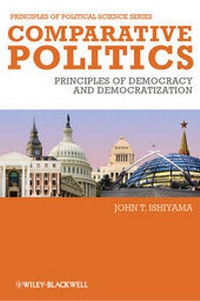
Comparative Politics
Principles of Democracy and Democratization
Published on 8. April 2011
Book
Paperback/Softback
260 pages
978-1-4051-8686-5 (ISBN)
Description
By revealing the contextual conditions which promote or hinder democratic development, Comparative Politics shows how democracy may not be the best institutional arrangement given a country's unique set of historical, economic, social, cultural and international circumstances.
* Addresses the contextual conditions which promote or hinder democratic development
* Reveals that democracy may not be the best institutional arrangement given a country's unique set of historical, economic, social, cultural and international circumstances
* Applies theories and principles relating to the promotion of the development of democracy to the contemporary case studies
More details
Series
Edition
1. Auflage
Language
English
Place of publication
Hoboken
United Kingdom
Publishing group
John Wiley and Sons Ltd
Target group
Professional and scholarly
Product notice
Paperback (trade)
Unsewn / adhesive bound
Dimensions
Height: 229 mm
Width: 152 mm
Thickness: 14 mm
Weight
382 gr
ISBN-13
978-1-4051-8686-5 (9781405186865)
Schweitzer Classification
Other editions
Additional editions
Book
04/2011
1st Edition
Wiley
€119.50
Shipment within 3-4 weeks
E-Book
03/2011
Wiley-Blackwell
€27.99
Available for download
E-Book
03/2011
Wiley-Blackwell
€27.99
Available for download
Person
John T. Ishiyama is Professor of Political Science at the University of North Texas. He is editor in chief of the Journal of Political Science Education. Professor Ishiyama is the author of six books and over 100 articles on political science-related issues. He studies the politics of post-communist eastern and central Europe and Africa (especially Ethiopia).
Content
1: Introduction--- Comparative Politics and Democracy
2: The development of democracy in historical perspective
3: Economic and Political Development
4: Political Culture and Ethnicity
5: Social Structure and Civil Society
6: The Global and International Environment
7: Electoral Systems
8: The Structure of the Executive and the Legislature
9: Comparative Judicial Politics and the territorial arrangement of the political system
10: Conclusion: Principles in Application