

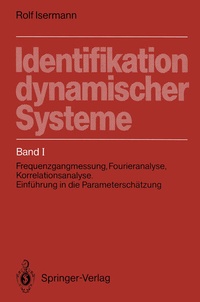
Identifikation dynamischer Systeme
Band I: Frequenzgangmessung, Fourieranalyse, Korrelationsanalyse, Einführung in die Parameterschätzung
Published on 19. January 2012
Book
Paperback/Softback
XVIII, 344 pages
978-3-642-96778-8 (ISBN)
Description
1 Einführung.- 1.1 Theoretische und experimentelle Systemanalyse.- 1.2 Aufgaben und Probleme der Identifikation dynamischer Systeme.- 1.3 Klassifikation von Identifikationsmethoden.- 1.4 Identifikationsmethoden.- 1.5 Testsignale.- 1.6 Besondere Einsatzfälle.- 1.7 Anwendungsmöglichkeiten.- 1.8 Literatur.- 2 Mathematische Modelle linearer dynamischer Prozesse und stochastischer Signale.- 2.1 Mathematische Modelle dynamischer Prozesse für zeitkontinuierliche Signale.- 2.2 Mathematische Modelle dynamischer Prozesse für zeitdiskrete Signale.- A Identifikation mit nichtparametrischen Modellen - zeitkontinuierliche Signale.- 3 Fourier-Analyse mit nichtperiodischen Testsignalen.- 4 Frequenzgangmessung mit periodischen Testsignalen.- 5 Korrelationsanalyse mit zeitkontinuierlichen stochastischen Testsignalen.- B Identifikation mit nichtparametrischen Modellen - zeitdiskrete Signale.- 6 Korrelationsanalyse mit zeitdiskreten Signalen.- C Identifikation mit parametrischen Modellen - zeitdiskrete Signale.- 7 Methode der kleinsten Quadrate für statische Prozesse.- 8 Methode der kleinsten Quadrate für dynamische Prozesse.- 9 Modifikationen der Methode der kleinsten Quadrate.- 10 Methode der Hilfsvariablen (Instrumental variables).- 11 Methode der stochastischen Approximation (STA).- A1 Fourier- und Laplace-Transformation.- A1.1 Fourier-Transformation.- A1.2 Laplace-Transformation.- A2 Modellstrukturen durch theoretische Modellbildung.- A2.1 Theoretische Modellbildung und elementare Modellstruktur.- A2.2 Beispiel für verschiedene Modellstrukturen.- A3 Einige Grundbegriffe der Wahrscheinlichkeitstheorie.- A4 Grundbegriffe der Schätztheorie.- A4.1 Konvergenzbegriffe für stochastische Variable.- A4.2 Eigenschaften von Parameterschätzverfahren.- A5 Zur Ableitung vonVektoren und Matrizen.- A6 Satz zur Matrizeninversion.- A7 Positiv reelle Übertragungsfunktionen.- A7.1 Kontinuierliche Signale.- A7.2 Zeitdiskrete Signale.
More details
Edition
Softcover reprint of the original 1st ed. 1988
Language
German
Place of publication
Berlin
Germany
Publishing group
Springer Berlin
Target group
Professional and scholarly
Research
Illustrations
XVIII, 344 S.
Dimensions
Height: 235 mm
Width: 155 mm
Thickness: 20 mm
Weight
552 gr
ISBN-13
978-3-642-96778-8 (9783642967788)
DOI
10.1007/978-3-642-96777-1
Schweitzer Classification
Other editions
Additional editions
Rolf Isermann
K.T.
Frequenzgangmessung, Fourieranalyse, Korrelationsanalyse, Einführung in die Parameterschätzung
Book
12/1987
Springer
€64.35
Article exhausted; check for reprint
Person
Rolf Isermann Rolf Isermann studied Mechanical Engineering and obtained the Dr.-Ing. degree in 1965 from the University of Stuttgart. In 1968 he became "Privatdozent" for Automatic Control and since 1972 Professor in Control Engineering at the University of Stuttgart. From 1977-2006 he was Professor for Control Systems and Process Automation at the Institute of Automatic Control of the Darmstadt University of Technology. Since 2006 he is Professor emeritus and is head of the Research Group of Control Systems and Process Automation. R. Isermann received the Dr. h.c. (honoris causa) from L'Université Libre de Bruxelles and from the Polytechnic University in Bucharest. In 1996 he was awarded the "VDE-Ehrenring", and in 2007 the "VDI-Ehrenmitglied". The MIT Technology Review Magazine awarded him in 2003 to the Top Ten representatives of emerging Technologies for the field of Mechatronics. R. Isermann has published books on Modeling of Technical Processes, Process Identification, Digital Control Systems, Adaptive Control Systems, Mechatronic Systems, Fault Diagnosis Systems, Engine Control and Vehicle Drive Dynamics Control. Current research concentrates on the fields of identification and digital control of nonlinear systems, intelligent control and model-based methods of process fault diagnosis with applications to servo systems, fault-tolerant systems, combustion engines, automobiles and mechatronic systems. The research group on combustion engines works on multivariable engine modeling, HiL-simulation, combustion pressure control and fault diagnosis of both, CR-Diesel engines and FSI-gasoline engines. In the vehicle dynamics group present topics are parameter estimation for drive dynamics control, fault detection of sensors, suspensions, tires and brake systems and the development of collision avoidance systems with surrounding sensing and active braking and steering. The first books on system identification were published in German and date back to1971, 1974, 1988, and 1992. Since 1975, R. Isermann held several chair positions of IFAC-Technical Committees (International Federation of Automatic Control). In 1996, he was elected as Vice-President of IFAC until 2002. From 2002 to 2008, he was member of the IFAC-Council. R. Isermann organized several national and international conferences like the 5th IFAC Symposium on Identification in Darmstadt in 1979, the 10th IFAC-World-Congress in Munich 1987, the 1st IFAC-Symposium SAFEPROCESS, Baden-Baden, 1991 and the 1st IFAC-Conference on Mechatronic Systems, Darmstadt, 2000. He also organized the biannual VDI/VDE-Conference AUTOREG (control of vehicles and power trains) from 2002 to 2008.
Content
1 Einführung.- 1.1 Theoretische und experimentelle Systemanalyse.- 1.2 Aufgaben und Probleme der Identifikation dynamischer Systeme.- 1.3 Klassifikation von Identifikationsmethoden.- 1.4 Identifikationsmethoden.- 1.5 Testsignale.- 1.6 Besondere Einsatzfälle.- 1.7 Anwendungsmöglichkeiten.- 1.8 Literatur.- 2 Mathematische Modelle linearer dynamischer Prozesse und stochastischer Signale.- 2.1 Mathematische Modelle dynamischer Prozesse für zeitkontinuierliche Signale.- 2.2 Mathematische Modelle dynamischer Prozesse für zeitdiskrete Signale.- A Identifikation mit nichtparametrischen Modellen - zeitkontinuierliche Signale.- 3 Fourier-Analyse mit nichtperiodischen Testsignalen.- 4 Frequenzgangmessung mit periodischen Testsignalen.- 5 Korrelationsanalyse mit zeitkontinuierlichen stochastischen Testsignalen.- B Identifikation mit nichtparametrischen Modellen - zeitdiskrete Signale.- 6 Korrelationsanalyse mit zeitdiskreten Signalen.- C Identifikation mit parametrischen Modellen - zeitdiskrete Signale.- 7 Methode der kleinsten Quadrate für statische Prozesse.- 8 Methode der kleinsten Quadrate für dynamische Prozesse.- 9 Modifikationen der Methode der kleinsten Quadrate.- 10 Methode der Hilfsvariablen (Instrumental variables).- 11 Methode der stochastischen Approximation (STA).- A1 Fourier- und Laplace-Transformation.- A1.1 Fourier-Transformation.- A1.2 Laplace-Transformation.- A2 Modellstrukturen durch theoretische Modellbildung.- A2.1 Theoretische Modellbildung und elementare Modellstruktur.- A2.2 Beispiel für verschiedene Modellstrukturen.- A3 Einige Grundbegriffe der Wahrscheinlichkeitstheorie.- A4 Grundbegriffe der Schätztheorie.- A4.1 Konvergenzbegriffe für stochastische Variable.- A4.2 Eigenschaften von Parameterschätzverfahren.- A5 Zur Ableitung vonVektoren und Matrizen.- A6 Satz zur Matrizeninversion.- A7 Positiv reelle Übertragungsfunktionen.- A7.1 Kontinuierliche Signale.- A7.2 Zeitdiskrete Signale.