

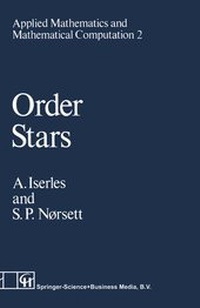
Order Stars
Theory and Applications
Published on 1. June 1991
Book
Paperback/Softback
XI, 248 pages
978-0-412-35260-7 (ISBN)
Description
According to Hilbert's dictum, the scaffolding should be invisible in a math ematical edifice. Less kind interpretation of this common principle of writing and presenting mathematics is that we should always strive to do it baek to-front, forever wise after the event. Nobody should be allowed to see the seams in the supposedly seamless robe or eompare authors' intentions with the outeome of their endeavour. In particular, the short pieee of prose oeea sionally labelIed 'Prefaee' or 'Forward' ought to be written after the main body of the book. And so it is, and we, the authors, can refleet (with much trepidation) on an enterprise that for us is finally over. Order stars have been originally introduced in the context of numerical solution of ordinary differential equations and, as far as many numerical an alysts are concerned, they still belong there. It is our case in this book that the seope of order stars ranges considerably wider and that the cornerstone of the order star theory is a function-theoretic interpretation of complex approximation theory. An application to numerical analysis is a matter of serendipity, not of essen ce.
More details
Series
Edition
Softcover reprint of the original 1st ed. 1991
Language
English
Place of publication
Boston
United States
Publishing group
Taylor & Francis Ltd
Target group
Professional and scholarly
Research
Dimensions
Height: 21.6 cm
Width: 14 cm
Weight
339 gr
ISBN-13
978-0-412-35260-7 (9780412352607)
DOI
10.1007/978-1-4899-3071-2
Schweitzer Classification
Other editions
Additional editions
E-Book
11/2020
1st Edition
Chapman & Hall/CRC
€364.99
Available for download
E-Book
11/2020
1st Edition
Chapman & Hall/CRC
€364.99
Available for download
Persons
A. Iserles (University of Cambridge) (Author) , S.P. Norsett (Author)
Content
1. Introduction 2. General order stars 3. Rational approximants to the exponential 4. A-acceptability barriers 5. Multistep methods 6. The advection equation 7. The diffusion equation 8. Pade approximants 9. Contractive approximation 10. Open problems