

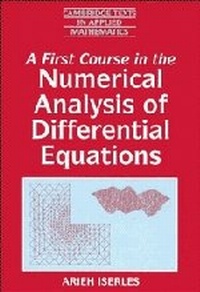
A First Course in the Numerical Analysis of Differential Equations
Published on 18. January 1996
Book
Hardback
396 pages
978-0-521-55376-6 (ISBN)
Description
Numerical analysis presents different faces to the world. For mathematicians it is a bona fide mathematical theory with an applicable flavour. For scientists and engineers it is a practical, applied subject, part of the standard repertoire of modelling techniques. For computer scientists it is a theory on the interplay of computer architecture and algorithms for real-number calculations. The tension between these standpoints is the driving force of this book, which presents a rigorous account of the fundamentals of numerical analysis of both ordinary and partial differential equations. The point of departure is mathematical but the exposition strives to maintain a balance between theoretical, algorithmic and applied aspects of the subject. In detail, topics covered include numerical solution of ordinary differential equations by multistep and Runge-Kutta methods; finite difference and finite elements techniques for the Poisson equation; a variety of algorithms to solve large, sparse algebraic systems; methods for parabolic and hyperbolic differential equations and techniques of their analysis. The book is accompanied by an appendix that presents brief back-up in a number of mathematical topics. Dr Iserles concentrates on fundamentals: deriving methods from first principles, analysing them with a variety of mathematical techniques and occasionally discussing questions of implementation and applications. By doing so, he is able to lead the reader to theoretical understanding of the subject without neglecting its practical aspects. The outcome is a textbook that is mathematically honest and rigorous and provides its target audience with a wide range of skills in both ordinary and partial differential equations.
Reviews / Votes
'This book can be highly recommended as a basis for courses in numerical analysis.' Zentralblatt fur Mathematik 'I believe this book succeeds. It provides an excellent introduction to the numerical analysis of differential equations.' J. Varah, Computing Reviews '... nicely crafted and full of interesting details.' R. Mattheij, ITW Nieuws '... a well written and exciting book ... the exposition throughout the book is clear and very lively. The author's enthusiasm and wit are obvious on almost every page and I recommend the text very strongly indeed.' J. Mackenzie, Proceedings of the Edinburgh Mathematical Society 'This is a well-written, challenging introductory text that addresses the essential issues in the development of effective numerical schemes for the solution of differential equations: stability, convergence, and efficiency. The soft cover edition is a terrific buy - I highly recommend it.' Tom King, Mathematics of ComputationMore details
Series
Language
English
Place of publication
Cambridge
United Kingdom
Target group
College/higher education
Illustrations
Worked examples or Exercises; 100 Line drawings, unspecified
Dimensions
Height: 255 mm
Width: 175 mm
Thickness: 25 mm
Weight
838 gr
ISBN-13
978-0-521-55376-6 (9780521553766)
Copyright in bibliographic data and cover images is held by Nielsen Book Services Limited or by the publishers or by their respective licensors: all rights reserved.
Schweitzer Classification
Other editions
New editions
Book
11/2008
2nd Edition
Cambridge University Press
€80.60
Shipment within 15-20 days
Person
Content
Part I. Ordinary Differential Eqations: 1. Euler's method and beyond; 2. Multistep methods; 3. Runge-Kutta methods; 4. Stiff equations; 5. Error control; 6. Nonlinear algebraic systems; Part II. The Possion Equation: 7. Finite difference schemes; 8. The finite element method; 9. Gaussian elimination for sparse linear equations; 10. Iterative methods for sparse linear equations; 11. Multigrid techniques; 12. Fast Poisson solvers; Part III. Partial Differential Equations of Evolution: 13. The diffusion equation; 14. Hyperbolic equations; Appendix: a bluffer's guide to useful mathematics.