

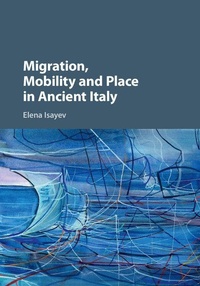
Migration, Mobility and Place in Ancient Italy
Published on 15. March 2019
Book
Hardback
542 pages
978-1-107-13061-6 (ISBN)
Description
Migration, Mobility and Place in Ancient Italy challenges prevailing conceptions of a natural tie to the land and a demographically settled world. It argues that much human mobility in the last millennium BC was ongoing and cyclical. In particular, outside the military context 'the foreigner in our midst' was not regarded as a problem. Boundaries of status rather than of geopolitics were those difficult to cross. The book discusses the stories of individuals and migrant groups, traders, refugees, expulsions, the founding and demolition of sites, and the political processes that could both encourage and discourage the transfer of people from one place to another. In so doing it highlights moments of change in the concepts of mobility and the definitions of those on the move. By providing the long view from history, it exposes how fleeting are the conventions that take shape here and now.
Reviews / Votes
'... highly important and innovative ... Isayev's book is undoubtedly a major contribution to the entire field of Classics. Apart from making its case quite brilliantly, it breaks with a number of self-imposed limitations and restrictions (of disciplines, methods, periods, regions ...) that have shaped and continue to shape much of Classical scholarship. This book is groundbreaking in the way it engages with the past by taking up current research from other fields and by formulating new models that will stimulate further debate - hopefully also beyond the scope of ancient Italy. It is worth adding that the book, although very scholarly, might also prove useful for undergraduate teaching, as it is written in a very understandable language ... In short, it is a must-have for all scholars in this field, and a book which, to my eyes, ranks among the works that have offered a sweeping (and controversial) vision of Mediterranean mobility and connectivity, from Braudel to Horden and Purcell and D. Abulafia.' Bryn Mawr Classical ReviewMore details
Language
English
Place of publication
Cambridge
United Kingdom
Target group
Professional and scholarly
Dimensions
Height: 260 mm
Width: 208 mm
Thickness: 34 mm
Weight
1392 gr
ISBN-13
978-1-107-13061-6 (9781107130616)
Copyright in bibliographic data and cover images is held by Nielsen Book Services Limited or by the publishers or by their respective licensors: all rights reserved.
Schweitzer Classification
Other editions
Additional editions
Elena Isayev
Migration, Mobility and Place in Ancient Italy
Book
07/2021
Cambridge University Press
€111.30
Shipment within 15-20 days
Elena Isayev
Migration, Mobility and Place in Ancient Italy
E-Book
08/2017
Cambridge University Press
€31.99
Available for download
Elena Isayev
Migration, Mobility and Place in Ancient Italy
E-Book
08/2017
Cambridge University Press
€130.99
Available for download
Person
Elena Isayev is Associate Professor of Ancient History at the University of Exeter. She is the author of Inside Ancient Lucania: Dialogues in History and Archaeology (2007) and co-editor of Ancient Italy: Regions without Boundaries (with G. Bradley and C. Riva, 2007). In support of her research into ancient mobility she has held the Davis Fellowship at Princeton University, New Jersey and for her current work on hospitality and asylum she has been awarded a Historical Research Centre Fellowship at the Australian National University, Canberra. She also works in current refugee contexts, including with Campus in Camps in Palestine, and has created the initiative Future Memory which works with communities where there are tensions.
Content
Part I: 1. Introduction; 2. Statistical uncertainties: mobility in the last 250 years BC; Part II: 3. Routeways, kinship and storytelling; 4. Mixed communities: mobility, connectivity and co-presence; 5. Why choose to come together and move apart? Convergence and redistribution of people and power; Part III: 6. Plautus on mobility of the every-day; 7. Polybius on mobility and a comedy of The Hostage Prince; 8. Polybius on the moving masses and those who moved them; Part IV: 9. Social war: reconciling differences of place and citizenship; 10. Mapping the moving Rome of Livy's Camillus speech; 11. Materialising Rome and Patria; 12. Conclusion: everyday and unpredictable mobility; Appendices A, B and C. Mobility in Plautus; Appendix D. Livy's Camillus Speech and translation.