

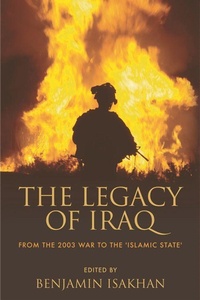
The Legacy of Iraq
From the 2003 War to the 'Islamic State'
Published on 15. September 2016
Book
Paperback/Softback
288 pages
978-1-4744-1791-4 (ISBN)
Description
'The Legacy of Iraq' critically reflects on the abject failure of the 2003 intervention to turn Iraq into a liberal democracy, underpinned by free-market capitalism, its citizens free to live in peace and prosperity. It argues that mistakes made by the coalition and the Iraqi political elite set a sequence of events in motion that have had devastating consequences for Iraq, the Middle East and for the rest of the world. Today, as the nation faces perhaps its greatest challenge in the wake of the devastating advance of the Islamic State of Iraq and Syria (ISIS) and another US-led coalition undertakes renewed military action in Iraq, understanding the complex and difficult legacies of the 2003 war could not be more urgent. Ignoring the legacies of the Iraq war and denying their connection to contemporary events could mean that vital lessons are ignored and the same mistakes made again.
More details
Language
English
Place of publication
Edinburgh
United Kingdom
Target group
College/higher education
Product notice
Paperback (trade)
Unsewn / adhesive bound
Dimensions
Height: 231 mm
Width: 154 mm
Thickness: 20 mm
Weight
443 gr
ISBN-13
978-1-4744-1791-4 (9781474417914)
Copyright in bibliographic data and cover images is held by Nielsen Book Services Limited or by the publishers or by their respective licensors: all rights reserved.
Schweitzer Classification
Person
Benjamin Isakhan is Associate Professor of Politics and Policy Studies and Director of the Middle East Studies Forum in the Alfred Deakin Institute at Deakin University, Australia. He is also Adjunct Senior Research Associate, Department of Politics and International Relations at the University of Johannesburg, South Africa and an Associate of the Sydney Democracy Network at the University of Sydney, Australia. He is the author of Democracy in Iraq: History, Politics and Discourse (Ashgate, 2012) and the editor of 6 books including The Edinburgh Companion to the History of Democracy (Edinburgh University Press, 2015 [2012]). Ben's current research includes a 3-year funded project entitled 'Measuring Heritage Destruction in Iraq and Syria'.
Content
Part I: The Aftermath of War: Strategic Decisions and Catastrophic Mistakes
1.The De-Baathification of post-2003 Iraq: Purging the Past for Political PowerBenjamin Isakhan
2. The Contested Politics of Iraq's Oil WealthPhilippe Le Billon
3. Torture at Abu Ghraib: Non-disclosure and ImpunityAloysia Brooks
Part II: Iraqi Politics since Saddam
4.Shattering the Shia: A Maliki Political Strategy in Post-Saddam IraqBenjamin Isakhan
5. The Dangerous Legacy of a Flawed Constitution: Resolving Iraq's Kurdish 'Problem'Liam Anderson
6. Between 'Aqalliya' and 'Mukawin': Understanding Sunni Political Attitudes in Post-Saddam IraqRonen Zeidel
7. Post-Withdrawal Prospects for Iraq's 'Ultra-Minorities'Nicholas Al-Jeloo
Part III: The Plight of Iraqi Culture and Civil Society
8. Doing Democracy in Difficult Times: Oil Unions and the Maliki GovernmentBenjamin Isakhan
9. 'If you are female, you risk being attacked': Digital Selves, Warblogs and Women's Rights in post-Invasion IraqPerri Campbell and Luke Howie
10. The Impact of Coalition Military Operations on Archaeological Sites in IraqDiane C. Siebrandt
Part IV: Regional and International Consequences of the Iraq War
11. Ethnic Cleansing in Iraq: Internal and External DisplacementHoward Adelman
12. The Shia Ascendency in Iraq and the Sectarian Polarisation of the Middle EastRanj Alaaldin
13. Humanitarian Intervention after Iraq: The Politics of Protection and RescueBinoy Kampmark
14. Iraq, the Illusion of Security and the Limits to PowerJoseph A. Camilleri
Conclusion: The Iraq Legacies and the Roots of the 'Islamic State'Benjamin Isakhan
Index
1.The De-Baathification of post-2003 Iraq: Purging the Past for Political PowerBenjamin Isakhan
2. The Contested Politics of Iraq's Oil WealthPhilippe Le Billon
3. Torture at Abu Ghraib: Non-disclosure and ImpunityAloysia Brooks
Part II: Iraqi Politics since Saddam
4.Shattering the Shia: A Maliki Political Strategy in Post-Saddam IraqBenjamin Isakhan
5. The Dangerous Legacy of a Flawed Constitution: Resolving Iraq's Kurdish 'Problem'Liam Anderson
6. Between 'Aqalliya' and 'Mukawin': Understanding Sunni Political Attitudes in Post-Saddam IraqRonen Zeidel
7. Post-Withdrawal Prospects for Iraq's 'Ultra-Minorities'Nicholas Al-Jeloo
Part III: The Plight of Iraqi Culture and Civil Society
8. Doing Democracy in Difficult Times: Oil Unions and the Maliki GovernmentBenjamin Isakhan
9. 'If you are female, you risk being attacked': Digital Selves, Warblogs and Women's Rights in post-Invasion IraqPerri Campbell and Luke Howie
10. The Impact of Coalition Military Operations on Archaeological Sites in IraqDiane C. Siebrandt
Part IV: Regional and International Consequences of the Iraq War
11. Ethnic Cleansing in Iraq: Internal and External DisplacementHoward Adelman
12. The Shia Ascendency in Iraq and the Sectarian Polarisation of the Middle EastRanj Alaaldin
13. Humanitarian Intervention after Iraq: The Politics of Protection and RescueBinoy Kampmark
14. Iraq, the Illusion of Security and the Limits to PowerJoseph A. Camilleri
Conclusion: The Iraq Legacies and the Roots of the 'Islamic State'Benjamin Isakhan
Index