

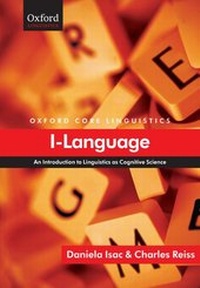
I-language
An Introduction to Linguistics as Cognitive Science
Published on 17. April 2008
Book
Hardback
336 pages
978-0-19-953419-7 (ISBN)
Description
I-Language introduces the uninitiated to linguistics as cognitive science. In an engaging, down-to-earth style Daniela Isac and Charles Reiss give a crystal-clear demonstration of the application of the scientific method in linguistic theory. Their presentation of the research programme inspired and led by Noam Chomsky shows how the focus of theory and research in linguistics shifted from treating language as a disembodied, human-external entity to cognitive biolinguistics - the study of language as a human cognitive system embedded within the mind/brain of each individual. The recurring theme of equivalence classes in linguistic computation ties together the presentation of material from phonology, morphology, syntax, and semantics. The same theme is used to help students understand the place of linguistics in the broader context of the cognitive sciences, by drawing on examples from vision, audition, and even animal cognition. This textbook is unique in its integration of empirical issues of linguistic analysis, engagement with philosophical questions that arise in the study of language, and treatment of the history of the field.
Topics ranging from allophony to reduplication, ergativity, and negative polarity are invoked to show the implications of findings in cognitive biolinguistics for philosophical issues like reference, the mind-body problem, and nature-nurture debates. This textbook contains numerous exercises and guides for further reading as well as ideas for student projects. A companion website with guidance for instructors and answers to the exercises features a series of pdf slide presentations to accompany the teaching of each topic.
Topics ranging from allophony to reduplication, ergativity, and negative polarity are invoked to show the implications of findings in cognitive biolinguistics for philosophical issues like reference, the mind-body problem, and nature-nurture debates. This textbook contains numerous exercises and guides for further reading as well as ideas for student projects. A companion website with guidance for instructors and answers to the exercises features a series of pdf slide presentations to accompany the teaching of each topic.
Reviews / Votes
This book is an engaging and pioneering introduction to Biolinguistic theory construction and scientific method. It's one of very few texts I've ever read that clarifies, with formal yet accessible linguistic analyses and argument, the Chomskyan shift in focus away from treating human language as some kind of non-psychological human-external entity to the study of human language as "I-language" - a cognitive system embedded within the mind/brain of each individual. Professor Samuel Epstein, University of Michigan Strikingly original and fully student-oriented, this book covers all the bases of modern linguistic theory from a single perspective: the workings of the human mind. Breaking with the traditional organization of a linguistics textbook, Isac and Reiss juxtapose an engaging presentation of linguistic analysis with exciting discussion of relevant aspects from cognitive science and philosophy. This is arguably the most stimulating introductory textbook around today, offering an approach that I now know was sorely missed. Dr Jan-Wouter Zwart, University of GroningenMore details
Language
English
Place of publication
Oxford
United Kingdom
Target group
College/higher education
The well-tested material in the book is appropriate for a variety of audiences, from large introductory courses in linguistics to graduate seminars in cognitive science or philosophy of mind
Illustrations
Figures and line drawings
Dimensions
Height: 253 mm
Width: 179 mm
Thickness: 21 mm
Weight
836 gr
ISBN-13
978-0-19-953419-7 (9780199534197)
Copyright in bibliographic data and cover images is held by Nielsen Book Services Limited or by the publishers or by their respective licensors: all rights reserved.
Schweitzer Classification
Other editions
Additional editions
Book
12/2008
Oxford University Press
€27.24
Article exhausted; check different version
Persons
Charles Reiss is Associate Professor of Linguistics at Concordia University, Montreal, co-editor with Gillian Ramchand of The Oxford Handbook of Linguistic Interfaces (OUP 2007), and co-author with Mark Hale of The Phonological Enterprise (OUP 2008).
Content
PART I THE OBJECT OF INQUIRY ; 1. The Object of Inquiry ; 2. I-Everything: Triangles, Streams, Words ; 3. Approaches to the Study of Language ; 4. I-/E-/P-Language ; PART II LINGUISTIC REPRESENTATION AND COMPUTATION ; 5. A Syntactic Theory That Won't Work ; 6. Abstract Representations ; 7. Some Details of Sentence Structure ; 8. Binding ; 9. Ergativity ; PART III UNIVERSAL GRAMMAR ; 10. Approaches to UG: Empirical Evidence ; 11. Approaches to UG: Logic ; PART IV IMPLICATIONS AND CONCLUSIONS ; 12. Social Implications ; 13. Some Philosophy ; 14. Open Questions and Closing Remarks ; References ; Index