

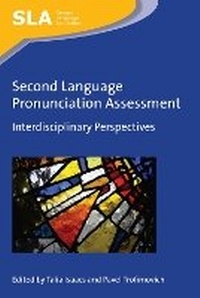
Second Language Pronunciation Assessment
Interdisciplinary Perspectives
Will be published approx. on 22. December 2016
Book
Hardback
288 pages
978-1-78309-684-8 (ISBN)
Description
This book is open access under a CC BY licence. It spans the areas of assessment, second language acquisition (SLA) and pronunciation and examines topical issues and challenges that relate to formal and informal assessments of second language (L2) speech in classroom, research and real-world contexts. It showcases insights from assessing other skills (e.g. listening and writing) and highlights perspectives from research in speech sciences, SLA, psycholinguistics and sociolinguistics, including lingua franca communication, with concrete implications for pronunciation assessment. This collection will help to establish commonalities across research areas and facilitate greater consensus about key issues, terminology and best practice in L2 pronunciation research and assessment. Due to its interdisciplinary nature, this book will appeal to a mixed audience of researchers, graduate students, teacher-educators and exam board staff with varying levels of expertise in pronunciation and assessment and wide-ranging interests in applied linguistics.
Reviews / Votes
The recent resurgence of interest in L2 pronunciation has been woefully incomplete without a wide-ranging consideration of pronunciation's role in spoken language assessment. This volume, with its many authoritative voices and varied empirical approaches to the intersection of pronunciation and language testing, will immensely strengthen both future approaches to L2 pronunciation and assessments of spoken language ability. * John M. Levis, Iowa State University, USA * This outstanding collection of 14 chapters on second language pronunciation assessment brings together diverse perspectives from speech sciences, second language acquisition, psycholinguistics, sociolinguistics, and lingua franca communication. The chapters use quantitative, qualitative, and mixed methods to examine both linguistic and nonlinguistic phenomena relevant to pronunciation assessment. Congratulations to the editors for drawing our attention to this emerging field of research. * Antony John Kunnan, University of Macao, China * This book has much to offer both postgraduate students and experienced researchers in applied linguistics, language assessment, and other related fields. Concluding remarks provided by Trofimovich and Isaacs highlight current issues and end, like most great papers do, with a long-list of questions rather than solutions. -- Nathan Thomas, University of Oxford, UK * BAAL News, Issue 115, Summer 2019 * The area of study and the interdisciplinary approach represented by the volume are definitely worthy of interest and further exploration; the book addresses issues of major importance for L2 pronunciation and L2 pronunciation assessment research. -- Ewa Waniek-Klimczak, University of Lodz, Poland * SSLLT 8 (3). 2018 * We have only scratched the surface in our understanding of how best to assess pronunciation. This book explicitly raises many interesting questions for researchers to follow up, and many of the chapters set my mind racing with new directions and questions for my own research and the higher degree research students I mentor in this field. In this way, the book was a treasure trove of insights that unite various specialised disciplines to provide an illuminating representation of the field. -- Michael Carey, University of the Sunshine Coast, Australia * Journal of Second Language Pronunciation 4:1 (2018) * This volume is an invaluable resource to those in the L2 pronunciation assessment field and those who are new to the topic. In these chapters, decades of research about the topic from varying perspectives are analyzed and organized to outline future research agendas. Many researchers will rely on this as the future of this field continues to blossom in the 21st century. -- Joan Palmiter Bajorek, University of Arizona, USA * LINGUIST List 28.4357 * This edited volume effectively connects multiple expertise and perspectives in research of L2 pronunciation assessment. In so doing, it offers a more comprehensive picture of what L2 pronunciation and pronunciation assessment embody. The interdisciplinary perspectives brought by different chapters make this volume a valuable resource for a wide range of audiences: pronunciation researchers, language testers, and language teachers. -- Xun Yan and Hyunji (Hayley) Park, University of Illinois at Urbana-Champaign, USA * Language Testing, 2017 *More details
Series
Language
English
Place of publication
Bristol
United Kingdom
Publishing group
Channel View Publications Ltd
Target group
Professional and scholarly
Product notice
sewn/stitched
Cloth over boards
Dimensions
Height: 244 mm
Width: 164 mm
Thickness: 25 mm
Weight
695 gr
ISBN-13
978-1-78309-684-8 (9781783096848)
Copyright in bibliographic data and cover images is held by Nielsen Book Services Limited or by the publishers or by their respective licensors: all rights reserved.
Schweitzer Classification
Other editions
Additional editions
Talia Isaacs | Pavel Trofimovich
Second Language Pronunciation Assessment
Interdisciplinary Perspectives
Book
12/2016
Multilingual Matters
€56.30
Shipment within 10-20 days
Complete work / Part of the work
David Singleton | Simone E. Pfenninger
Second Language Acquisition (Vols 101-110)
Book
Multilingual Matters
€1,034.20
The article will not be published
Persons
Talia Isaacs is Senior Lecturer in Applied Linguistics and TESOL at the UCL Centre for Applied Linguistics, UCL Institute of Education, University College London, UK. Her research interests include second language speaking and listening, pronunciation assessment and instruction, raters, rating scales, machine scoring, and language for specific and academic purposes.
Pavel Trofimovich is Professor in the Department of Education at Concordia University, Canada. His research interests include cognitive aspects of second language processing, second language pronunciation, sociolinguistic aspects of second language acquisition and the teaching of second language pronunciation.
Pavel Trofimovich is Professor in the Department of Education at Concordia University, Canada. His research interests include cognitive aspects of second language processing, second language pronunciation, sociolinguistic aspects of second language acquisition and the teaching of second language pronunciation.
Content
Section 1: Introduction
1. Talia Isaacs and Pavel Trofimovich: Key Themes, Constructs, and Interdisciplinary Perspectives in Second Language Pronunciation Assessment
2. Luke Harding: What Do Raters Need In A Pronunciation Scale? The Users' View
Section 2: Insights from Assessing Other Language Skills
3. Kevin Browne and Glenn Fulcher: Pronunciation and Intelligibility in Assessing Spoken Fluency
4. Ute Knoch: What Can Pronunciation Researchers Learn From Research Into Second Language Writing?
5. Elvis Wagner and Paul Toth: The Role of Pronunciation in the Assessment of L2 Listening Ability
Section 3: Perspectives on Pronunciation Assessment from Psycholinguistics and Speech Sciences
6. Joan C. Mora and Isabelle Darcy: The Relationship between Cognitive Control and Pronunciation in a Second Language
7. Laura Ballard and Paula Winke: The Interplay of Accent Familiarity, Comprehensibility, Intelligibility, Perceived Native-Speaker Status, and Acceptability as a Teacher
8. Kazuya Saito, Pavel Trofimovich, Talia Isaacs and Stuart Webb: Re-Examining Phonological and Lexical Correlates Of Second Language Comprehensibility: The Role of Rater Experience
9. Evelina Galaczi, Brechtje Post, Aike Li, Fiona Barker and Elaine Schmidt: Assessing L2 Pronunciation: Distinguishing Features Of Rhythm in Learner Speech at Different Proficiency Levels
Section 4: Sociolinguistic, Cross-Cultural and Lingua Franca Perspectives in Pronunciation Assessment
10. Alan Davies: Commentary on the Native Speaker Status in Pronunciation Research
11. Stephanie Lindemann: Variation or 'Error'? Perception of Pronunciation Variation and Its Implications for Assessment
12. Sara Kennedy, Josee Blanchet and Danielle Guenette: Teacher-Raters' Assessments of French Lingua Franca Pronunciation
13. Andrew Sewell: Pronunciation Assessment in Asia's World City: Implications of a Lingua Franca Approach in Hong Kong
Section 5: Concluding Remarks
14. Pavel Trofimovich and Talia Isaacs: L2 Pronunciation Assessment: A Look at the Present and the Future
1. Talia Isaacs and Pavel Trofimovich: Key Themes, Constructs, and Interdisciplinary Perspectives in Second Language Pronunciation Assessment
2. Luke Harding: What Do Raters Need In A Pronunciation Scale? The Users' View
Section 2: Insights from Assessing Other Language Skills
3. Kevin Browne and Glenn Fulcher: Pronunciation and Intelligibility in Assessing Spoken Fluency
4. Ute Knoch: What Can Pronunciation Researchers Learn From Research Into Second Language Writing?
5. Elvis Wagner and Paul Toth: The Role of Pronunciation in the Assessment of L2 Listening Ability
Section 3: Perspectives on Pronunciation Assessment from Psycholinguistics and Speech Sciences
6. Joan C. Mora and Isabelle Darcy: The Relationship between Cognitive Control and Pronunciation in a Second Language
7. Laura Ballard and Paula Winke: The Interplay of Accent Familiarity, Comprehensibility, Intelligibility, Perceived Native-Speaker Status, and Acceptability as a Teacher
8. Kazuya Saito, Pavel Trofimovich, Talia Isaacs and Stuart Webb: Re-Examining Phonological and Lexical Correlates Of Second Language Comprehensibility: The Role of Rater Experience
9. Evelina Galaczi, Brechtje Post, Aike Li, Fiona Barker and Elaine Schmidt: Assessing L2 Pronunciation: Distinguishing Features Of Rhythm in Learner Speech at Different Proficiency Levels
Section 4: Sociolinguistic, Cross-Cultural and Lingua Franca Perspectives in Pronunciation Assessment
10. Alan Davies: Commentary on the Native Speaker Status in Pronunciation Research
11. Stephanie Lindemann: Variation or 'Error'? Perception of Pronunciation Variation and Its Implications for Assessment
12. Sara Kennedy, Josee Blanchet and Danielle Guenette: Teacher-Raters' Assessments of French Lingua Franca Pronunciation
13. Andrew Sewell: Pronunciation Assessment in Asia's World City: Implications of a Lingua Franca Approach in Hong Kong
Section 5: Concluding Remarks
14. Pavel Trofimovich and Talia Isaacs: L2 Pronunciation Assessment: A Look at the Present and the Future