

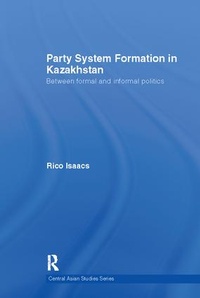
Party System Formation in Kazakhstan
Between Formal and Informal Politics
1st Edition
Published on 24. May 2017
Book
Paperback/Softback
224 pages
978-1-138-10234-7 (ISBN)
Description
Since the collapse of the Soviet Union, Central Asian states have developed liberal-constitutional formal institutions. However, at the same time, political phenomena in Central Asia are shaped by informal political behaviour and relations. This relationship is now a critical issue affecting democratization and regime consolidation processes in former Soviet Central Asia, and this book provides an account of the interactive and dynamic relationship between informal and formal politics through the case of party-system formation in Kazakhstan.
Based on extensive interviews with political actors and a wide range of historical and contemporary documentary sources, the book utilises and develops neopatrimonialism as an analytical concept for studying post-Soviet authoritarian consolidation and failed democratisation. It illustrates how personalism of political office, patronage and patron-client networks and factional elite conflict have influenced and shaped the institutional constraints affecting party development, the type of emerging parties and parties' relationship with society. The case of Kazakhstan, however, also demonstrates how in the former Soviet space political parties emerge as central to the legitimization of informal political behavior, the structuring of factional competition and the consolidation of authoritarianism. The book represents an important contribution to the study of Central Asian Politics.
Based on extensive interviews with political actors and a wide range of historical and contemporary documentary sources, the book utilises and develops neopatrimonialism as an analytical concept for studying post-Soviet authoritarian consolidation and failed democratisation. It illustrates how personalism of political office, patronage and patron-client networks and factional elite conflict have influenced and shaped the institutional constraints affecting party development, the type of emerging parties and parties' relationship with society. The case of Kazakhstan, however, also demonstrates how in the former Soviet space political parties emerge as central to the legitimization of informal political behavior, the structuring of factional competition and the consolidation of authoritarianism. The book represents an important contribution to the study of Central Asian Politics.
Reviews / Votes
In his text, Rico Isaacs explains how Kazakh society has avoided fragmentation along party lines by showing that Kazakh political parties do not operate on ethnic, religious, or racial grounds, while, in contrast, the experience in Kyrgyzstan exposes how the "ethnic card" can easily be played in Central Asia. Isaacs offers an innovative analysis of post-Soviet Central Asian politics. The book is based on a PhD thesis rich in theoretical interpretation, in-depth fieldwork, and historical analysis as the author takes into account the spectrum of external global and regional influences on party politics in Kazakhstan.Farkhad Alimukhamedov PhD
Turgut OEzal University, Ankara
More details
Series
Language
English
Place of publication
London
United Kingdom
Publishing group
Taylor & Francis Ltd
Target group
College/higher education
Illustrations
6 s/w Zeichnungen, 12 s/w Tabellen, 6 s/w Abbildungen
12 Tables, black and white; 6 Line drawings, black and white; 6 Illustrations, black and white
Dimensions
Height: 234 mm
Width: 156 mm
Weight
453 gr
ISBN-13
978-1-138-10234-7 (9781138102347)
Copyright in bibliographic data and cover images is held by Nielsen Book Services Limited or by the publishers or by their respective licensors: all rights reserved.
Schweitzer Classification
Other editions
Additional editions
Book
03/2011
1st Edition
Routledge
€245.90
Shipment within 15-20 days
E-Book
03/2011
1st Edition
Routledge
€64.49
Available for download
E-Book
03/2011
1st Edition
Routledge
€64.49
Available for download
Person
Rico Isaacs is a Lecturer in International Studies at Oxford Brookes University, UK. His research interests include the relationship between formal and informal politics, institutional development and authoritarianism and democracy in the former Soviet Union.
Content
1. Introduction: In-between the Informal and Formal - Introducing Party Development in Kazakhstan and Central Asia 2. Neopatrimonialism and Party Development: A Framework for Analysis 3. Uncertain Transition: The Development of Neopatrimonialism in Kazakhstan 4. The Institutional Constraints on Political Parties: Presidency, Elections and the Law on Political Parties 5. What Type of Parties? Membership, Organisation, Ideology and Behavioural Norms 6. Passiveness and Disconnection: Parties and Society in Kazakhstan 7. Conclusion: Patrimonial Politics and Party Development Beyond Kazakhstan