

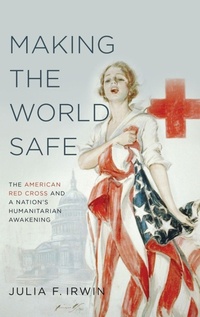
Making the World Safe
The American Red Cross and a Nation's Humanitarian Awakening
Published on 23. May 2013
Book
Hardback
288 pages
978-0-19-976640-6 (ISBN)
Description
At the turn of the twentieth century, the United States was growing by fits and starts into its new role as a global power. Unlike European empires, it sought to distinguish itself as a new kind of power. Corporations and media outlets were spreading American brands, ideas, and commodities worldwide, increasing we would today call soft power. Meanwhile, American citizens and government officials grappled with their nation's rising prominence and debated how best to engage with the wider world. One of those ways was to use foreign aid to define the nation's new role and responsibilities with regards to the international community.
This first book narrates the early history of American foreign relief and assistance as a way of guiding the international community in peaceful cooperation and modernization towards greater stability and democracy. It tells the story of how the United States government came to realize the value of overseas aid as a tool of statecraft. A prime case in point is the American Red Cross, a quasi-private, quasi-state organization. Established in 1882, the ARC was a privately funded and staffed organization, primarily dependent on volunteer labor. However, it shared a special relationship with the U.S. government, formalized by Congressional charters, which made it the "official voluntary" aid association of the United States in times of war and natural disaster. Together, international-minded American progressives--a generation of American health professionals, social scientists, and public intellectuals--made the ARC into a vehicle for the global dissemination of their ideas about health, social welfare, and education. They urged their fellow citizens to reject their traditional attachments to isolationism and non-entanglement and to commit to "humanitarian internationalism." Their international activities included feeding, housing, and anti-epidemic projects in wartime France, Italy, Russia, and Serbia; the development of playgrounds, education initiatives, and child health clinics in postwar Poland and Czechoslovakia; correspondence programs to unite American children and their international peers; and the extension of all of these efforts to U.S. territories, sites where the conceptual lines between foreign and domestic blurred in the U.S. imagination.
This history calls attention to the ways that private organizations have served the diplomatic needs of the U.S. state, as well as been an institutional space for Americans who wanted to participate in international affairs in ways that deviated from official state agendas. By the mid-1920s, voluntary humanitarian interventionism had become the basis for a new set of American civic and political obligations to the world community.
This first book narrates the early history of American foreign relief and assistance as a way of guiding the international community in peaceful cooperation and modernization towards greater stability and democracy. It tells the story of how the United States government came to realize the value of overseas aid as a tool of statecraft. A prime case in point is the American Red Cross, a quasi-private, quasi-state organization. Established in 1882, the ARC was a privately funded and staffed organization, primarily dependent on volunteer labor. However, it shared a special relationship with the U.S. government, formalized by Congressional charters, which made it the "official voluntary" aid association of the United States in times of war and natural disaster. Together, international-minded American progressives--a generation of American health professionals, social scientists, and public intellectuals--made the ARC into a vehicle for the global dissemination of their ideas about health, social welfare, and education. They urged their fellow citizens to reject their traditional attachments to isolationism and non-entanglement and to commit to "humanitarian internationalism." Their international activities included feeding, housing, and anti-epidemic projects in wartime France, Italy, Russia, and Serbia; the development of playgrounds, education initiatives, and child health clinics in postwar Poland and Czechoslovakia; correspondence programs to unite American children and their international peers; and the extension of all of these efforts to U.S. territories, sites where the conceptual lines between foreign and domestic blurred in the U.S. imagination.
This history calls attention to the ways that private organizations have served the diplomatic needs of the U.S. state, as well as been an institutional space for Americans who wanted to participate in international affairs in ways that deviated from official state agendas. By the mid-1920s, voluntary humanitarian interventionism had become the basis for a new set of American civic and political obligations to the world community.
Reviews / Votes
[a] sharp, enlightening monograph ... Rather than a simple institutional history of a crucial actor Irwin has provided us a textured view of a critical agent in the evolution of humanitarianism in the United States that illuminates a diverse set of historical themes. * David Ekbladh, Diplomatic History *More details
Language
English
Place of publication
New York
United States
Target group
College/higher education
Illustrations
15 hts
Dimensions
Height: 240 mm
Width: 161 mm
Thickness: 20 mm
Weight
599 gr
ISBN-13
978-0-19-976640-6 (9780199766406)
Copyright in bibliographic data and cover images is held by Nielsen Book Services Limited or by the publishers or by their respective licensors: all rights reserved.
Schweitzer Classification
Other editions
Additional editions
Book
04/2017
Oxford University Press Inc
€51.10
Shipment within 15-20 days
E-Book
03/2013
1st Edition
OUP eBook
€27.49
Available for download
E-Book
03/2013
1st Edition
OUP eBook
€27.49
Available for download
Person
Julia F. Irwin is Assistant Professor of History, University of South Florida
Content
Introduction: A New Manifest Destiny ; 1. Making International Humanitarianism American ; 2. Humanitarian Preparedness ; 3. Mobilizing a Volunteer Army ; 4. Relieving Europe ; 5. Rebuilding Europe ; 6. A World Made Safe? ; Epilogue A New Manifest Destiny Revisited ; Notes ; Bibliography ; Index