

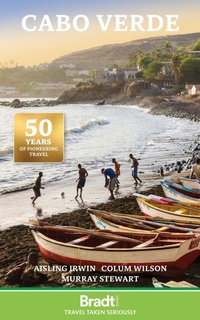
Cabo Verde (Cape Verde)
8th Edition
Published on 18. July 2025
Book
Paperback/Softback
400 pages
978-1-80469-281-3 (ISBN)
Description
The new, thoroughly updated eighth edition of Bradt's Cabo Verde (Cape Verde) remains the most detailed and extensive English-language guidebook available to this alluring Atlantic archipelago, described by some as 'Africa light'. Stable and peaceful, quietly isolated by its mid-Atlantic location, malaria-free and with year-round sun, Cabo Verde's appeal to independent travellers is a natural one - with its unique island geography making it something of an adventure to navigate beyond the more conventional single-island visit of the increasing numbers of package tourists.
The archipelago is diverse, particularly in terms of its tourist infrastructure. Sal and Boavista, the oldest of these volcanic islands, boast white-sand beaches that rival those anywhere in the world, and are complemented by dream windsurfing and kitesurfing opportunities, courtesy of strong breezes and powerful Atlantic waves. Consequently, these two islands attract 95% of Cape Verde's visitors, leaving the other seven inhabited islands undeveloped - and awaiting discovery.
Hikers, music fans and those curious to experience something more authentically Cabo Verdean are drawn to these seven islands. Lace up your walking boots to trek amid the jaw-dropping mountainous landscapes of Fogo or Santo Antao. Or chill, taking time out in tiny Brava or mellow Maio. Or let your internal culture-vulture revel in the fusion of African, Portuguese and Brazilian influences that courses through the cities of Praia and Mindelo, with their constant backdrop of seductive music (or February's raucous carnival) - the aural thread that ties together these islands scattered across the mid-Atlantic.
Although Sal and Boavista's all-inclusives dominate the tourist market, they are increasingly joined by small, independently owned eco-lodges across all islands, complemented by an upswing in the quality and accessibility of traditional pensao and homestays. Throw in coffee and wine, and an authentic culture of organic food, and you have a recipe for well-catered relaxation. So, whether you are a winter sunseeker craving beach-based downtime or an ecotourist looking for nesting loggerhead turtles and birds found nowhere else, an Africa afficionado or a digital nomad enticed by new long-stay visas, Bradt's Cabo Verde provides the perfect guide to getting the most out of these unexpectedly rewarding islands.
The archipelago is diverse, particularly in terms of its tourist infrastructure. Sal and Boavista, the oldest of these volcanic islands, boast white-sand beaches that rival those anywhere in the world, and are complemented by dream windsurfing and kitesurfing opportunities, courtesy of strong breezes and powerful Atlantic waves. Consequently, these two islands attract 95% of Cape Verde's visitors, leaving the other seven inhabited islands undeveloped - and awaiting discovery.
Hikers, music fans and those curious to experience something more authentically Cabo Verdean are drawn to these seven islands. Lace up your walking boots to trek amid the jaw-dropping mountainous landscapes of Fogo or Santo Antao. Or chill, taking time out in tiny Brava or mellow Maio. Or let your internal culture-vulture revel in the fusion of African, Portuguese and Brazilian influences that courses through the cities of Praia and Mindelo, with their constant backdrop of seductive music (or February's raucous carnival) - the aural thread that ties together these islands scattered across the mid-Atlantic.
Although Sal and Boavista's all-inclusives dominate the tourist market, they are increasingly joined by small, independently owned eco-lodges across all islands, complemented by an upswing in the quality and accessibility of traditional pensao and homestays. Throw in coffee and wine, and an authentic culture of organic food, and you have a recipe for well-catered relaxation. So, whether you are a winter sunseeker craving beach-based downtime or an ecotourist looking for nesting loggerhead turtles and birds found nowhere else, an Africa afficionado or a digital nomad enticed by new long-stay visas, Bradt's Cabo Verde provides the perfect guide to getting the most out of these unexpectedly rewarding islands.
More details
Edition
8th Revised edition
Language
English
Place of publication
Buckinghamshire
United Kingdom
Dimensions
Height: 215 mm
Width: 134 mm
Thickness: 19 mm
Weight
408 gr
ISBN-13
978-1-80469-281-3 (9781804692813)
Copyright in bibliographic data and cover images is held by Nielsen Book Services Limited or by the publishers or by their respective licensors: all rights reserved.
Schweitzer Classification
Other editions
Previous edition
Murray Stewart
Cape Verde
Book
06/2017
7th Edition
Bradt Travel Guides
€25.90
Article exhausted; check for reprint
Persons
Aisling Irwin (aislingirwin.com) is a journalist and writer who specialises in the environment, the developing world and science. A former correspondent for The Daily Telegraph, she has won several prizes for her writing. Co-authored with Colum Wilson, her Bradt guidebook to Cape Verde - the first ever English-language travel guide to the islands - was initially published in 1998. When Irwin first visited Cape Verde, it was an obscure destination with just a few tens of thousands of tourists each year. Although the tourist volume is now approaching seven figures, she believes that Cape Verde is, at heart, a place not to be consumed, but to be treasured and understood. Irwin and Wilson have co-authored one other book (In Quest of Livingstone: a Journey to the Four Fountains, about their retracing of David Livingstone's last journey), and she has contributed to books on various subjects, including Bradt's guide to solar eclipses.
Colum Wilson is a relief worker. He worked for Medecins Sans Frontieres and now works for the UK government's Department for International Development, specialising in providing humanitarian aid to west Africa. Together with journalist Aisling Irwin, he has lived in and written about a range of countries including Zambia and Angola. They have co-authored two books: Bradt's Cape Verde and In Quest of Livingstone: a Journey to the Four Fountains, which retraced David Livingstone's last journey. During the time that he has been visiting Cape Verde, Wilson has seen it change from a country with little tourism to one definitively on the tourist map.
Murray Stewart has written or co-authored five Bradt guides, and has been published in national travel magazines. He updated the sixth and seventh editions of Bradt's Cape Verde guidebook, building on his understanding of Portuguese and a network of island-based contacts to convey the changes in this fast-developing country. He notes that Cape Verde does not have a wealth of obvious 'treasures', possessing few museums, no art galleries, a mere scattering of historical sites. Accordingly, he recommends 'travelling as an anthropologist such that little treasures appear and quickly turn into big treasures - treasures to store in the memory'. Although loving the Fogo volcano, Santo Antao's craggy peaks and the glistening beaches of Sal and Boavista, what won him over was 'the gentle patience of the archipelago's inhabitants, their ability to intimately share both time and space with each other (and me), and their commitment to live life communally'.
Colum Wilson is a relief worker. He worked for Medecins Sans Frontieres and now works for the UK government's Department for International Development, specialising in providing humanitarian aid to west Africa. Together with journalist Aisling Irwin, he has lived in and written about a range of countries including Zambia and Angola. They have co-authored two books: Bradt's Cape Verde and In Quest of Livingstone: a Journey to the Four Fountains, which retraced David Livingstone's last journey. During the time that he has been visiting Cape Verde, Wilson has seen it change from a country with little tourism to one definitively on the tourist map.
Murray Stewart has written or co-authored five Bradt guides, and has been published in national travel magazines. He updated the sixth and seventh editions of Bradt's Cape Verde guidebook, building on his understanding of Portuguese and a network of island-based contacts to convey the changes in this fast-developing country. He notes that Cape Verde does not have a wealth of obvious 'treasures', possessing few museums, no art galleries, a mere scattering of historical sites. Accordingly, he recommends 'travelling as an anthropologist such that little treasures appear and quickly turn into big treasures - treasures to store in the memory'. Although loving the Fogo volcano, Santo Antao's craggy peaks and the glistening beaches of Sal and Boavista, what won him over was 'the gentle patience of the archipelago's inhabitants, their ability to intimately share both time and space with each other (and me), and their commitment to live life communally'.
Content
Introduction
PART ONE GENERAL INFORMATION
Chapter 1
Background Information
Geography and climate, Natural history and conservation, History, Government and politics, Economy, People, Language, Religion and beliefs, Education, Culture
Chapter 2 Practical Information
When to visit, Highlights, Suggested itineraries, Tour operators, Red tape, Getting there and away, Health, Safety, Focus on specific groups, What to take, Money and budgeting, Getting around, Accommodation, Eating and drinking, Public holidays and festivals, Shopping, Arts and entertainment, Opening hours, Media and communications, Cultural etiquette, Travelling positively
PART TWO THE GUIDE
Chapter 3 Sal
Highlights and lowlights, Background information, Getting there and away, Getting around, Where to stay and eat, Excursions and tour operators, Activities, Espargos, Murdeira, Santa Maria, Other places to visit, Hikes
Chapter 4 Boavista
Highlights and lowlights, Background information, Getting there and away, Getting around, Where to stay and eat, Excursions and tour operators, Activities, Sal Rei, Other places to visit, Hikes
Chapter 5 Santiago
Highlights and lowlights, Background information, Getting there and away, Getting around, Where to stay and eat, Excursions and tour operators, Activities, Praia, Cidade Velha, Sao Domingos, Assomada, Serra Malagueta, Tarrafal, Other places to visit, Hikes
Chapter 6 Maio
Highlights and lowlights, Background information, Getting there and away, Getting around, Where to stay and eat, Excursions and tour operators, Activities, Cidade do Porto Ingles (Vila do Maio), Other places to visit
Chapter 7 Fogo
Highlights and lowlights, Background information, Getting there and away, Getting around, Where to stay and eat, Excursions and tour operators, Activities, Sao Filipe, Cha das Caldeiras, The east-coast road to Mosteiros, Mosteiros, Other places to visit, Hikes
Chapter 8 Brava
Highlights and lowlights, Background information, Getting there and away, Getting around, Where to stay and eat, Excursions and tour operators, Activities, Furna, Vila Nova Sintra, Faja d'Agua, Other places to visit, Drives, Hikes
Chapter 9 Sao Vicente
Highlights and lowlights, Background information, Getting there and away, Getting around, Where to stay and eat, Excursions and tour operators, Activities, Mindelo, Other places to visit
Chapter 10 Santo Antao
Highlights and lowlights, Background information, Getting there and away, Getting around, Where to stay and eat, Excursions and tour operators, Activities, The East, The West, Hikes
Chapter 11 Sao Nicolau
Highlights and lowlights, Background information, Getting there and away, Getting around, Where to stay and eat, Excursions and tour operators, Activities, Ribeira Brava, Around Ribeira Brava, Tarrafal, North of Tarrafal, South of Ribeira Brava, The East, Hikes, Raso and Branco
Appendix 1 Language
Appendix 2 Further Information
Index
Index of advertisers
PART ONE GENERAL INFORMATION
Chapter 1
Background Information
Geography and climate, Natural history and conservation, History, Government and politics, Economy, People, Language, Religion and beliefs, Education, Culture
Chapter 2 Practical Information
When to visit, Highlights, Suggested itineraries, Tour operators, Red tape, Getting there and away, Health, Safety, Focus on specific groups, What to take, Money and budgeting, Getting around, Accommodation, Eating and drinking, Public holidays and festivals, Shopping, Arts and entertainment, Opening hours, Media and communications, Cultural etiquette, Travelling positively
PART TWO THE GUIDE
Chapter 3 Sal
Highlights and lowlights, Background information, Getting there and away, Getting around, Where to stay and eat, Excursions and tour operators, Activities, Espargos, Murdeira, Santa Maria, Other places to visit, Hikes
Chapter 4 Boavista
Highlights and lowlights, Background information, Getting there and away, Getting around, Where to stay and eat, Excursions and tour operators, Activities, Sal Rei, Other places to visit, Hikes
Chapter 5 Santiago
Highlights and lowlights, Background information, Getting there and away, Getting around, Where to stay and eat, Excursions and tour operators, Activities, Praia, Cidade Velha, Sao Domingos, Assomada, Serra Malagueta, Tarrafal, Other places to visit, Hikes
Chapter 6 Maio
Highlights and lowlights, Background information, Getting there and away, Getting around, Where to stay and eat, Excursions and tour operators, Activities, Cidade do Porto Ingles (Vila do Maio), Other places to visit
Chapter 7 Fogo
Highlights and lowlights, Background information, Getting there and away, Getting around, Where to stay and eat, Excursions and tour operators, Activities, Sao Filipe, Cha das Caldeiras, The east-coast road to Mosteiros, Mosteiros, Other places to visit, Hikes
Chapter 8 Brava
Highlights and lowlights, Background information, Getting there and away, Getting around, Where to stay and eat, Excursions and tour operators, Activities, Furna, Vila Nova Sintra, Faja d'Agua, Other places to visit, Drives, Hikes
Chapter 9 Sao Vicente
Highlights and lowlights, Background information, Getting there and away, Getting around, Where to stay and eat, Excursions and tour operators, Activities, Mindelo, Other places to visit
Chapter 10 Santo Antao
Highlights and lowlights, Background information, Getting there and away, Getting around, Where to stay and eat, Excursions and tour operators, Activities, The East, The West, Hikes
Chapter 11 Sao Nicolau
Highlights and lowlights, Background information, Getting there and away, Getting around, Where to stay and eat, Excursions and tour operators, Activities, Ribeira Brava, Around Ribeira Brava, Tarrafal, North of Tarrafal, South of Ribeira Brava, The East, Hikes, Raso and Branco
Appendix 1 Language
Appendix 2 Further Information
Index
Index of advertisers