

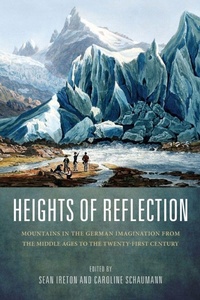
Heights of Reflection
Mountains in the German Imagination from the Middle Ages to the Twenty-First Century
Published on 15. February 2017
Book
Paperback/Softback
406 pages
978-1-57113-987-0 (ISBN)
Description
Examines the lure of mountains in German literature, philosophy, film, music, and culture from the Middle Ages to the twenty-first century.
Mountains have always stirred the human imagination, playing a crucial role in the cultural evolution of peoples around the globe and becoming infused with meaning in the process. Beyond their geographical-geological significance,mountains affect the topography of the mind, whether as objects of peril or attraction, of spiritual enlightenment or existential fulfillment, of philosophical contemplation or aesthetic inspiration. This volume challenges the oversimplified assumption that human interaction with mountains is a distinctly modern development, one that began with the empowerment of the individual in the wake of Enlightenment rationalism and Romantic subjectivity. These essays by European and North American scholars examine the lure of mountains in German literature, philosophy, film, music, and culture from the Middle Ages to the present, with a focus on the interaction between humans and the alpineenvironment. The contributors consider mountains not as mere symbolic tropes or literary metaphors, but as constituting a tangible reality that informs the experiences and ideas of writers, naturalists, philosophers, filmmakers,and composers. Overall, this volume seeks to provide multiple answers to questions regarding the cultural significance of mountains as well as the physical practice of climbing them.
Contributors: Peter Arnds, Olaf Berwald, Albrecht Classen, Roger Cook, Scott Denham, Sean Franzel, Christof Hamann, Harald Hoebusch, Dan Hooley, Peter Hoeyng, Sean Ireton, Oliver Lubrich, Anthony Ozturk, Caroline Schaumann, Heather I. Sullivan, Johannes Tuerk, Sabine Wilke, Wilfried Wilms.
Sean Ireton is Associate Professor of German at the University of Missouri. Caroline Schaumann is Associate Professor of German Studies at Emory University.
Mountains have always stirred the human imagination, playing a crucial role in the cultural evolution of peoples around the globe and becoming infused with meaning in the process. Beyond their geographical-geological significance,mountains affect the topography of the mind, whether as objects of peril or attraction, of spiritual enlightenment or existential fulfillment, of philosophical contemplation or aesthetic inspiration. This volume challenges the oversimplified assumption that human interaction with mountains is a distinctly modern development, one that began with the empowerment of the individual in the wake of Enlightenment rationalism and Romantic subjectivity. These essays by European and North American scholars examine the lure of mountains in German literature, philosophy, film, music, and culture from the Middle Ages to the present, with a focus on the interaction between humans and the alpineenvironment. The contributors consider mountains not as mere symbolic tropes or literary metaphors, but as constituting a tangible reality that informs the experiences and ideas of writers, naturalists, philosophers, filmmakers,and composers. Overall, this volume seeks to provide multiple answers to questions regarding the cultural significance of mountains as well as the physical practice of climbing them.
Contributors: Peter Arnds, Olaf Berwald, Albrecht Classen, Roger Cook, Scott Denham, Sean Franzel, Christof Hamann, Harald Hoebusch, Dan Hooley, Peter Hoeyng, Sean Ireton, Oliver Lubrich, Anthony Ozturk, Caroline Schaumann, Heather I. Sullivan, Johannes Tuerk, Sabine Wilke, Wilfried Wilms.
Sean Ireton is Associate Professor of German at the University of Missouri. Caroline Schaumann is Associate Professor of German Studies at Emory University.
Reviews / Votes
[E]xcellent coverage of the part played by mountaineering and its representations in the recuperation of German self-esteem post-1918, and into the evolution of the Bergfilm after 1945. . . . What makes mountain space so interesting from the point of view of the imagination -- one of many insights available here -- are the ways in which time can be figured in it . . . . [A] collection whose historical depth and breadth of reference make it a resource for scholars of the spatial imagination. * FORUM FOR MODERN LANGUAGE STUDIES * [A]n invaluable and intellectually lively contribution to a growing international scholarship on the cultural significance of mountains. * ECOZON * [T]urns what could have been a tired exercise in Toposforschung into an absorbing and insightful investigation of geology, history, and culture. . . . Overall, reading this book is in many respects just like climbing a mountain: . . . because, in the end, one can look back and contemplate a magnificent view. * JOURNAL OF EUROPEAN STUDIES * [Gives] extensive, insightful treatment to shifting discursive, cultural, and political valences of mountains in the German imagination. . . . [T]he range of the collection is quite broad. Nonetheless, the . . . essays on poetry, film, literature, and music address a set of related questions. . . . [T]o be praised not only for being the first to treat the cultural meaning of mountains so extensively, but also for tracing their meanings in such variety and depth. . . . Recommended. * CHOICE * [A]n impressive high mountain tour that as it goes on opens vistas on not-yet-climbed routes. * GERMAN STUDIES REVIEW * An excellent example of a variety of approaches in interdisciplinary environmental humanities, the volume presents an informative and critical addition to the study of nature representation in German culture . . . . * WOMEN IN GERMAN NEWSLETTER *More details
Series
Language
English
Place of publication
Columbia, MD
United States
Publishing group
Boydell & Brewer Ltd
Target group
Professional and scholarly
Product notice
Paperback (trade)
Illustrations
15 s/w Abbildungen
15 b/w illus.
Dimensions
Height: 229 mm
Width: 152 mm
Thickness: 24 mm
Weight
657 gr
ISBN-13
978-1-57113-987-0 (9781571139870)
Copyright in bibliographic data and cover images is held by Nielsen Book Services Limited or by the publishers or by their respective licensors: all rights reserved.
Schweitzer Classification
Other editions
Additional editions
Sean M. Ireton | Caroline Schaumann
Heights of Reflection
Mountains in the German Imagination from the Middle Ages to the Twenty-First Century
Book
06/2012
Camden House Inc
€157.20
Shipment within 15-20 days
Sean M. Ireton | Caroline Schaumann
Heights of Reflection
Mountains in the German Imagination from the Middle Ages to the Twenty-First Century
E-Book
06/2012
1st Edition
De Gruyter
€48.99
Available for download
Persons
SEAN IRETON is Associate Professor of German in the School of Languages, Literatures, and Cultures at the University of Missouri. CAROLINE SCHAUMANN is Professor and Chairperson of German Studies at Emory College, GA. ALBRECHT CLASSEN is University Distinguished Professor of German Studies at the University of Arizona; he received the title of Grand Knight Commander of the Most Noble Order of the Three Lions in 2017, in recognition of his outstanding service to German studies. CAROLINE SCHAUMANN is Professor and Chairperson of German Studies at Emory College, GA. OLAF BERWALD is Department Chair of World Languages, Literatures, and Cultures and Professor of German at Middle Tennessee State University. PETER HOEYNG is Professor of German at Emory University. SEAN FRANZEL is Professor of German at the University of Missouri. SEAN IRETON is Associate Professor of German in the School of Languages, Literatures, and Cultures at the University of Missouri.
Content
Introduction: The Meaning of Mountains: Geology, History, Culture - Caroline Schaumann and Sean Ireton
Prelude: Classical Mountain Landscapes and the Language of Ascent - Dan Hooley
Terra Incognita? Mountains in Medieval and Early Modern German Literature - Albrecht Classen
From Meadows to Mountaintops: Albrecht von Haller's"Die Alpen" - Caroline Schaumann
Geo-Poetics: The Alpine Sublime in Art and Literature, 1779-1860 - Anthony Ozturk
Time and Narrative in the Mountain Sublime around 1800 - Sean Franzel
Faust's Mountains: An Ecocritical Reading of Goethe's Tragedy and Science - Heather I. Sullivan
Spectacular Scenery and Slippery Descents: Narrating the Mountains of Tropical Polynesia - Sabine Wilke
Fascinating Voids: Alexander von Humboldt and the Myth of Chimborazo - Oliver Lubrich
From Eros to Thanatos: Hiking and Spelunking in Ludwig Tieck's Der Runenberg - Peter Arnds
Geology, Mountaineering, and Self-Formation in Adalbert Stifter's Der Nachsommer - Sean Ireton
"An Apparition from Another World" -- The Mountains of the Moon and Kilimanjaro from the Perspective of Nineteenth-Century Germany - Christof Hamman
Leaving the Summit Behind: Tracking Biographical and Philosophical Pathways in Richard Strauss's Eine Alpensinfonie - Peter Hoeyng
Elevation and Insight: Thomas Mann's Der Zauberberg - Johannes Turk
"The Essence of the Alpine World Is Struggle": Strategies of Gesundung in Arnold Fanck's Early Mountain Films - Wilfried Wilms PhD
"Mountain of Destiny": The Filmic Legacy of Nanga Parbat - Harald Hoebusch
Spatial Orientation and Embodied Transcendence in Werner Herzog's Mountain Climbing Films - Roger F. Cook
W. G. Sebald's Magic Mountains - Scott Denham
Conflicting Ascents: Inscriptions, Cartographies, andDisappearance in Christoph Ransmayr's Der fliegende Berg - Olaf Berwald
Works Cited
Notes on the Contributors
Index
Prelude: Classical Mountain Landscapes and the Language of Ascent - Dan Hooley
Terra Incognita? Mountains in Medieval and Early Modern German Literature - Albrecht Classen
From Meadows to Mountaintops: Albrecht von Haller's"Die Alpen" - Caroline Schaumann
Geo-Poetics: The Alpine Sublime in Art and Literature, 1779-1860 - Anthony Ozturk
Time and Narrative in the Mountain Sublime around 1800 - Sean Franzel
Faust's Mountains: An Ecocritical Reading of Goethe's Tragedy and Science - Heather I. Sullivan
Spectacular Scenery and Slippery Descents: Narrating the Mountains of Tropical Polynesia - Sabine Wilke
Fascinating Voids: Alexander von Humboldt and the Myth of Chimborazo - Oliver Lubrich
From Eros to Thanatos: Hiking and Spelunking in Ludwig Tieck's Der Runenberg - Peter Arnds
Geology, Mountaineering, and Self-Formation in Adalbert Stifter's Der Nachsommer - Sean Ireton
"An Apparition from Another World" -- The Mountains of the Moon and Kilimanjaro from the Perspective of Nineteenth-Century Germany - Christof Hamman
Leaving the Summit Behind: Tracking Biographical and Philosophical Pathways in Richard Strauss's Eine Alpensinfonie - Peter Hoeyng
Elevation and Insight: Thomas Mann's Der Zauberberg - Johannes Turk
"The Essence of the Alpine World Is Struggle": Strategies of Gesundung in Arnold Fanck's Early Mountain Films - Wilfried Wilms PhD
"Mountain of Destiny": The Filmic Legacy of Nanga Parbat - Harald Hoebusch
Spatial Orientation and Embodied Transcendence in Werner Herzog's Mountain Climbing Films - Roger F. Cook
W. G. Sebald's Magic Mountains - Scott Denham
Conflicting Ascents: Inscriptions, Cartographies, andDisappearance in Christoph Ransmayr's Der fliegende Berg - Olaf Berwald
Works Cited
Notes on the Contributors
Index