

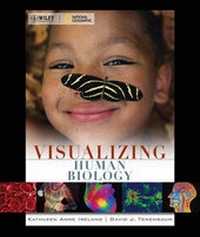
Human Biology
Published on 1. March 2007
Book
Paperback/Softback
750 pages
978-0-471-68932-4 (ISBN)
Description
Based on a partnership between Wiley and the rich resources of The National Geographic Society, this book presents the important concepts of human biology as they relate to the world we live in. It stresses the role of the human in the environment throughout, ensuring that topics such as evolution, ecology and chemistry are introduced in a non-threatening and logical fashion. This approach stimulates the reader to ask questions and pursue knowledge for the sheer fun of it.
More details
Language
English
Place of publication
New York
United States
Publishing group
John Wiley and Sons Ltd
Target group
College/higher education
Professional and scholarly
Dimensions
Height: 276 mm
Width: 236 mm
Weight
1882 gr
ISBN-13
978-0-471-68932-4 (9780471689324)
Copyright in bibliographic data and cover images is held by Nielsen Book Services Limited or by the publishers or by their respective licensors: all rights reserved.
Schweitzer Classification
Persons
Kathleen Ireland currently teaches biology and anatomy and physiology at a private high school on Maui. In the past she was on the faculties of Maui Community College and Iowa State University where she taught both of these courses. In between her current position and her position at Maui CC, Kathleen worked for Prentice Hall as Media Editor in Applied Biology, leading the team that worked on the technology that accompanied all of Ric Martini's textbooks. She has pursued advanced studies in both physiology and education, and has a PhD in Curriculum and Instructional Technology, Science Education. David Tenenbaum has an MA in Science Writing from the University of Wisconsin Madison School of Journalism and Mass Communication. He has written, contributed to and edited many books, including California Geology (McGraw Hill; contributor); Financial Planning in the Bank (edited); Managing Technology (author). He was co winner in 2002 of the Science in Society Award from the National Association of Science Writers for his writing in The Why Files http://whyfiles.org.
Content
Foreword. Preface. Unit 1: Introduction to the Study of the Life. National Geographic videos: The Incredible Human Machine. Stem Cell Research. Chapter 1: What is Life? Chapter 2: Everyday Chemistry. Chapter 3: Cells, Organization and Communication. Chapter 4: Tissues. Unit 2: Movement Through the Environment. National Geographic video: Hugh Herr: A Man with Robotic Limbs. Chapter 5: The Skeletal System. Chapter 6: The Muscular System. Chapter 7: The Nervous System. Chapter 8: The Special Senses. Unit 3: Protection from the Environment. National Geographic video: High Altitude Peoples. Chapter 9: Defense Against Disease: Stress, Non specific Immunity and the Integumentary System. Chapter 10: The Lymphatic System and Specific Immunity. Unit 4: Thriving within the Environment. National Geographic video: High Altitude Peoples. Chapter 11: The Cardiovascular System: Blood, Heart, and Circulation. Chapter 12: The Respiratory System. Chapter 13: The Digestive System. Chapter 14: The Urinary System. Unit 5: Populating the Environment. National Geographic video: The Incredible Human Machine: The Miracle of Conception. Chapter 15: The Endocrine System. Chapter 16: The Reproductive Systems. Chapter 17: Fertilization and Development. Unit 6: Adapting to and Affecting the Environment. National Geographic video: The Search for Adam. Chapter 18: Inheritance and DNA. Chapter 19: Evolution. Chapter 20: Ecology and Societal Issues. Appendix A: Answers to Self test. Appendix B: The Periodic Table of Elements. Appendix C: Measurements. Glossary. Index.