

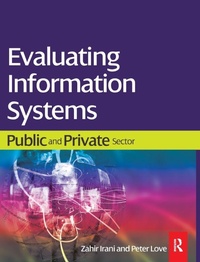
Evaluating Information Systems
Public and Private Sector
1st Edition
Published on 18. August 2016
Book
Hardback
384 pages
978-1-138-15264-9 (ISBN)
Description
The adoption of Information Technology (IT) and Information Systems (IS) represents significant financial investments, with alternative perspectives to the evaluation domain coming from both the public and private sectors.
As a result of increasing IT/IS budgets and their growing significance within the development of an organizational infrastructure, the evaluation and performance measurement of new technology remains a perennial issue for management. This book offers a refreshing and updated insight into the social fabric and technical dimensions of IT/IS evaluation together with insights into approaches used to measure the impact of information systems on its stakeholders. In doing so, it describes the portfolio of appraisal techniques that support the justification of IT/IS investments.
Evaluating Information Systems explores the concept of evaluation as an evolutionary and dynamic process that takes into account the ability of enterprise technologies to integrate information systems within and between organisations. In particular, when set against a backdrop of organisational learning. It examines the changing portfolio of benefits, costs and risks associated with the adoption and diffusion of technology in today's global marketplace. Finally approaches to impact assessment through performance management and benchmarking is discussed.
As a result of increasing IT/IS budgets and their growing significance within the development of an organizational infrastructure, the evaluation and performance measurement of new technology remains a perennial issue for management. This book offers a refreshing and updated insight into the social fabric and technical dimensions of IT/IS evaluation together with insights into approaches used to measure the impact of information systems on its stakeholders. In doing so, it describes the portfolio of appraisal techniques that support the justification of IT/IS investments.
Evaluating Information Systems explores the concept of evaluation as an evolutionary and dynamic process that takes into account the ability of enterprise technologies to integrate information systems within and between organisations. In particular, when set against a backdrop of organisational learning. It examines the changing portfolio of benefits, costs and risks associated with the adoption and diffusion of technology in today's global marketplace. Finally approaches to impact assessment through performance management and benchmarking is discussed.
More details
Language
English
Place of publication
London
United Kingdom
Publishing group
Taylor & Francis Ltd
Target group
College/higher education
Dimensions
Height: 260 mm
Width: 208 mm
Thickness: 25 mm
Weight
1044 gr
ISBN-13
978-1-138-15264-9 (9781138152649)
Copyright in bibliographic data and cover images is held by Nielsen Book Services Limited or by the publishers or by their respective licensors: all rights reserved.
Schweitzer Classification
Other editions
Additional editions
Zahir Irani | Peter Love
Evaluating Information Systems
E-Book
05/2008
1st Edition
Routledge
€77.99
Available for download
Zahir Irani | Peter Love
Evaluating Information Systems
E-Book
05/2008
1st Edition
Routledge
€77.99
Available for download
Book
03/2008
1st Edition
Butterworth-Heinemann
€85.00
Shipment within 15-20 days
Persons
Zahir Irani, Peter Love
Content
Information systems evaluation: A crisis of understanding (Irani and Love);
Information technology and systems justification (Gunasekaran, Ngai and McGaughey);
Revisiting the content, context and process of IS evaluation (Stockdale, Standing, Love and Irani);
How IT evaluation methods are used: Examining case research from an ANT perspective (Nijland and Willcocks);
IT project evaluation: Why more formal evaluation is not necessarily better (Thomas, Seddon and Fernandez);
Don't mention the war: Managing disbenefits (Bannister);
Spot the difference: Evaluation of custom and package applications (Entwistle and Light);
Post-implementation evaluation of IT systems: A close review of practice (Al-Yaseen, Eldabi, Paul and El-Haddadeh);
Evaluation of information providers in support of fixed-income market (Montazemi, Esfahanipour and Siam);
Evaluating actors and factors associated with healthcare information systems (Mantzana, Themistocleous, Morabito and Soulioutis);
Evalutating the governance structure for public sector IT: The UK National Programme in the Health Service (Currie);
Strategic alignment and a culture innovation: Using the SPRINT methodology to meet two challenges of information age government (Kawalek and Wastell);
Social dimension of IT/IS evaluation: Views from the public sector (Jones);
Benchmarking e-Government: Improving the national and international measurement, evaluation and comparison of e-Government (Heeks);
Evaluating e-Government infrastructure through enterprise application integration (EAI) (Kamal, Themistocleous and Morabito);
t-Government for benefit realisation: A research agenda (Sahraoui, Ghoneim, Irani and Ozkan);
Information technology and systems justification (Gunasekaran, Ngai and McGaughey);
Revisiting the content, context and process of IS evaluation (Stockdale, Standing, Love and Irani);
How IT evaluation methods are used: Examining case research from an ANT perspective (Nijland and Willcocks);
IT project evaluation: Why more formal evaluation is not necessarily better (Thomas, Seddon and Fernandez);
Don't mention the war: Managing disbenefits (Bannister);
Spot the difference: Evaluation of custom and package applications (Entwistle and Light);
Post-implementation evaluation of IT systems: A close review of practice (Al-Yaseen, Eldabi, Paul and El-Haddadeh);
Evaluation of information providers in support of fixed-income market (Montazemi, Esfahanipour and Siam);
Evaluating actors and factors associated with healthcare information systems (Mantzana, Themistocleous, Morabito and Soulioutis);
Evalutating the governance structure for public sector IT: The UK National Programme in the Health Service (Currie);
Strategic alignment and a culture innovation: Using the SPRINT methodology to meet two challenges of information age government (Kawalek and Wastell);
Social dimension of IT/IS evaluation: Views from the public sector (Jones);
Benchmarking e-Government: Improving the national and international measurement, evaluation and comparison of e-Government (Heeks);
Evaluating e-Government infrastructure through enterprise application integration (EAI) (Kamal, Themistocleous and Morabito);
t-Government for benefit realisation: A research agenda (Sahraoui, Ghoneim, Irani and Ozkan);