

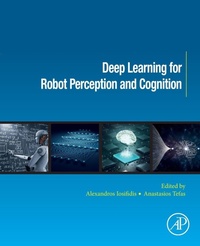
Deep Learning for Robot Perception and Cognition
Published on 10. March 2022
Book
Paperback/Softback
634 pages
978-0-323-85787-1 (ISBN)
Description
Deep Learning for Robot Perception and Cognition introduces a broad range of topics and methods in deep learning for robot perception and cognition together with end-to-end methodologies. The book provides the conceptual and mathematical background needed for approaching a large number of robot perception and cognition tasks from an end-to-end learning point-of-view. The book is suitable for students, university and industry researchers and practitioners in Robotic Vision, Intelligent Control, Mechatronics, Deep Learning, Robotic Perception and Cognition tasks.
More details
Language
English
Place of publication
Oxford
United Kingdom
Publishing group
Elsevier Science & Technology
Target group
Professional and scholarly
Product notice
Paperback (trade)
Illustrations
55 illustrations (15 in full color); Illustrations
Dimensions
Height: 235 mm
Width: 191 mm
Thickness: 33 mm
Weight
1078 gr
ISBN-13
978-0-323-85787-1 (9780323857871)
Copyright in bibliographic data and cover images is held by Nielsen Book Services Limited or by the publishers or by their respective licensors: all rights reserved.
Schweitzer Classification
Other editions
Additional editions
Alexandros Iosifidis | Anastasios Tefas
Deep Learning for Robot Perception and Cognition
E-Book
02/2022
Academic Press
€113.00
Available for download
Persons
Alexandros Iosifidis is a Professor at Aarhus University, Denmark. He leads the Machine Learning and
Computational Intelligence group at the Department of Electrical and Computer Engineering. He received his Ph.D.
from the Department of Informatics at Aristotle University of Thessaloniki, Greece in 2014. He participated in more
than 15 research and development projects financed by national and European funds. Anastasios Tefas received the B.Sc. in Informatics in 1997 and the Ph.D. degree in Informatics in 2002, both from
the Aristotle University of Thessaloniki, Greece. Since 2017, he has been an Associate Professor at the Department of
Informatics, Aristotle University of Thessaloniki. Dr. Tefas participated in 20 research projects financed by national and
European funds. He is the coordinator of the H2020 project OpenDR, "Open Deep Learning Toolkit for Robotics.?
Computational Intelligence group at the Department of Electrical and Computer Engineering. He received his Ph.D.
from the Department of Informatics at Aristotle University of Thessaloniki, Greece in 2014. He participated in more
than 15 research and development projects financed by national and European funds. Anastasios Tefas received the B.Sc. in Informatics in 1997 and the Ph.D. degree in Informatics in 2002, both from
the Aristotle University of Thessaloniki, Greece. Since 2017, he has been an Associate Professor at the Department of
Informatics, Aristotle University of Thessaloniki. Dr. Tefas participated in 20 research projects financed by national and
European funds. He is the coordinator of the H2020 project OpenDR, "Open Deep Learning Toolkit for Robotics.?
Content
1. Introduction
2. Neural Networks and Backpropagation
3. Convolutional Neural Networks
4. Graph Convolutional Networks
5. Recurrent Neural Networks
6. Deep Reinforcement Learning
7. Lightweight Deep Learning
8. Knowledge Distillation
9. Progressive and Compressive Deep Learning
10. Representation Learning and Retrieval
11. Object Detection and Tracking
12. Semantic Scene Segmentation for Robotics
13. 3D Object Detection and Tracking
14. Human Activity Recognition
15. Deep Learning for Vision-based Navigation in Autonomous Drone Racing
16. Robotic Grasping in Agile Production
17. Deep learning in Multiagent Systems
18. Simulation Environments
19. Biosignal time-series analysis
20. Medical Image Analysis
21. Deep learning for robotics examples using OpenDR
2. Neural Networks and Backpropagation
3. Convolutional Neural Networks
4. Graph Convolutional Networks
5. Recurrent Neural Networks
6. Deep Reinforcement Learning
7. Lightweight Deep Learning
8. Knowledge Distillation
9. Progressive and Compressive Deep Learning
10. Representation Learning and Retrieval
11. Object Detection and Tracking
12. Semantic Scene Segmentation for Robotics
13. 3D Object Detection and Tracking
14. Human Activity Recognition
15. Deep Learning for Vision-based Navigation in Autonomous Drone Racing
16. Robotic Grasping in Agile Production
17. Deep learning in Multiagent Systems
18. Simulation Environments
19. Biosignal time-series analysis
20. Medical Image Analysis
21. Deep learning for robotics examples using OpenDR