

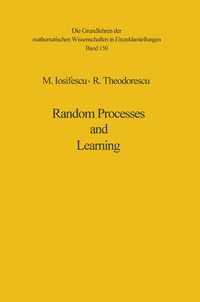
Random Processes and Learning
Published on 25. February 2012
Book
Paperback/Softback
X, 308 pages
978-3-642-46186-6 (ISBN)
Description
The aim of" the present monograph is two-fold: (a) to give a short account of the main results concerning the theory of random systems with complete connections, and (b) to describe the general learning model by means of random systems with complete connections. The notion of chain with complete connections has been introduced in probability theory by ONICESCU and MIHOC (1935a). These authors have set themselves the aim to define a very broad type of dependence which takes into account the whole history of the evolution and thus includes as a special case the Markovian one. In a sequel of papers of the period 1935-1937, ONICESCU and MIHOC developed the theory of these chains for the homogeneous case with a finite set of states from differ ent points of view: ergodic behaviour, associated chain, limit laws. These results led to a chapter devoted to these chains, inserted by ONI CESCU and MIHOC in their monograph published in 1937. Important contributions to the theory of chains with complete connections are due to DOEBLIN and FORTET and refer to the period 1937-1940. They consist in the approach of chains with an infinite history (the so-called chains of infinite order) and in the use of methods from functional analysis.
More details
Series
Edition
Softcover reprint of the original 1st ed. 1969
Language
English
Place of publication
Berlin
Germany
Publishing group
Springer Berlin
Target group
Professional and scholarly
Research
Illustrations
X, 308 p.
Dimensions
Height: 235 mm
Width: 155 mm
Thickness: 18 mm
Weight
487 gr
ISBN-13
978-3-642-46186-6 (9783642461866)
DOI
10.1007/978-3-642-46184-2
Schweitzer Classification
Other editions
Additional editions
Marius Iosifescu | Radu Theodorescu
Random Processes and Learning
Book
01/1969
1st Edition
Springer
€85.55
Article exhausted; check different version
Content
1 A study of random sequences via the dependence coefficient.- 1.1. The general case.- 1.2. The Markovian case.- 2 Random systems with complete connections.- 2.1. Ergodicity.- 2.2. Asymptotic behaviour.- 2.3. Special random systems with complete connections.- 3 Learning.- 3.1. Basic models.- 3.2. Linear models.- 3.3. Nonlinear models.- Notation index.- Author and subject index.