

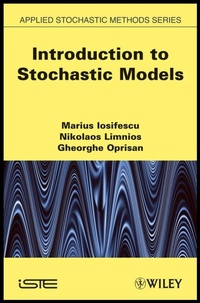
Introduction to Stochastic Models
1st Edition
Will be published approx. on 9. March 2010
Book
Hardback
320 pages
978-1-84821-057-8 (ISBN)
Description
This book provides a pedagogical examination of the way in which stochastic models are encountered in applied sciences and techniques such as physics, engineering, biology and genetics, economics and social sciences. It covers Markov and semi-Markov models, as well as their particular cases: Poisson, renewal processes, branching processes, Ehrenfest models, genetic models, optimal stopping, reliability, reservoir theory, storage models, and queuing systems. Given this comprehensive treatment of the subject, students and researchers in applied sciences, as well as anyone looking for an introduction to stochastic models, will find this title of invaluable use.
More details
Language
English
Place of publication
London
United Kingdom
Target group
College/higher education
Product notice
sewn/stitched
Cloth over boards
Dimensions
Height: 234 mm
Width: 163 mm
Thickness: 28 mm
Weight
680 gr
ISBN-13
978-1-84821-057-8 (9781848210578)
Copyright in bibliographic data and cover images is held by Nielsen Book Services Limited or by the publishers or by their respective licensors: all rights reserved.
Schweitzer Classification
Other editions
Additional editions
Marius Iosifescu | Nikolaos Limnios | Gheorghe Oprisan
Introduction to Stochastic Models
E-Book
03/2013
Wiley-ISTE
€139.99
Available for download
Marius Iosifescu | Nikolaos Limnios | Gheorghe Oprisan
Introduction to Stochastic Models
E-Book
03/2013
Wiley-ISTE
€139.99
Available for download
Persons
Marius Iosifescu is a member and vice-president of the Romanian Academy of Sciences and director of the Bucharest Institute of Mathematical Statistics and Applied Mathematics. His research concerns stochastic processes, the probabilistic theory of numbers and their applications.
Nikolaos Limnios is a professor of applied mathematics at the University of Technology of Compiegne, France. His research and teaching activities concern stochastic processes, statistical inference and their applications.
Gheorghe Oprisan is a professor of applied mathematics at the 'Politehnica' University of Bucharest and the head of the Mathematical section II there. His research concerns stochastic processes and their applications.
Nikolaos Limnios is a professor of applied mathematics at the University of Technology of Compiegne, France. His research and teaching activities concern stochastic processes, statistical inference and their applications.
Gheorghe Oprisan is a professor of applied mathematics at the 'Politehnica' University of Bucharest and the head of the Mathematical section II there. His research concerns stochastic processes and their applications.
Content
Preface ix
Chapter 1. Introduction to Stochastic Processes 1
1.1. Sequences of random variables 1
1.2. The notion of stochastic process 10
1.3. Martingales 13
1.4. Markov chains 17
1.5. State classification 24
1.6. Continuous-time Markov processes 27
1.7. Semi-Markov processes 33
Chapter 2. Simple Stochastic Models 37
2.1. Urn models 37
2.2. Random walks 39
2.3. Brownian motion 44
2.4. Poisson processes 50
2.5. Birth and death processes 59
Chapter 3. Elements of Markov Modeling 61
3.1. Markov models: ideas, history, applications 61
3.2. The discrete-time Ehrenfest model 63
3.3. Markov models in genetics 79
3.4. Markov storage models 110
3.5. Reliability of Markov models 124
Chapter 4. Renewal Models 149
4.1. Fundamental concepts and examples 149
4.2. Waiting times 155
4.3. Modified renewal processes 159
4.4. Replacement models 161
4.5. Renewal reward processes 165
4.6. The risk problem of an insurance company 168
4.7. Counter models 171
4.8. Alternating renewal processes 180
4.9. Superposition of renewal processes 182
4.10. Regenerative processes 186
Chapter 5. Semi-Markov Models 189
5.1. Introduction 189
5.2. Markov renewal processes 190
5.3. First-passage times and state classification 196
5.4. Reliability 200
5.5. Reservoir models 207
5.6. Queues 218
5.7. Digital communication channels 222
Chapter 6. Branching Models 227
6.1. The Bienayme-Galton-Watson model 227
6.2. Generalizations of the B-G-W model 271
6.3. Continuous-time models 302
Chapter 7. Optimal Stopping Models 315
7.1. The classic optimal stopping problem 315
7.2. Renewal with binary decision 333
Bibliography 343
Notation 367
Index 369
Chapter 1. Introduction to Stochastic Processes 1
1.1. Sequences of random variables 1
1.2. The notion of stochastic process 10
1.3. Martingales 13
1.4. Markov chains 17
1.5. State classification 24
1.6. Continuous-time Markov processes 27
1.7. Semi-Markov processes 33
Chapter 2. Simple Stochastic Models 37
2.1. Urn models 37
2.2. Random walks 39
2.3. Brownian motion 44
2.4. Poisson processes 50
2.5. Birth and death processes 59
Chapter 3. Elements of Markov Modeling 61
3.1. Markov models: ideas, history, applications 61
3.2. The discrete-time Ehrenfest model 63
3.3. Markov models in genetics 79
3.4. Markov storage models 110
3.5. Reliability of Markov models 124
Chapter 4. Renewal Models 149
4.1. Fundamental concepts and examples 149
4.2. Waiting times 155
4.3. Modified renewal processes 159
4.4. Replacement models 161
4.5. Renewal reward processes 165
4.6. The risk problem of an insurance company 168
4.7. Counter models 171
4.8. Alternating renewal processes 180
4.9. Superposition of renewal processes 182
4.10. Regenerative processes 186
Chapter 5. Semi-Markov Models 189
5.1. Introduction 189
5.2. Markov renewal processes 190
5.3. First-passage times and state classification 196
5.4. Reliability 200
5.5. Reservoir models 207
5.6. Queues 218
5.7. Digital communication channels 222
Chapter 6. Branching Models 227
6.1. The Bienayme-Galton-Watson model 227
6.2. Generalizations of the B-G-W model 271
6.3. Continuous-time models 302
Chapter 7. Optimal Stopping Models 315
7.1. The classic optimal stopping problem 315
7.2. Renewal with binary decision 333
Bibliography 343
Notation 367
Index 369