

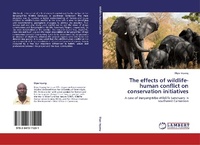
The Effects of Wildlife-Human Conflict on Conservation Initiatives
A case of Banyang-Mbo Wildlife Sanctuary in southwest Cameroon
Published on 8. December 2011
Book
Paperback/Softback
128 pages
978-3-8473-1120-1 (ISBN)
Description
This book is the result of a field research carried out by the author at the Banyang-Mbo Wildlife Sanctuary in southwest Cameroon. The main objective was to develop a better understanding of factors and issues involved in wildlife-human conflict in the area with a view to identifying and recommending appropriate strategies to address the situation. Two surveys and one case study were carried out to get the views of village communities and Banyang-Mbo Wildlife Sanctuary Project, respectively, as the main stakeholders in the conflict. The research found that elephants, cane rats and bush pigs are the major crop-raiders at Banyang-Mbo. Village communities consider crop-raiding levels to be determined by the presence or absence of elephants, whereas the project regards cane rats to be the determining species. It is concluded that the wildlife-human conflict at the area is complicated by a combination of real and perceived causes, largely coloured by a few but important differences in beliefs, values and preferences between the project and the local communities.
More details
Language
English
Place of publication
Germany
Product notice
Paperback (trade)
Unsewn / adhesive bound
Dimensions
Height: 220 mm
Width: 150 mm
Thickness: 9 mm
Weight
209 gr
ISBN-13
978-3-8473-1120-1 (9783847311201)
Copyright in bibliographic data and cover images is held by Nielsen Book Services Limited or by the publishers or by their respective licensors: all rights reserved.
Schweitzer Classification
Person
Ekpe Inyang holds an MSc degree in Environmental Studies obtained from the University of Strathclyde, UK. He is a writer with great passion for Nature and has many years of experience, having worked with the World Wide Fund for Nature (WWF), Wildlife Conservation Society (WCS), and Pan African Institute for Development-West Africa in Cameroon.