

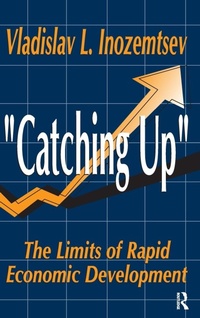
Catching Up
The Limits of Rapid Economic Development
1st Edition
Published on 2. August 2017
Book
Hardback
204 pages
978-1-138-52009-7 (ISBN)
Description
Disparities between the economic development of nations have widened throughout the twentieth century, and they show no sign of closing. In the nineteenth century, the economic potential of developed countries was three times that of the rest of the world. Today the gap is twenty times greater, and the trend is increasing. In this provocative reexamination of theories of accelerated development, or "catching up," Vladislav L. Inozemtsev traces the evolution of thinking about how countries lagging behind can most swiftly move forward, and assesses their prospects for success in this effort.
Inozemtsev reviews the experience of the Soviet Union, as well as the recent experience of Japan, China, and Southeast Asia. He finds that those countries that have moved forward most rapidly have successfully adapted new technology to old processes. But even then, they face daunting odds, as they grapple with the need to change their population's ideas and behavior. And in the 1990s, their rates of development have noticeably declined. "Catching Up" assesses prospects for successful application of theories of accelerated development in the global economy. Inozemtsev's pessimistic conclusion is that rapid industrial progress is not achievable in the information society of the twenty-first century.
Inozemtsev reaches this conclusion after reviewing theories of accelerated development thinking from the diverse viewpoints of the 1940s and 1950s, to the more intensive ideological polarization of the 1960s. Inozemtsev believes it will be impossible for non-Western nations to "catch up" with the West because of their inability to generate or control information and knowledge.
Inozemtsev reviews the experience of the Soviet Union, as well as the recent experience of Japan, China, and Southeast Asia. He finds that those countries that have moved forward most rapidly have successfully adapted new technology to old processes. But even then, they face daunting odds, as they grapple with the need to change their population's ideas and behavior. And in the 1990s, their rates of development have noticeably declined. "Catching Up" assesses prospects for successful application of theories of accelerated development in the global economy. Inozemtsev's pessimistic conclusion is that rapid industrial progress is not achievable in the information society of the twenty-first century.
Inozemtsev reaches this conclusion after reviewing theories of accelerated development thinking from the diverse viewpoints of the 1940s and 1950s, to the more intensive ideological polarization of the 1960s. Inozemtsev believes it will be impossible for non-Western nations to "catch up" with the West because of their inability to generate or control information and knowledge.
More details
Language
English
Place of publication
London
United Kingdom
Publishing group
Taylor & Francis Ltd
Target group
College/higher education
Dimensions
Height: 235 mm
Width: 157 mm
Thickness: 16 mm
Weight
454 gr
ISBN-13
978-1-138-52009-7 (9781138520097)
Copyright in bibliographic data and cover images is held by Nielsen Book Services Limited or by the publishers or by their respective licensors: all rights reserved.
Schweitzer Classification
Other editions
Additional editions
E-Book
07/2017
Routledge
€65.99
Available for download
E-Book
07/2017
Routledge
€65.99
Available for download
Book
08/2004
1st Edition
Transaction Publishers
€72.10
Shipment within 10-20 days
Person
Vladislav Inozemtsev
Content
Introduction to the American Edition
1. The Concept of "Catching Up"
Development in the Twentieth Century
2. Post-Industrial Trends and Prerequisites for the
Crisis of the "Catching Up" Development Model
3. Internal Contradictions of the "Catching Up"
Development Model
4. The Japanese Economic Miracle: A Manifest
Success or a Strategic Setback?
5. Southeast Asia: From Boom to Crisis
6. China: Sharing the Fate of the Others or Going
Its Distinctive Way?
7. Russia: Pipe Dreams and Realistic Objectives
Index
1. The Concept of "Catching Up"
Development in the Twentieth Century
2. Post-Industrial Trends and Prerequisites for the
Crisis of the "Catching Up" Development Model
3. Internal Contradictions of the "Catching Up"
Development Model
4. The Japanese Economic Miracle: A Manifest
Success or a Strategic Setback?
5. Southeast Asia: From Boom to Crisis
6. China: Sharing the Fate of the Others or Going
Its Distinctive Way?
7. Russia: Pipe Dreams and Realistic Objectives
Index