

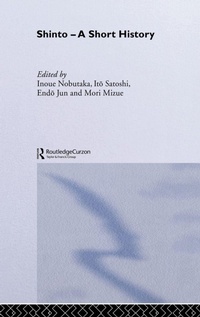
Shinto
A Short History
Published on 29. May 2003
Book
Hardback
240 pages
978-0-415-31179-3 (ISBN)
Description
Shinto - A Short History provides an introductory outline of the historical development of Shinto from the ancient period of Japanese history until the present day.
Shinto does not offer a readily identifiable set of teachings, rituals or beliefs; individual shrines and kami deities have led their own lives, not within the confines of a narrowly defined Shinto, but rather as participants in a religious field that included Buddhist, Taoist, Confucian and folk elements. Thus, this book approaches Shinto as a series of historical 'religious systems' rather than attempting to identify a timeless 'Shinto essence'.
This history focuses on three aspects of Shinto practice: the people involved in shrine worship, the institutional networks that ensured continuity, and teachings and rituals. By following the interplay between these aspects in different periods, a pattern of continuity and discontinuity is revealed that challenges received understandings of the history of Shinto.
This book does not presuppose prior knowledge of Japanese religion, and is easily accessible for those new to the subject.
Shinto does not offer a readily identifiable set of teachings, rituals or beliefs; individual shrines and kami deities have led their own lives, not within the confines of a narrowly defined Shinto, but rather as participants in a religious field that included Buddhist, Taoist, Confucian and folk elements. Thus, this book approaches Shinto as a series of historical 'religious systems' rather than attempting to identify a timeless 'Shinto essence'.
This history focuses on three aspects of Shinto practice: the people involved in shrine worship, the institutional networks that ensured continuity, and teachings and rituals. By following the interplay between these aspects in different periods, a pattern of continuity and discontinuity is revealed that challenges received understandings of the history of Shinto.
This book does not presuppose prior knowledge of Japanese religion, and is easily accessible for those new to the subject.
Reviews / Votes
'Shinto: A Short History is a benchmark publication in Shinto studies.' - Monumenta Nipponica'This book should have wide appeal to teachers of East Asian relgions as a detailed textbook for upper-level undergraduates and taught postgraduates, as well as being a useful resource for scholars. The use of the concept of 'religious tradition' as an analytical framework is an important contribtution and gives much food for thought for all scholars of religious studies.' Social Anthropology 'Shinto: A Short History is a benchmark publication in Shinto studies.' - Monumenta Nipponica
'This book should have wide appeal to teachers of East Asian relgions as a detailed textbook for upper-level undergraduates and taught postgraduates, as well as being a useful resource for scholars. The use of the concept of 'religious tradition' as an analytical framework is an important contribtution and gives much food for thought for all scholars of religious studies.' Social Anthropology
More details
Language
English
Place of publication
London
United Kingdom
Publishing group
Taylor & Francis Ltd
Target group
College/higher education
Professional and scholarly
Dimensions
Height: 240 mm
Width: 161 mm
Thickness: 18 mm
Weight
529 gr
ISBN-13
978-0-415-31179-3 (9780415311793)
Copyright in bibliographic data and cover images is held by Nielsen Book Services Limited or by the publishers or by their respective licensors: all rights reserved.
Schweitzer Classification
Other editions
Additional editions
E-Book
09/2003
Routledge
€100.99
Available for download
E-Book
09/2003
Routledge
€100.99
Available for download
Book
05/2003
Routledge
€108.50
Shipment within 15-20 days
Persons
Mark Teeuwen teaches at the University of Oslo, Norway. His specialisation is the history of Japanese religion. He has published extensively on the history of Shinto and kami worship within this field.
John Breen teaches at the School of Oriental and African Studies, University of London. He specialises in cultural history and has published widely on politics and religion in modern Japan.
Inoue Nobutaka teaches at Kokugakuin University in Tokyo, where he is a central member of the newly created Faculty of Shinto Studies. His field is sociology of religion. He is widely recognised as one of the foremost experts on Japanese New Religions in general, and sect Shinto in particular.
John Breen teaches at the School of Oriental and African Studies, University of London. He specialises in cultural history and has published widely on politics and religion in modern Japan.
Inoue Nobutaka teaches at Kokugakuin University in Tokyo, where he is a central member of the newly created Faculty of Shinto Studies. His field is sociology of religion. He is widely recognised as one of the foremost experts on Japanese New Religions in general, and sect Shinto in particular.
Content
Translators' introduction Introduction What is Shinto? 1. Ancient and Classical Japan: The Dawn of Shinto 2. The Medieval Period: The Kami Merge with Buddhism 3. The Early Modern Period: In Search of a Shinto Identity 4. The Modern Age: Shinto Confronts Modernity Index