

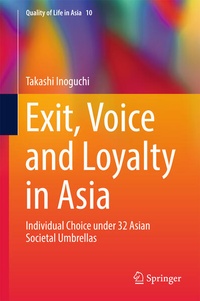
Exit, Voice and Loyalty in Asia
Individual Choice under 32 Asian Societal Umbrellas
Published on 6. June 2017
Book
Hardback
IX, 236 pages
978-981-10-4722-0 (ISBN)
Description
This book provides insightful observations and analyses of Asian citizens' behaviour associated with requests to get a permit in conditions typically characterized by bureaucratic callousness. Using the AsiaBarometer Survey data on quality of life, it studies various types of behaviour using the multi-level regression models for 32 countries. In doing so, the book provides insights into how these societies cope with the state's bureaucratism using Albert Hirschman's concepts of Exit, Voice and Loyalty. Arguments are then juxtaposed with issues such as rampant corruption, government regulatory principles and measures, and calls by international organisations and non-governmental groups for business firms to be more strictly bound. Given the generally receding tide of democracy in Asian societies, this book will be of interest to academics, business, mass media and other professionals.
More details
Series
Edition
1st ed. 2017
Language
English
Place of publication
Singapore
Singapore
Target group
Professional and scholarly
Illustrations
30 farbige Abbildungen
IX, 236 p. 30 illus. in color.
Dimensions
Height: 241 mm
Width: 160 mm
Thickness: 19 mm
Weight
586 gr
ISBN-13
978-981-10-4722-0 (9789811047220)
DOI
10.1007/978-981-10-4724-4
Schweitzer Classification
Other editions
Additional editions
Book
12/2018
Springer
€96.29
Shipment within 15-20 days
E-Book
05/2017
Springer
€96.29
Available for download
Person
Takashi Inoguchi is a PhD at MIT, Professor Emeritus of the University of Tokyo, former Assistant Secretary General of the United Nations and former President of the University of Niigata Prefecture and current University Guest Professor of J.F. Oberlin University (Tokyo). His latest works include The Quality of Life in Asia, Japanese Politics Today, Political Parties and Democracy and The Troubled Triangle.
Content
Chapter 1. Introduction.- Chapter 2. Conceptual Scheme.- Chapter 3. rofiles of Twenty-nine Asian Societies in terms of Exit, Voice and Loyalty.- Chapter 4. Country Profiles of Twenty-nine Asian Societies: Logit Regression Analysis.- Chapter 5. Comparisons with Asian and non-Asian Societies: The United States, Australia, Japan, Russia, China and India.- Chapter 6. Discussion and Conclusion.- References.