

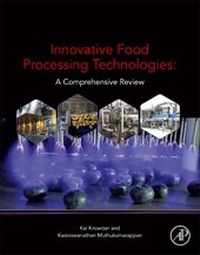
Innovative Food Processing Technologies
A Comprehensive Review
Elsevier (Publisher)
Published on 18. August 2020
Book
2480 pages
978-0-12-815781-7 (ISBN)
Description
Food process engineering, a branch of both food science and chemical engineering, has evolved over the years since its inception and still is a rapidly changing discipline. While traditionally the main objective of food process engineering was preservation and stabilization, the focus today has shifted to enhance health aspects, flavour and taste, nutrition, sustainable production, food security and also to ensure more diversity for the increasing demand of consumers.
The food industry is becoming increasingly competitive and dynamic, and strives to develop high quality, freshly prepared food products. To achieve this objective, food manufacturers are today presented with a growing array of new technologies that have the potential to improve, or replace, conventional processing technologies, to deliver higher quality and better consumer targeted food products, which meet many, if not all, of the demands of the modern consumer. These new, or innovative, technologies are in various stages of development, including some still at the R&D stage, and others that have been commercialised as alternatives to conventional processing technologies.
Food process engineering comprises a series of unit operations traditionally applied in the food industry. One major component of these operations relates to the application of heat, directly or indirectly, to provide foods free from pathogenic microorganisms, but also to enhance or intensify other processes, such as extraction, separation or modification of components. The last three decades have also witnessed the advent and adaptation of several operations, processes, and techniques aimed at producing high quality foods, with minimum alteration of sensory and nutritive properties. Some of these innovative technologies have significantly reduced the thermal component in food processing, offering alternative nonthermal methods.
Food Processing Technologies: A Comprehensive Review, Three Volume Set covers the latest advances in innovative and nonthermal processing, such as high pressure, pulsed electric fields, radiofrequency, high intensity pulsed light, ultrasound, irradiation and new hurdle technology. Each section will have an introductory article covering the basic principles and applications of each technology, and in-depth articles covering the currently available equipment (and/or the current state of development), food quality and safety, application to various sectors, food laws and regulations, consumer acceptance, advancements and future scope. It will also contain case studies and examples to illustrate state-of-the-art applications. Each section will serve as an excellent reference to food industry professionals involved in the processing of a wide range of food categories, e.g., meat, seafood, beverage, dairy, eggs, fruits and vegetable products, spices, herbs among others.
The food industry is becoming increasingly competitive and dynamic, and strives to develop high quality, freshly prepared food products. To achieve this objective, food manufacturers are today presented with a growing array of new technologies that have the potential to improve, or replace, conventional processing technologies, to deliver higher quality and better consumer targeted food products, which meet many, if not all, of the demands of the modern consumer. These new, or innovative, technologies are in various stages of development, including some still at the R&D stage, and others that have been commercialised as alternatives to conventional processing technologies.
Food process engineering comprises a series of unit operations traditionally applied in the food industry. One major component of these operations relates to the application of heat, directly or indirectly, to provide foods free from pathogenic microorganisms, but also to enhance or intensify other processes, such as extraction, separation or modification of components. The last three decades have also witnessed the advent and adaptation of several operations, processes, and techniques aimed at producing high quality foods, with minimum alteration of sensory and nutritive properties. Some of these innovative technologies have significantly reduced the thermal component in food processing, offering alternative nonthermal methods.
Food Processing Technologies: A Comprehensive Review, Three Volume Set covers the latest advances in innovative and nonthermal processing, such as high pressure, pulsed electric fields, radiofrequency, high intensity pulsed light, ultrasound, irradiation and new hurdle technology. Each section will have an introductory article covering the basic principles and applications of each technology, and in-depth articles covering the currently available equipment (and/or the current state of development), food quality and safety, application to various sectors, food laws and regulations, consumer acceptance, advancements and future scope. It will also contain case studies and examples to illustrate state-of-the-art applications. Each section will serve as an excellent reference to food industry professionals involved in the processing of a wide range of food categories, e.g., meat, seafood, beverage, dairy, eggs, fruits and vegetable products, spices, herbs among others.
Reviews / Votes
"Food processing engineering, a branch of both food science and chemical engineering is rapidly evolving. The text covers the latest in innovative and non-innovative treatments, such as ultrasounds and pulsed electric fields. Each section opens with an article that covers the basic principles and applications of each technology." --Tecnica MolitoriaMore details
Language
English
Place of publication
United States
Target group
Professional and scholarly
Advanced graduate students and researchers working with food processing technologies, as well as food engineers and technologists in the food industry. Food processing companies considering the use of any new processing technology. Food Processing Technologies will provide systematic knowledge to industrial readers, with numerous examples of process design
Dimensions
Height: 276 mm
Width: 216 mm
Weight
3320 gr
ISBN-13
978-0-12-815781-7 (9780128157817)
Copyright in bibliographic data and cover images is held by Nielsen Book Services Limited or by the publishers or by their respective licensors: all rights reserved.
Schweitzer Classification
Other editions
Additional editions
Kasiviswanathan Muthukumarappan | Kai Knoerzer
Innovative Food Processing Technologies
A Comprehensive Review
E-Book
08/2020
1st Edition
Elsevier
from
€1,655.00
Available for download
Persons
Dr. Kasiviswanathan Muthukumarappan is Maynard A. Klingbeil Endowed Department Head and Distinguished Professor of the Department of Agricultural and Biosystems Engineering at the South Dakota State University.
In his more than 25 years of professional career, Dr. Muthu has devoted his time to develop novel methods to test the functional properties of food materials, develop fundamental platform technologies and bio-refinery systems to produce energy, materials and chemicals from renewable resources and extrusion processing of value-added co-products. He has authored or co-authored more than 250 peer-reviewed publications and made more than 350 regional, national, and international presentations. A few of his awards and honors include a 2013 Distinguished Professor, 2012 ASABE Fellow Award, 2011 Griffith Faculty Research Award, 2009 Evelyn E. Rosentreter Standards Award in recognition of his outstanding contributions as a research leader and educator in the food and bioprocess engineering area. Dr. Kai Knoerzer has a background in process engineering (BSc), chemical engineering (MSc) and food process engineering (PhD, summa cum laude), all awarded from the Karlsruhe Institute of Technology (Germany). In 2006, he commenced work with Food Science Australia (a joint venture of the Commonwealth Scientific and Industrial Research Organisation (CSIRO) and the Victorian Government) as a Postdoctoral fellow. He has since become a Principal Research Scientist in CSIRO Agriculture and Food. Kai has a proven track record in food process engineering research and development, particularly of innovative technologies. Currently, he is leading research and venture science activities across a number of innovative food processing technologies, including high pressure thermal processing and extrusion technology. Kai's work has shown both science impact, with more than 100 peer-reviewed journal publications, conference proceedings and book chapters, 7 patents/applications, 4 edited books and over 100 oral and 50 poster presentations at national and international conferences, as well as commercial impact in the food industry. His work has also been recognised with various international awards for research excellence. Kai has been an active member of IFT's International Division in the leadership team for >10 years and is past chair of this division. Kai serves Elsevier's Food Science Reference Collections as the Food Process Engineering section editor.
In his more than 25 years of professional career, Dr. Muthu has devoted his time to develop novel methods to test the functional properties of food materials, develop fundamental platform technologies and bio-refinery systems to produce energy, materials and chemicals from renewable resources and extrusion processing of value-added co-products. He has authored or co-authored more than 250 peer-reviewed publications and made more than 350 regional, national, and international presentations. A few of his awards and honors include a 2013 Distinguished Professor, 2012 ASABE Fellow Award, 2011 Griffith Faculty Research Award, 2009 Evelyn E. Rosentreter Standards Award in recognition of his outstanding contributions as a research leader and educator in the food and bioprocess engineering area. Dr. Kai Knoerzer has a background in process engineering (BSc), chemical engineering (MSc) and food process engineering (PhD, summa cum laude), all awarded from the Karlsruhe Institute of Technology (Germany). In 2006, he commenced work with Food Science Australia (a joint venture of the Commonwealth Scientific and Industrial Research Organisation (CSIRO) and the Victorian Government) as a Postdoctoral fellow. He has since become a Principal Research Scientist in CSIRO Agriculture and Food. Kai has a proven track record in food process engineering research and development, particularly of innovative technologies. Currently, he is leading research and venture science activities across a number of innovative food processing technologies, including high pressure thermal processing and extrusion technology. Kai's work has shown both science impact, with more than 100 peer-reviewed journal publications, conference proceedings and book chapters, 7 patents/applications, 4 edited books and over 100 oral and 50 poster presentations at national and international conferences, as well as commercial impact in the food industry. His work has also been recognised with various international awards for research excellence. Kai has been an active member of IFT's International Division in the leadership team for >10 years and is past chair of this division. Kai serves Elsevier's Food Science Reference Collections as the Food Process Engineering section editor.
Content
1. High Pressure Processing (High Hydrostatic Pressure Processing)
2. Pulsed Electric (and possibly Pulsed Magnetic) Field Processing
3. Ultrasound and Megasonics Processing
4. Hydrodynamic Pressure Processing (including high pressure homogenization and shockwave processing)
5. Advances in (conventional) food processing technologies
6. Cool Plasma Processing
7. Irradiation with Ionizing Radiation
8. Microwave, Radiofrequency and Ohmic Processing
9. Ultraviolet Light Processing
10. Infrared Processing
11. Super and subcritical fluid processing
12. Innovations in Food Nanotechnology
2. Pulsed Electric (and possibly Pulsed Magnetic) Field Processing
3. Ultrasound and Megasonics Processing
4. Hydrodynamic Pressure Processing (including high pressure homogenization and shockwave processing)
5. Advances in (conventional) food processing technologies
6. Cool Plasma Processing
7. Irradiation with Ionizing Radiation
8. Microwave, Radiofrequency and Ohmic Processing
9. Ultraviolet Light Processing
10. Infrared Processing
11. Super and subcritical fluid processing
12. Innovations in Food Nanotechnology