

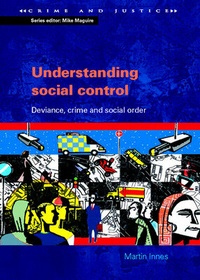
Understanding Social Control
Published on 1. December 2003
Book
Other book format
978-0-335-22588-0 (ISBN)
Unfortunately, price unknown
Available (delivery time upon request)
Not available
Description
*Provides a clear, yet panoramic analysis of how the concept of social control has been used by different theoretical traditions in the social sciences.
*Connects contemporary changes in areas such as policing, penal systems and surveillance, with wider and deeper changes in the constitution of society.
*Employs empirical examples to illustrate key conceptual points.
*Develops an innovative argument about the nature and scope of social control in late-modern societies.
Understanding Social Control investigates how the concept of social control has been used to capture the ways in which individuals, communities and societies respond to a variety of forms of deviant behaviour. In so doing, the book demonstrates how an appreciation of the meanings of the concept of social control is vital to understanding the dynamics and trajectories of social order in contemporary late-modern societies. Through an analysis of a range of different modes of social control including: policing, imprisonment, surveillance, risk management, audit and architecture, this book explores how and why the mechanisms and processes of social control are changing. The book will be of interest to those studying courses in criminology and the social sciences, researchers with interests in the sociology of deviance and social control, and readers who want to understand the social forces that are shaping the world they live in.
*Connects contemporary changes in areas such as policing, penal systems and surveillance, with wider and deeper changes in the constitution of society.
*Employs empirical examples to illustrate key conceptual points.
*Develops an innovative argument about the nature and scope of social control in late-modern societies.
Understanding Social Control investigates how the concept of social control has been used to capture the ways in which individuals, communities and societies respond to a variety of forms of deviant behaviour. In so doing, the book demonstrates how an appreciation of the meanings of the concept of social control is vital to understanding the dynamics and trajectories of social order in contemporary late-modern societies. Through an analysis of a range of different modes of social control including: policing, imprisonment, surveillance, risk management, audit and architecture, this book explores how and why the mechanisms and processes of social control are changing. The book will be of interest to those studying courses in criminology and the social sciences, researchers with interests in the sociology of deviance and social control, and readers who want to understand the social forces that are shaping the world they live in.
More details
Content
Series editor's foreword
The argument
A history of the idea of social control
A history of social control practice
Everyday order
Policing
Punishing
Surveillance
The architecture of social control
Risk, regulation, audit
Conclusion
Index.
The argument
A history of the idea of social control
A history of social control practice
Everyday order
Policing
Punishing
Surveillance
The architecture of social control
Risk, regulation, audit
Conclusion
Index.