

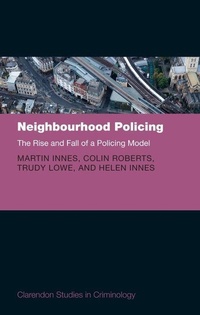
Neighbourhood Policing
The Rise and Fall of a Policing Model
Published on 28. May 2020
Book
Hardback
278 pages
978-0-19-878321-3 (ISBN)
Description
Neighbourhood policing is one of the most significant and high profile innovations in UK policing in recent times. It has also been one of the most successful, garnering widespread political and public support for its objectives and the processes of policing that it has sought to embed. Indeed, it has recently been described as the 'bedrock' of the British policing model. But it was not always so lauded. At the time of its initial development it encountered considerable opposition and scepticism from both within and outside of the police.
This book tells the story of how and why the neighbourhood policing model was originally designed and implemented, and then, what has led to a decline in its prominence in terms of everyday police practice. To do this, Neighbourhood Policing draws upon unparalleled empirical data from the authors' ten-year programme of research to provide unique and compelling insights into the key practices and processes associated with the concept and implementation of neighbourhood policing. The chapters describe how: key processes and practices have evolved and matured; the ways neighbourhood policing delivers a range of local policing services; as well as how, in some towns and cities, it has provided a platform for tackling violent extremism and organised crime. This approach is used to set out a broader analytic frame that addresses the conditions under which innovative policing models emerge, are developed and decline. In so doing, the book engages with wider and deeper questions about the police function in contemporary society.
This book tells the story of how and why the neighbourhood policing model was originally designed and implemented, and then, what has led to a decline in its prominence in terms of everyday police practice. To do this, Neighbourhood Policing draws upon unparalleled empirical data from the authors' ten-year programme of research to provide unique and compelling insights into the key practices and processes associated with the concept and implementation of neighbourhood policing. The chapters describe how: key processes and practices have evolved and matured; the ways neighbourhood policing delivers a range of local policing services; as well as how, in some towns and cities, it has provided a platform for tackling violent extremism and organised crime. This approach is used to set out a broader analytic frame that addresses the conditions under which innovative policing models emerge, are developed and decline. In so doing, the book engages with wider and deeper questions about the police function in contemporary society.
Reviews / Votes
engaging ... this book provides a rare insight into an internationally important community policing model. For those passionate about community and neighbourhood policing, this is a treat. * Caroline Hay & Peter Neyroud, Criminal Law and Criminal Justice Books *More details
Series
Language
English
Place of publication
Oxford
United Kingdom
Target group
Professional and scholarly
Product notice
sewn/stitched
Cloth over boards
Dimensions
Height: 211 mm
Width: 137 mm
Thickness: 25 mm
Weight
499 gr
ISBN-13
978-0-19-878321-3 (9780198783213)
Copyright in bibliographic data and cover images is held by Nielsen Book Services Limited or by the publishers or by their respective licensors: all rights reserved.
Schweitzer Classification
Other editions
Additional editions
Martin Innes | Colin Roberts | Trudy Lowe
Neighbourhood Policing
The Rise and Fall of a Policing Model
E-Book
05/2020
1st Edition
OUP eBook
€58.49
Available for download
Martin Innes | Colin Roberts | Trudy Lowe
Neighbourhood Policing
The Rise and Fall of a Policing Model
E-Book
05/2020
1st Edition
OUP eBook
€58.49
Available for download
Persons
Martin Innes is a Professor in the School of Social Sciences. He is Director of the Universities' Police Science Institute (www.upsi.org.uk) and is recognised as one of the world's leading authorities on policing and social control.
Dr Colin Roberts is a member of the Universities' Police Science Institute at Cardiff University.
Ms Trudy Lowe is a Research Fellow at the Universities' Police Science Institute at Cardiff University. She was also a Research Fellow for the Signal Crimes Research team throughout the National Reassurance Policing Programme and contributed to the development of i-NSI, an operational methodology for the collection and analysis of signal crimes within communities.
Dr Helen Innes is a Research Associate at the Universities' Police Science Institute at Cardiff University.
Dr Colin Roberts is a member of the Universities' Police Science Institute at Cardiff University.
Ms Trudy Lowe is a Research Fellow at the Universities' Police Science Institute at Cardiff University. She was also a Research Fellow for the Signal Crimes Research team throughout the National Reassurance Policing Programme and contributed to the development of i-NSI, an operational methodology for the collection and analysis of signal crimes within communities.
Dr Helen Innes is a Research Associate at the Universities' Police Science Institute at Cardiff University.
Content
1: The Public Understanding of Crime and Policing
2: Reassurance Policing
3: Neighbourhood Problems and Problem Neighbourhoods
4: Neighbourhood Policing Policy Development
5: Policing Neighbourhoods: The Work of Neighbourhood Teams
6: The Cardiff Community Engagement Field Experiment
7: Seeing Like a Citizen: A Six Year Study of Sutton
8: Above and Beyond the Neighbourhood: Serious Organised Crime and Counter-Terrorism
9: Disinvestment and How Neighbourhood Policing Ends
10: Policing Fashions: How Ideas Gain and Lose Power
Appendix: Research Design and Methods
2: Reassurance Policing
3: Neighbourhood Problems and Problem Neighbourhoods
4: Neighbourhood Policing Policy Development
5: Policing Neighbourhoods: The Work of Neighbourhood Teams
6: The Cardiff Community Engagement Field Experiment
7: Seeing Like a Citizen: A Six Year Study of Sutton
8: Above and Beyond the Neighbourhood: Serious Organised Crime and Counter-Terrorism
9: Disinvestment and How Neighbourhood Policing Ends
10: Policing Fashions: How Ideas Gain and Lose Power
Appendix: Research Design and Methods