

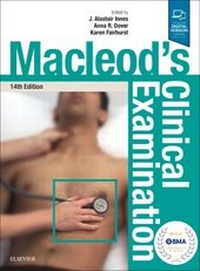
Macleod's Clinical Examination
14th Edition
Published on 11. June 2018
Book
Paperback/Softback
400 pages
978-0-7020-6993-2 (ISBN)
Description
This classic textbook aims to assist clinicians develop the consultation skills required to elicit a clear history, and the practical skills needed to detect clinical signs of disease. Where possible, the physical basis of clinical signs is explained to aid understanding. Formulation of a differential diagnosis from the information gained is introduced, and the logical initial investigations are included for each system.
The first part of the book addresses the general principles of good interaction with patients, from the basics of taking a history and examining, to the use of pattern recognition to identify spot diagnoses.
The second part documents the relevant history, examination and investigations for all the major body systems.
The third part illustrates the application of these skills to specific clinical situations.
The final part covers preparation for assessments of clinical skills and the use of these skills in everyday practice.
The book has accompanying videos demonstrating many of the key clinical examination routines as set out in the book.
A new editorial team has undertaken a substantial review of the book's contents and with the help of many new authors has radically revised the order and approach of the text.
Several new chapters have been created including a chapter on patients with mental disorders; a chapter covering the approach to a deteriorating patient; a chapter on assessment of patients towards the end of life and two new chapters on applying the key clinical skills during assessments and in practice.
The structure of the text has been rationalised with careful use of boxes, tables and figures to set out the concepts for maximum clarity.
The first part of the book addresses the general principles of good interaction with patients, from the basics of taking a history and examining, to the use of pattern recognition to identify spot diagnoses.
The second part documents the relevant history, examination and investigations for all the major body systems.
The third part illustrates the application of these skills to specific clinical situations.
The final part covers preparation for assessments of clinical skills and the use of these skills in everyday practice.
The book has accompanying videos demonstrating many of the key clinical examination routines as set out in the book.
A new editorial team has undertaken a substantial review of the book's contents and with the help of many new authors has radically revised the order and approach of the text.
Several new chapters have been created including a chapter on patients with mental disorders; a chapter covering the approach to a deteriorating patient; a chapter on assessment of patients towards the end of life and two new chapters on applying the key clinical skills during assessments and in practice.
The structure of the text has been rationalised with careful use of boxes, tables and figures to set out the concepts for maximum clarity.
More details
Edition
14th edition
Language
English
Place of publication
London
United Kingdom
Target group
College/higher education
Illustrations
Approx. 443 illustrations (409 in full color); Illustrations
Dimensions
Height: 264 mm
Width: 195 mm
Weight
980 gr
ISBN-13
978-0-7020-6993-2 (9780702069932)
Copyright in bibliographic data and cover images is held by Nielsen Book Services Limited or by the publishers or by their respective licensors: all rights reserved.
Schweitzer Classification
Other editions
New editions
Anna R. Dover | J. Alastair Innes | Karen Fairhurst
Macleod's Clinical Examination
Book
04/2023
15th Edition
Elsevier
€56.00
Available immediately
Additional editions
J. Alastair Innes | Anna R. Dover | Karen Fairhurst
Macleod's Clinical Examination
E-Book
03/2018
14th Edition
Elsevier
€40.99
Available for download
Previous edition
Graham Douglas | Fiona Nicol | Colin Robertson
Macleod's Clinical Examination
With STUDENT CONSULT Online Access
Book
06/2013
13th Edition
Churchill Livingstone
€73.22
Article exhausted; check for reprint
Persons
Editor
Consultant Physician, Respiratory Unit, Western General Hospital, Edinburgh; Honorary Reader in Respiratory Medicine, University of Edinburgh, UK
Consultant in Diabetes, Endocrinology and General Medicine, Edinburgh Centre for Endocrinology and Diabetes, Royal Infirmary of Edinburgh; Honorary Clinical Senior Lecturer, University of Edinburgh, UK
General Practice Principal, Mackenzie Medical Centre, Edinburgh; Clinical Senior Lecturer, Centre for Population Health Sciences, University of Edinburgh, UK
Content
Section 1: Principles of clinical history and examination
Managing clinical encounters with patients
General aspects of history taking
The value of initial observations
Section 2: System based examination
The cardiovascular system
The respiratory system
The gastrointestinal system
The nervous system
The visual system
The ear, nose & throat
The endocrine system
The reproductive system
The renal system
The musculoskeletal system
The skin, hair and nails
Section 3: Applying history and examination skills in specific situations
Babies and Children
Patients with mental illness and learning disability
The frail elderly
Examining the deteriorating patient
History and examination towards the end of life
Section 4: Putting History and Examination skills to Use
Preparing for assessments of clinical skills
Preparing for practice
Managing clinical encounters with patients
General aspects of history taking
The value of initial observations
Section 2: System based examination
The cardiovascular system
The respiratory system
The gastrointestinal system
The nervous system
The visual system
The ear, nose & throat
The endocrine system
The reproductive system
The renal system
The musculoskeletal system
The skin, hair and nails
Section 3: Applying history and examination skills in specific situations
Babies and Children
Patients with mental illness and learning disability
The frail elderly
Examining the deteriorating patient
History and examination towards the end of life
Section 4: Putting History and Examination skills to Use
Preparing for assessments of clinical skills
Preparing for practice