

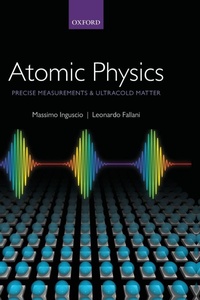
Atomic Physics: Precise Measurements and Ultracold Matter
Published on 19. September 2013
Book
Hardback
352 pages
978-0-19-852584-4 (ISBN)
Description
This book illustrates the history of Atomic Physics and shows how its most recent advances allow the possibility of performing precise measurements and achieving an accurate control on the atomic state. Written in an introductory style, this book is addressed to advanced undergraduate and graduate students, as well as to more experienced researchers who need to remain up-to-date with the most recent advances. The book focuses on experimental investigations, illustrating milestone experiments and key experimental techniques, and discusses the results and the challenges of contemporary research. Emphasis is put on the investigations of precision physics: from the determination of fundamental constants of Nature to tests of General Relativity and Quantum Electrodynamics; from the realization of ultra-stable atomic clocks to the precise simulation of condensed matter theories with ultracold gases. The book discusses these topics while tracing the evolution of experimental Atomic Physics from traditional laser spectroscopy to the revolution introduced by laser cooling, which allows the manipulation of atoms at a billionth of a degree above absolute zero and reveals new frontiers of precision in atomic spectroscopy.
Reviews / Votes
The book is perfect for an advanced readership, as well as for a specialized PhD school. For the atomic physics community it offers a very timely and useful assembly of the present state of knowledge on very hot research topics. * E. Arimondo, Il Nuovo Saggiatore * This book illuminates the extraordinary evolution of atomic physics during the past decades, and it leads the reader to the fast-moving frontier of current research. The text conveys the fascination and excitement of the field through the eyes of pioneering researchers, so that it can provide inspiration to students and seasoned colleagues alike. * From the Foreword by Theodor W. Haensch, Ludwig Maximilian University of Munich * Atomic Physics provides an expert guide to two spectacular new landscapes in physics: precision measurements, which have been revolutionized by the advent of the optical frequency comb, and atomic physics, which has been revolutionized by laser cooling. These advances are not incremental but transformative: they have generated a consilience between atomic and many-body physics, precipitated an explosion of scientific and technological applications, opened new areas of research, and attracted a brilliant generation of younger scientists. The research is advancing so rapidly, the barrage of applications is so dazzling, that students can be bewildered. For both students and experienced scientists, this book provides an invaluable description of basic principles, experimental methods, and scientific applications. * Daniel Kleppner, Massachusetts Institute of Technology *More details
Language
English
Place of publication
Oxford
United Kingdom
Target group
College/higher education
- Advanced undergraduate and graduate students in physics
- Researchers who want to remain up-to-date with the recent advancements in atomic physics
Illustrations
146 b/w illustrations
Dimensions
Height: 260 mm
Width: 183 mm
Thickness: 23 mm
Weight
850 gr
ISBN-13
978-0-19-852584-4 (9780198525844)
Copyright in bibliographic data and cover images is held by Nielsen Book Services Limited or by the publishers or by their respective licensors: all rights reserved.
Schweitzer Classification
Other editions
Additional editions
Book
01/2018
Oxford University Press
€49.59
Shipment within 15-20 days
Persons
Massimo Inguscio has worked as an Assistant Professor in Physics at Universities of Pisa and Lecce (1976-1980), Associated Professor at University of Pisa (1980-1986), and Full Professor in Physics at Universities of Napoli (1986-1990) and Firenze (since 1991). He has served as director of LENS (European Laboratory for Nonlinear Spectroscopy) and of the Department for Materials and Devices of CNR (National Research Council). He has a long-standing experience of experimental research in atomic, molecular and optical physics, quantum optics, light-matter interaction, laser cooling, quantum simulation with ultracold quantum gases, and the development of spectroscopic instrumentation. For his research he has been awarded several prizes, including the Humboldt Research Award (2004), the "Enrico Fermi" Prize from Italian Physical Society (2004), and the Grand Prix Scientifique de l'Academie de Sciences de l'Institut de France (2005).
Leonardo Fallani obtained his PhD in Physics from the University of Florence in 2005, and now works as an Assistant Professor in Physics at University of Florence (since 2007). He has long-standing experience of experimental research in atomic physics, high-precision spectroscopy, nonlinear optics, laser cooling, and quantum simulation with ultracold quantum gases. He is the author of more than 40 publications in international journals and books (with more than 1500 citations and h-index 17) and editor of 1 book.
Leonardo Fallani obtained his PhD in Physics from the University of Florence in 2005, and now works as an Assistant Professor in Physics at University of Florence (since 2007). He has long-standing experience of experimental research in atomic physics, high-precision spectroscopy, nonlinear optics, laser cooling, and quantum simulation with ultracold quantum gases. He is the author of more than 40 publications in international journals and books (with more than 1500 citations and h-index 17) and editor of 1 book.
Content
1. Hydrogen ; 2. Alkali atoms and laser cooling ; 3. Bose-Einstein condensation ; 4. Helium ; 5. Alkaline-earth atoms and ions ; 6. Optical lattices and precise measurements ; 7. Optical lattices and quantum simulation ; Appendix A: Atom-light interaction ; Appendix B: Laser optics ; Appendix C: Bose-Einstein condensation ; Appendix D: Constants and units