

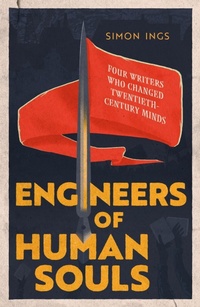
Engineers of Human Souls
Four Writers Who Changed Twentieth-Century Minds
Published on 30. January 2025
Book
Paperback/Softback
368 pages
978-0-349-12859-7 (ISBN)
Description
Four writers. Four dictators. One world, changed out of all recognition. ENGINEERS OF HUMAN SOULS is an intimate and shocking shadow history of creative vanity in a time that turned writers - once the faithful servants of authority - into figures of political consequence.
Maurice Barres, who first wielded the politics of identity. Gabriele D'Annunzio, whose poetry became a blueprint for fascism. Maxim Gorky, dramatist of the working class and Stalin's cheerleader. The Maoist Ding Ling, whose stories exculpated the regime that kept her imprisoned.
All four nursed extravagant visions of the future, and believed they were vital to its realisation. Each was lured to the centre of political action. Each established a dangerous and damaging relationship with a notorious dictator. And when writers and rulers find a use for each other, the consequences can be shattering for us all. These stories - of courage and compromise, vanity and malevolence - speak urgently to the uncontrollable power of words.
Maurice Barres, who first wielded the politics of identity. Gabriele D'Annunzio, whose poetry became a blueprint for fascism. Maxim Gorky, dramatist of the working class and Stalin's cheerleader. The Maoist Ding Ling, whose stories exculpated the regime that kept her imprisoned.
All four nursed extravagant visions of the future, and believed they were vital to its realisation. Each was lured to the centre of political action. Each established a dangerous and damaging relationship with a notorious dictator. And when writers and rulers find a use for each other, the consequences can be shattering for us all. These stories - of courage and compromise, vanity and malevolence - speak urgently to the uncontrollable power of words.
Reviews / Votes
An utterly thrilling and intellectually revelatory book. At a time when everything seems to be in freefall, and we are all trying to make sense of who we should be in a time of crisis, this is a stunningly wise book. If you read it, you'll learn about some of the deepest questions human beings can ask - and get closer to the answers -- Johann Hari A compelling new book by Simon Ings about the corrupting effect of power on literary talent -- Thomas W. Hodgkinson * Spectator * Ings gives his readers a concise round-up of the intellectual ground in which the twentieth-century dictatorships took root. He has a talent for succinct statements so well turned that they immediately ring true ... His openings are arrestingly quirky. He cleverly leaves out the boring bits to offer the reader a staccato sequence of telling vignettes. His tone - by turns breezy and bitterly sardonic - is engaging ... Rather than plod through the welter of historical facts, he skips lightly from resonant incident to ringing quotation. His put-downs are trenchant, his asides witty, his exposition of political theory is clear and concise ... his book is enlightening and surprisingly entertaining -- Lucy Hughes-Hallett * New Statesman * [Ings is] the perfect guide to this peculiar selection of odd and ambitious writers ... there are brilliant novelistic flourishes throughout as he frantically blurs the boundaries between fiction and non-fiction ... There's enough material in the vignettes alone for about four different books. Instead, we get just this one wild ride -- Ian Sansom * Spectator *More details
Language
English
Place of publication
London
United Kingdom
Publishing group
Little, Brown Book Group
Dimensions
Height: 127 mm
Width: 198 mm
Thickness: 26 mm
Weight
294 gr
ISBN-13
978-0-349-12859-7 (9780349128597)
Copyright in bibliographic data and cover images is held by Nielsen Book Services Limited or by the publishers or by their respective licensors: all rights reserved.
Schweitzer Classification
Other editions
Additional editions
E-Book
01/2024
The Bridge Street Press
€3.99
Available for download
Person
Simon Ings is the author of eight novels and two works of non-fiction, including the Baillie Gifford longlisted Stalin and the Scientists. He co-founded and edited Arc magazine, a digital publication about the future, before joining New Scientist magazine as its arts editor. He writes a monthly science-fiction column and reviews for The Times, in addition to reviews for the Financial Times, Telegraph, The Spectator and others.