

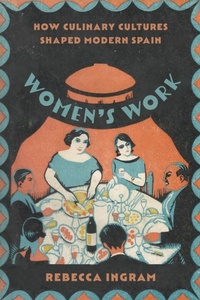
Women's Work
How Culinary Cultures Shaped Modern Spain
Published on 15. September 2022
Book
Paperback/Softback
220 pages
978-0-8265-0489-0 (ISBN)
Description
We are living a moment in which famous chefs, Michelin stars, culinary techniques, and gastronomical accolades attract moneyed tourists to Spain from all over the world. This has prompted the Spanish government to declare its cuisine as part of Spanish patrimony.
Yet even with this widespread global attention, we know little about how Spanish cooking became a litmus test for demonstrating Spain's modernity and, in relation, the roles ascribed to the modern Spanish women responsible for daily cooking. Efforts to articulate a new, modern Spain infiltrated writing in multiple genres and media. Women's Work places these efforts in their historical context to yield a better understanding of the roles of food within an inherently uneven modernization process. Further, the book reveals the paradoxical messages women have navigated, even in texts about a daily practice that shaped their domestic and work lives. This argument is significant because of the degree to which domestic activities, including cooking, occupied women's daily lives, even while issues like their fitness as citizens and participation in the public sphere were hotly debated. At the same time, progressive intellectuals from diverse backgrounds began to invoke Spanish cooking and eating as one measure of Spanish modernity.
Women's Work shows how culinary writing engaged these debates and reached women at the site of much of their daily labor-the kitchen-and, in this way, shaped their thinking about their roles in modernizing Spain.
Yet even with this widespread global attention, we know little about how Spanish cooking became a litmus test for demonstrating Spain's modernity and, in relation, the roles ascribed to the modern Spanish women responsible for daily cooking. Efforts to articulate a new, modern Spain infiltrated writing in multiple genres and media. Women's Work places these efforts in their historical context to yield a better understanding of the roles of food within an inherently uneven modernization process. Further, the book reveals the paradoxical messages women have navigated, even in texts about a daily practice that shaped their domestic and work lives. This argument is significant because of the degree to which domestic activities, including cooking, occupied women's daily lives, even while issues like their fitness as citizens and participation in the public sphere were hotly debated. At the same time, progressive intellectuals from diverse backgrounds began to invoke Spanish cooking and eating as one measure of Spanish modernity.
Women's Work shows how culinary writing engaged these debates and reached women at the site of much of their daily labor-the kitchen-and, in this way, shaped their thinking about their roles in modernizing Spain.
Reviews / Votes
This book moves existing scholarship to not only value women's and gendered work and the bodies (and subjectivities) that perform this labor, but also calls our attention to how the study and acknowledgment of feminist movements and feminist studies in Spain are not aligned with first-wave feminism."-H. Rosi Song, coauthor of A Taste of Barcelona: The History of Catalan Cooking and Eating"Clean and concise; it's a tight book without any filler that does what it sets out to do. This is great cultural studies work and rich scholarship. Ingram is to be congratulated for expanding our understanding of gendered (food)work in Spain during the early twentieth century."-Robert A. Davidson, author of Jazz Age Barcelona
More details
Language
English
Place of publication
Tennessee
United States
Target group
Professional and scholarly
Illustrations
7 b&w images
Dimensions
Height: 229 mm
Width: 152 mm
Thickness: 13 mm
Weight
365 gr
ISBN-13
978-0-8265-0489-0 (9780826504890)
Copyright in bibliographic data and cover images is held by Nielsen Book Services Limited or by the publishers or by their respective licensors: all rights reserved.
Schweitzer Classification
Other editions
Additional editions
E-Book
09/2022
1st Edition
Vanderbilt University Press
€48.99
Available for download
Person
Rebecca Ingram is a professor of Spanish at the University of San Diego.
Content
Acknowledgments
Introduction
1. Emilia Pardo BazAn: Culinary Nationalist and Ambivalent Feminist
2. Frivolous and Feminist: Carmen de Burgos's Culinary-Political Platform
3. Mythologies of Culinary Modernity: Gregorio MaraNOn and Nicolasa Pradera
4. Cooking and Civic Virtue: Women, Work, and Barcelona
Conclusion: Feminist Food Studies and Spain
Bibliography
Index
Introduction
1. Emilia Pardo BazAn: Culinary Nationalist and Ambivalent Feminist
2. Frivolous and Feminist: Carmen de Burgos's Culinary-Political Platform
3. Mythologies of Culinary Modernity: Gregorio MaraNOn and Nicolasa Pradera
4. Cooking and Civic Virtue: Women, Work, and Barcelona
Conclusion: Feminist Food Studies and Spain
Bibliography
Index