

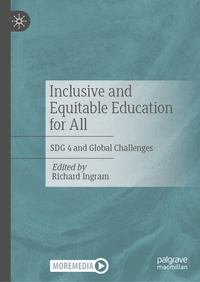
Inclusive and Equitable Education for All
Description
This edited book brings together researchers, partners, Ministry staff, disability activists, teachers, and influential commentators to present a constructive dialogue around the opportunities associated with inclusive and equitable education. Contributors from the Global North and South draw on their own lived experiences of education systems to argue for transformative and meaningful change within them. By contextualising educational issues within the wider push for sustainable development, inclusive and equitable education is presented as not only an ethical necessity, but as a practical way to benefit every learner, to build more accepting societies, and to tackle key global challenges.
This edition also includes an audio version of Chapter 1.
Reviews / Votes
"Education for All is a simple concept, a simple commitment, but sadly, a promise that simply isn't being met. This book presents a compelling argument that slow, incremental expansion of education systems, of the kind the international community has supported in recent decades, is not the path to EFA. Too many children will always be left on the margins and technological developments such as AI are accelerating exclusion...Surprisingly, almost unexpectedly, this is a book about optimism. It argues that when education systems embrace and build on diversity, an opportunity mindset can emerge, with Education for All again within our reach (and none too soon for a world that is facing the extraordinary challenges of rapid climate change and escalating conflicts)." (Robert Prouty, former head of Global Partnership for Education)
"I'm honoured to support Richard Ingram's important new book, which brings together a powerful and diverse group of global leaders committed to inclusive education. With contributors representing ministries, universities, and organisations across the UK, US, India, Eswatini, Portugal, Kenya, Austria, and beyond, this work reflects a shared vision for a more equitable world. I'm especially proud that Puneet Singh Singhal, my CMO at Billion Strong and founder of Green Disability in India, has authored a chapter. His voice-and the voices of all contributors-add depth, urgency, and humanity to this essential publication. This book is not just a resource; it is a catalyst for change." (Debra Ruh, CEO Ruh Global IMPACT, Co-Founder Billion Strong, Life For Relief and Development Partner)
"Few books manage to speak across continents, disciplines, and perspectives with such clarity and conviction. This volume gathers an extraordinary array of contributors from policymakers to practitioners to illuminate inclusion not as a technical fix, but as a moral architecture for education in an increasingly volatile world. Its essays resist abstraction; instead, they fuse scholarly insight with lived realities, rendering inclusion both intellectually robust and pragmatically accessible. What emerges is a vision of education as both sanctuary and catalyst; a place where diversity is not tolerated, but generatively centred. For anyone grappling with the complexities of systems change, this is an indispensable and deeply human guide. A must read for any inclusionista!" (Daniel Sobel, Founder and President of the World Inclusion Congress, Chair of the International Forums of Inclusion Practitioners (IFIP))
More details
Other editions
Additional editions
Person
Richard Ingram is based at the School of Education at the University of Exeter, UK, where he specialises in inclusive education and systems thinking. He has also worked with high profile international organisations, including UNESCO, UNICEF, and the World Bank.
Content
Part 1: Why we all need inclusive education.- Chapter 1: Introduction, Richard Ingram (Ed) Inclusive education; global challenges; systems thinking.- Chapter 2: Wither education Matthew Schuelka.- Education purpose; inclusive education.- Chapter 3: From special education to inclusive education, David Rodrigues.- Inclusive education; special needs education.- Chapter 4: Diversity and belonging in education, Puneet Singh Singhal.- Diversity and schooling; disability inclusion; inclusive education.- Chapter 5: Climate change and inclusive education, Sarah Beardmore.- Climate change; climate education; education system change.- Chapter 6: Inclusive and engaging lessons are better for all students, Xammie Likoko.- Inclusive pedagogy; inclusive education; inclusive science teaching.- Part 2: Transforming education systems.- Chapter 7: Inclusion and equity in education: Pathways for reform, Mel Ainscow.- Education system change; inclusive education.- Chapter 8: Disruptive innovations: An inside-out systems argument, Christopher Johnstone, Sheldon Berman, and Jackie Jodl.- Inclusive education; systems thinking; education systems change.- Chapter 9: Harnessing hidden curriculum, school culture, and inclusivity to transform teaching and learning, Vikas Pota.- School culture; inclusive education; hidden curricula.- Chapter 10: Putting inclusive principles into practice to improve student self-belief and learning: Insights and models that teachers can easily apply, Leo Thompson.- Inclusive pedagogies; inclusive education; learner self-belief.- Chapter 11: The role of NGOs in fostering change and promoting inclusion, Imran Khan.- Inclusive education; non-governmental organisations; education systems change.- Chapter 12: The role of parents and communities in the promotion of inclusive education: The case of Zimbabwe, Pedzisai Mangayi.- Education change; community allies; disability inclusion.- Chapter 13: Democratising inclusion, Brahm Norwich.- Inclusive education; deliberative democracy; community engagement.- Chapter 14: Inclusive EdTech: Opportunities and considerations, Julia McGeown.- Inclusive education; inclusive EdTech; education technology.- Chapter 15: Advocating for inclusive education in Eswatini: A journey of personal discovery, Cebsile Nxumalo.- Education advocacy; inclusive education.- Chapter 16: Conclusion: A call to action, Richard Ingram (Ed).- Inclusive education; education system change.