

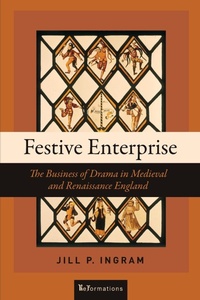
Festive Enterprise
The Business of Drama in Medieval and Renaissance England
Published on 15. March 2021
Book
Paperback/Softback
260 pages
978-0-268-10909-7 (ISBN)
Description
Festive Enterprise reveals marketplace pressures at the heart of dramatic form in medieval and Renaissance drama.
In Festive Enterprise, Jill P. Ingram merges the history of economic thought with studies of theatricality and spectatorship to examine how English Renaissance plays employed forms and practices from medieval and traditional entertainments to signal the expectation of giving from their audiences. Resisting the conventional divide between medieval and Renaissance, Festive Enterprise takes a trans-Reformation view of dramaturgical strategies, which reflected the need to generate both income and audience assent. By analyzing a wide range of genres (such as civic ceremonial, mummings, interludes, scripted plays, and university drama) and a diverse range of venues (including great halls, city streets, the Inns of Court, and public playhouses), Ingram demonstrates how early moderns borrowed medieval money-gatherers' techniques to signal communal obligations and rewards for charitable support of theatrical endeavors. Ingram shows that economics and drama cannot be considered as separate enterprises in the medieval and Renaissance periods. Rather, marketplace pressures were at the heart of dramatic form in medieval and Renaissance drama alike.
Festive Enterprise is an original study that traces how economic forces drove creativity in drama from medieval civic processions and guild cycle plays to the early Renaissance. It will appeal to scholars of medieval and early modern drama, theater historians, religious historians, scholars of Renaissance drama, and students in English literature, drama, and theater.
In Festive Enterprise, Jill P. Ingram merges the history of economic thought with studies of theatricality and spectatorship to examine how English Renaissance plays employed forms and practices from medieval and traditional entertainments to signal the expectation of giving from their audiences. Resisting the conventional divide between medieval and Renaissance, Festive Enterprise takes a trans-Reformation view of dramaturgical strategies, which reflected the need to generate both income and audience assent. By analyzing a wide range of genres (such as civic ceremonial, mummings, interludes, scripted plays, and university drama) and a diverse range of venues (including great halls, city streets, the Inns of Court, and public playhouses), Ingram demonstrates how early moderns borrowed medieval money-gatherers' techniques to signal communal obligations and rewards for charitable support of theatrical endeavors. Ingram shows that economics and drama cannot be considered as separate enterprises in the medieval and Renaissance periods. Rather, marketplace pressures were at the heart of dramatic form in medieval and Renaissance drama alike.
Festive Enterprise is an original study that traces how economic forces drove creativity in drama from medieval civic processions and guild cycle plays to the early Renaissance. It will appeal to scholars of medieval and early modern drama, theater historians, religious historians, scholars of Renaissance drama, and students in English literature, drama, and theater.
Reviews / Votes
Indeed, as an innovative, deeply detailed study of Renaissance drama's interrelation with pre-commercial economic practices, Festive Enterprise deserves much applause: it reveals the humanity and sense of community in the rise of theatrical commercialism. -Journal of British Studies"The virtue of Festive Enterprise is to situate famous plays from the era in a detailed historical context that helps to illuminate the achievement of Shakespeare and some of his better-known contemporaries. It's a solid and significant contribution to the scholarship of medieval and Renaissance drama in England." -Paul A. Cantor, author of Shakespeare's Roman Trilogy
"Economically and precisely expressed, packed full of detail and useful information, and consistently lively and entertaining." -The English Historical Review
More details
Series
Edition
New edition
Language
English
Place of publication
Notre Dame IN
United States
Target group
Professional and scholarly
Edition type
New edition
Illustrations
- 6 Illustrations, black and white
Dimensions
Height: 229 mm
Width: 152 mm
Thickness: 14 mm
Weight
382 gr
ISBN-13
978-0-268-10909-7 (9780268109097)
Copyright in bibliographic data and cover images is held by Nielsen Book Services Limited or by the publishers or by their respective licensors: all rights reserved.
Schweitzer Classification
Other editions
Additional editions
E-Book
03/2021
University of Notre Dame Press
from
€96.99
Available for download
Person
Jill P. Ingram is associate professor of English at Ohio University. She is the editor of the New Kittredge edition of Shakespeare's Love's Labour's Lost and author of Idioms of Self-Interest: Credit, Identity, and Property in English Renaissance Literature.
Content
Introduction
1. The Festive Gatherer and the Empathetic Thief: The Genealogy of a Character
2. Forms of Investment: Mummings, Prologues and Epilogues
3. Reconciliation in The Winter's Tale: Devotion and Commerce from Guilds to Church Ales
4. The Mobile Entertainer: John Taylor's Penniless Pilgrimage
5. Coding Complaint in Gesta Grayorum and The Christmas Prince
6. "A Jest's Prosperity": The Market, Marprelate, and Love's Labour's Lost
Conclusion
1. The Festive Gatherer and the Empathetic Thief: The Genealogy of a Character
2. Forms of Investment: Mummings, Prologues and Epilogues
3. Reconciliation in The Winter's Tale: Devotion and Commerce from Guilds to Church Ales
4. The Mobile Entertainer: John Taylor's Penniless Pilgrimage
5. Coding Complaint in Gesta Grayorum and The Christmas Prince
6. "A Jest's Prosperity": The Market, Marprelate, and Love's Labour's Lost
Conclusion