

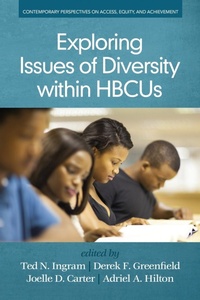
Exploring Issues of Diversity within HBCUs
Published on 1. July 2015
Book
Paperback/Softback
350 pages
978-1-68123-098-6 (ISBN)
Description
The purpose of this edited volume is to examine the historical and contemporary dynamics of diversity as well as the realities, challenges, and opportunities associated with diversity work at Historically Black Colleges and Universities (HBCUs). This proposed book will include four sections, focusing on the historical developments and socio-political factors impacting diversity work at HBCUs, organizational structure and philosophical approaches, challenges and opportunities facing particular populations, and analysis of best practices.
This text is designed to provide an overview and better understanding of diversity and multiculturalism that exists in historically Black colleges and universities. The contents of the text will examine equity and inclusion efforts in these institutions, and will explore various theories and practices utilized within the academy. Also, the text will examine race, class, gender, ethnicity, nationality, religion, age, ability and sexuality. The goal of the book is to assist students, faculty, and staff in the higher educational landscape in developing their own understandings of historical and contemporary issues related to diversity at HBCUs. Critical analysis of the multiple worldviews will be discussed as we explore the origin, nature and scope of multiple ideologies within diversity, equity and inclusion at HBCUs. In addition, this book will be an invaluable teaching resource for faculty in Educational Leadership Programs, Student Affairs Programs, or Sociology Programs, and other fields interested in issues of retaining and supporting diverse college students.
This text is designed to provide an overview and better understanding of diversity and multiculturalism that exists in historically Black colleges and universities. The contents of the text will examine equity and inclusion efforts in these institutions, and will explore various theories and practices utilized within the academy. Also, the text will examine race, class, gender, ethnicity, nationality, religion, age, ability and sexuality. The goal of the book is to assist students, faculty, and staff in the higher educational landscape in developing their own understandings of historical and contemporary issues related to diversity at HBCUs. Critical analysis of the multiple worldviews will be discussed as we explore the origin, nature and scope of multiple ideologies within diversity, equity and inclusion at HBCUs. In addition, this book will be an invaluable teaching resource for faculty in Educational Leadership Programs, Student Affairs Programs, or Sociology Programs, and other fields interested in issues of retaining and supporting diverse college students.
More details
Series
Language
English
Place of publication
Charlotte
United States
Publishing group
Emerald Publishing Inc
Target group
Professional and scholarly
Dimensions
Height: 234 mm
Width: 156 mm
Thickness: 19 mm
Weight
532 gr
ISBN-13
978-1-68123-098-6 (9781681230986)
Copyright in bibliographic data and cover images is held by Nielsen Book Services Limited or by the publishers or by their respective licensors: all rights reserved.
Schweitzer Classification
Other editions
Additional editions
Ted N. Ingram
Exploring Issues of Diversity within HBCUs
E-Book
01/2015
1st Edition
Information Age Publishing
from
€62.33
Available for download
Persons
Ted N. Ingram, Bronx Community College, USA
Joelle D. Carter, Western Kentucky University, USA
Adriel A. Hilton, Western Carolina University, USA
Chance W. Lewis, University of North Carolina at Charlotte, USA
Joelle D. Carter, Western Kentucky University, USA
Adriel A. Hilton, Western Carolina University, USA
Chance W. Lewis, University of North Carolina at Charlotte, USA
Content
Foreword: Exploring Issues of Diversity Within Historically Black Colleges and Universities.
Acknowledgements.
Chapter 1. The Skin I Am In: A Perspective on Diversity in Historically Black Colleges and Universities, John T. Wolfe, Jr.
Chapter 2. Rethinking the Diversity Paradigm in Higher Education: HBCUs and New Frameworks for Inclusion and Equity, Derek F. Greenfield.
Chapter 3. Re(Defining) the Diversity of HBCUs Beyond Race, John Michael Lee, Jr.
Chapter 4. The Contemporary Economic and Social Landscape of Historically Black Colleges and Universities, Monica Galloway Burke and Colin D. Cannonier.
Chapter 5. An Analysis of Diversity Work at HBCUs and PWIs, Joelle Carter and Wilmon A. Christian, III.
Chapter 6. Ethnic and Cultural Diversity at HBCUs and Its Impact on Students, Faculty, and Staff, Anita Nahal, Adrian Thompson, Mai Abdul Rahman, and Verna F. Orr.
Chapter 7. Aren't They All the Same?: Black Racial Identity at Historically Black Colleges and Universities, Jonathan M. Cox.
Chapter 8. More Cream in the Coffee: Diversity in the HBCU, Yoruba Mutakabbir, Rosemary B. Closson, and Wilma J. Henry.
Chapter 9. From Another Perspective: Perceptions of White Faculty of the Racial Climate at Black Colleges, Barbara J. Johnson, SaFiya D. Hoskins, and Timothy E. Johnson.
Chapter 10. A Three-Way Analysis of Diversity in HBCUs: Contemplating How Diversity of Methodologies and Researcher Backgrounds Influences Interpretations of Diversity Data, Aundria Green and Rachelle Winkle-Wagner.
Chapter 11. Sharecropping in Higher Education: A Case Study of the Florida Agricultural and Mechanical University-Florida State University Joint College of Engineering, Carl Darnell.
Chapter 12. Dedicated to Difference in a Sea of Similarity: HBCU Administrative Commitments to Diversity, Brian K. Bridges and Tracae M. McClure.
Chapter 13. The Way Forward: The Need for Continued Work and Continuing to Work at Framing the Diversity Agenda at HBCUs, Derek F. Greenfield and Douglas W. Curry.
Epilogue, Earl S. Richardson.
About the Editors.
About the Contributors.
Acknowledgements.
Chapter 1. The Skin I Am In: A Perspective on Diversity in Historically Black Colleges and Universities, John T. Wolfe, Jr.
Chapter 2. Rethinking the Diversity Paradigm in Higher Education: HBCUs and New Frameworks for Inclusion and Equity, Derek F. Greenfield.
Chapter 3. Re(Defining) the Diversity of HBCUs Beyond Race, John Michael Lee, Jr.
Chapter 4. The Contemporary Economic and Social Landscape of Historically Black Colleges and Universities, Monica Galloway Burke and Colin D. Cannonier.
Chapter 5. An Analysis of Diversity Work at HBCUs and PWIs, Joelle Carter and Wilmon A. Christian, III.
Chapter 6. Ethnic and Cultural Diversity at HBCUs and Its Impact on Students, Faculty, and Staff, Anita Nahal, Adrian Thompson, Mai Abdul Rahman, and Verna F. Orr.
Chapter 7. Aren't They All the Same?: Black Racial Identity at Historically Black Colleges and Universities, Jonathan M. Cox.
Chapter 8. More Cream in the Coffee: Diversity in the HBCU, Yoruba Mutakabbir, Rosemary B. Closson, and Wilma J. Henry.
Chapter 9. From Another Perspective: Perceptions of White Faculty of the Racial Climate at Black Colleges, Barbara J. Johnson, SaFiya D. Hoskins, and Timothy E. Johnson.
Chapter 10. A Three-Way Analysis of Diversity in HBCUs: Contemplating How Diversity of Methodologies and Researcher Backgrounds Influences Interpretations of Diversity Data, Aundria Green and Rachelle Winkle-Wagner.
Chapter 11. Sharecropping in Higher Education: A Case Study of the Florida Agricultural and Mechanical University-Florida State University Joint College of Engineering, Carl Darnell.
Chapter 12. Dedicated to Difference in a Sea of Similarity: HBCU Administrative Commitments to Diversity, Brian K. Bridges and Tracae M. McClure.
Chapter 13. The Way Forward: The Need for Continued Work and Continuing to Work at Framing the Diversity Agenda at HBCUs, Derek F. Greenfield and Douglas W. Curry.
Epilogue, Earl S. Richardson.
About the Editors.
About the Contributors.