

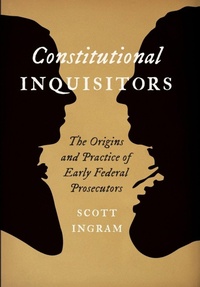
Constitutional Inquisitors
The Origins and Practice of Early Federal Prosecutors
Published on 26. September 2023
Book
Hardback
376 pages
978-1-4214-4686-8 (ISBN)
Description
The evolution of the federal prosecutor's role from a pragmatic necessity to a significant political figure.
In the United States, federal prosecutors enjoy a degree of power unmatched elsewhere in the world. They are free to investigate and prosecute-or decline to prosecute-criminal cases without significant oversight. And yet, no statute grants them these powers; their role is not mentioned in the Constitution. How did they obtain this power, and are they truly independent from the political process? In Constitutional Inquisitors, Scott Ingram answers these questions by tracing the origins and development of federal criminal law enforcement.
In the first book to examine the development of the federal law enforcement apparatus in the earliest part of the early republic, Ingram explains how federal prosecutors' roles began as an afterthought but quickly evolved into powerful political positions. He also addresses two long-held perceptions about early federal criminal prosecution: that prosecutors tried many more cases than historians thought and that the relationship between prosecution and executive power is much more complex and interwoven than commonly assumed.
Drawing on materials at the National Archives as well as correspondence and trial reports, Ingram explores the first federal criminal case, the first use of presidential pardon power, the first federal prosecution of a female, and the first interstate criminal investigation. He also discloses internal Administration discussions involving major criminal cases, including those arising from the Whiskey Insurrection, Neutrality Crisis, Alien and Sedition Acts, and Fries' Rebellion. As the United States grapples today with political divisions and arguments over who should be prosecuted for what, Constitutional Inquisitors reveals that these problems began with the creation of the federal prosecutor role and have continued as the role gained power.
In the United States, federal prosecutors enjoy a degree of power unmatched elsewhere in the world. They are free to investigate and prosecute-or decline to prosecute-criminal cases without significant oversight. And yet, no statute grants them these powers; their role is not mentioned in the Constitution. How did they obtain this power, and are they truly independent from the political process? In Constitutional Inquisitors, Scott Ingram answers these questions by tracing the origins and development of federal criminal law enforcement.
In the first book to examine the development of the federal law enforcement apparatus in the earliest part of the early republic, Ingram explains how federal prosecutors' roles began as an afterthought but quickly evolved into powerful political positions. He also addresses two long-held perceptions about early federal criminal prosecution: that prosecutors tried many more cases than historians thought and that the relationship between prosecution and executive power is much more complex and interwoven than commonly assumed.
Drawing on materials at the National Archives as well as correspondence and trial reports, Ingram explores the first federal criminal case, the first use of presidential pardon power, the first federal prosecution of a female, and the first interstate criminal investigation. He also discloses internal Administration discussions involving major criminal cases, including those arising from the Whiskey Insurrection, Neutrality Crisis, Alien and Sedition Acts, and Fries' Rebellion. As the United States grapples today with political divisions and arguments over who should be prosecuted for what, Constitutional Inquisitors reveals that these problems began with the creation of the federal prosecutor role and have continued as the role gained power.
More details
Language
English
Place of publication
Baltimore, MD
United States
Target group
Professional and scholarly
Product notice
sewn/stitched
Cloth over boards
With dust jacket
Dimensions
Height: 229 mm
Width: 152 mm
Thickness: 25 mm
Weight
721 gr
ISBN-13
978-1-4214-4686-8 (9781421446868)
DOI
10.56021/9781421446868
Copyright in bibliographic data and cover images is held by Nielsen Book Services Limited or by the publishers or by their respective licensors: all rights reserved.
Schweitzer Classification
Person
Scott Ingram is an associate professor of Criminal Justice at High Point University in High Point, North Carolina. He served as a prosecutor in the Circuit Attorney's Office in St. Louis and as an Assistant United States Attorney in the Southern District of Indiana.
Content
Acknowledgments
Introduction
1: The Labors of the Court
2: Meet Person, Learned in the Law
3: The Fittest Persons to Expound the Laws
4: The First in the Nation
5: A Hair to Split
6: Measures for Apprehending and Prosecuting
7: Exercise Some Degree of Discretion
8: Foes Who Are Plotting Mischief
9: A Faithful Execution of His Views
10: Cultivate Peace by Observing Justice
Notes
Index
Introduction
1: The Labors of the Court
2: Meet Person, Learned in the Law
3: The Fittest Persons to Expound the Laws
4: The First in the Nation
5: A Hair to Split
6: Measures for Apprehending and Prosecuting
7: Exercise Some Degree of Discretion
8: Foes Who Are Plotting Mischief
9: A Faithful Execution of His Views
10: Cultivate Peace by Observing Justice
Notes
Index