

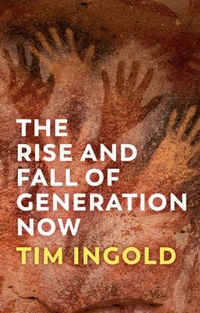
The Rise and Fall of Generation Now
Published on 24. November 2023
Book
Paperback/Softback
157 pages
978-1-5095-5661-8 (ISBN)
Description
Is the future about to close in, or is it open to new horizons? For anthropologist Tim Ingold, the root of our difficulty in facing up to the future lies in the way we think about generations. We imagine them as layers, succeeding one another like sheets in a stack. This view figures as a largely unquestioned backdrop to discussions of evolution, life and death, longevity, extinction, sustainability, education, climate change, and other matters of contemporary concern. What if we were to think of generations, instead, as wrapping around one another along their length, more like fibres in a rope than stacked sheets?
In this compelling new book, Ingold argues that a return to the idea that life is forged in the collaboration of overlapping generations might not only assuage some of our anxieties, but also offer a lasting foundation for future coexistence. But it would mean having to abandon our faith both in the inevitability of progress, and in the ability of science and technology to cushion humanity from environmental impacts. A perfect world is not around the corner, nor will our troubles ever end. Nevertheless, for as long as life continues, there is hope for generations to come.
Is the future about to close in, or is it open to new horizons? For anthropologist Tim Ingold, the root of our difficulty in facing up to the future lies in the way we think about generations. We imagine them as layers, succeeding one another like sheets in a stack. This view figures as a largely unquestioned backdrop to discussions of evolution, life and death, longevity, extinction, sustainability, education, climate change, and other matters of contemporary concern. What if we were to think of generations, instead, as wrapping around one another along their length, more like fibres in a rope than stacked sheets?
In this compelling new book, Ingold argues that a return to the idea that life is forged in the collaboration of overlapping generations might not only assuage some of our anxieties, but also offer a lasting foundation for future coexistence. But it would mean having to abandon our faith both in the inevitability of progress, and in the ability of science and technology to cushion humanity from environmental impacts. A perfect world is not around the corner, nor will our troubles ever end. Nevertheless, for as long as life continues, there is hope for generations to come.
In this compelling new book, Ingold argues that a return to the idea that life is forged in the collaboration of overlapping generations might not only assuage some of our anxieties, but also offer a lasting foundation for future coexistence. But it would mean having to abandon our faith both in the inevitability of progress, and in the ability of science and technology to cushion humanity from environmental impacts. A perfect world is not around the corner, nor will our troubles ever end. Nevertheless, for as long as life continues, there is hope for generations to come.
Is the future about to close in, or is it open to new horizons? For anthropologist Tim Ingold, the root of our difficulty in facing up to the future lies in the way we think about generations. We imagine them as layers, succeeding one another like sheets in a stack. This view figures as a largely unquestioned backdrop to discussions of evolution, life and death, longevity, extinction, sustainability, education, climate change, and other matters of contemporary concern. What if we were to think of generations, instead, as wrapping around one another along their length, more like fibres in a rope than stacked sheets?
In this compelling new book, Ingold argues that a return to the idea that life is forged in the collaboration of overlapping generations might not only assuage some of our anxieties, but also offer a lasting foundation for future coexistence. But it would mean having to abandon our faith both in the inevitability of progress, and in the ability of science and technology to cushion humanity from environmental impacts. A perfect world is not around the corner, nor will our troubles ever end. Nevertheless, for as long as life continues, there is hope for generations to come.
Reviews / Votes
"This short book is a deeply felt personal statement as well as an important and timely intervention in a range of scholarly debates concerning not least the relationship between past, present, and future in a time of planetary crisis."Stuart McLean, University of Minnesota
"This short book is a deeply felt personal statement as well as an important and timely intervention in a range of scholarly debates concerning not least the relationship between past, present, and future in a time of planetary crisis."
<b>Stuart McLean, University of Minnesota</b>
More details
Edition
1
Language
English
Place of publication
Oxford
United Kingdom
Publishing group
John Wiley and Sons Ltd
Target group
Professional and scholarly
Dimensions
Height: 216 mm
Width: 139 mm
Thickness: 15 mm
Weight
210 gr
ISBN-13
978-1-5095-5661-8 (9781509556618)
Copyright in bibliographic data and cover images is held by Nielsen Book Services Limited or by the publishers or by their respective licensors: all rights reserved.
Schweitzer Classification
Other editions
Additional editions
Tim Ingold
The Rise and Fall of Generation Now
Book
11/2023
Polity Press
€50.00
Shipment within 15-20 days
Tim Ingold
The Rise and Fall of Generation Now
E-Book
11/2023
1st Edition
Wiley
€14.99
Available for download
Person
Tim Ingold is Emeritus Professor of Social Anthropology at the University of Aberdeen.
<b>Tim Ingold</b> is Emeritus Professor of Social Anthropology at the University of Aberdeen.
<b>Tim Ingold</b> is Emeritus Professor of Social Anthropology at the University of Aberdeen.
Content
<i>Preface</i>
<i>List of Figures</i>
Chapter 1: Generations and the Regeneration of Life
Chapter 2: Modelling the Human Life Course
Chapter 3: Remembering the Way
Chapter 4: Uncertainty and Possibility
Chapter 5: Loss and Extinction
Chapter 6: Recentring Anthropos
Chapter 7: The Way of Education
Chapter 8: After Science and Technology
<i>Notes</i>
<i>Index</i>
<i>List of Figures</i>
Chapter 1: Generations and the Regeneration of Life
Chapter 2: Modelling the Human Life Course
Chapter 3: Remembering the Way
Chapter 4: Uncertainty and Possibility
Chapter 5: Loss and Extinction
Chapter 6: Recentring Anthropos
Chapter 7: The Way of Education
Chapter 8: After Science and Technology
<i>Notes</i>
<i>Index</i>