

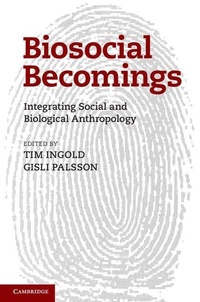
Biosocial Becomings
Integrating Social and Biological Anthropology
Published on 13. June 2013
Book
Hardback
288 pages
978-1-107-02563-9 (ISBN)
Description
All human life unfolds within a matrix of relations, which are at once social and biological. Yet the study of humanity has long been divided between often incompatible 'social' and 'biological' approaches. Reaching beyond the dualisms of nature and society and of biology and culture, this volume proposes a unique and integrated view of anthropology and the life sciences. Featuring contributions from leading anthropologists, it explores human life as a process of 'becoming' rather than 'being', and demonstrates that humanity is neither given in the nature of our species nor acquired through culture but forged in the process of life itself. Combining wide-ranging theoretical argument with in-depth discussion of material from recent or ongoing field research, the chapters demonstrate how contemporary anthropology can move forward in tandem with groundbreaking discoveries in the biological sciences.
Reviews / Votes
'In this ambitious and highly original volume, Ingold and Palsson try to lead anthropology toward a fundamental rethinking of the static dichotomy of biology and culture. Challenging the assumptions of nineteenth-century biology, which are often still taken as axiomatic - that human skin is a boundary between the autonomous natural world of the organism and the exogenous cultural and ecological setting in which the human being is embedded - the contributors invite you to blur those categorical distinctions with modern data and theory. Instead they present humans as 'becomings' - as parts of continually unfolding biosocial relationships with other humans, and other species. To a scientist who is trying to comprehend a bipedal, linguistic creature that nevertheless takes several years before it can even move and communicate properly, this makes a good deal of sense ... an intellectually very rewarding work.' Jonathan Marks, University of North Carolina, Charlotte 'Biosocial Becomings is a thought-provoking collection of essays on the current re-negotiation of the boundaries between the biological and the social in the study of humans. The subtitle of the book promises a new integration of social and biological anthropology after a long century of divorce. It does more: it explores a conceptual space that is no longer dominated by the dichotomy between nature and culture.' Hans-Joerg Rheinberger, Max Planck Institute for the History of Science 'The essays included in the book are highly informative and inspiring. I am pleased that the authors actually build upon an interdisciplinary approach. The texts are based not only on findings and theories of social and biological anthropology, but the authors also benefit from various concepts of philosophy, psychology, and other scientific fields. Biosocial Becomings is a highly original volume including inspiriting texts. I personally find [it] groundbreaking, because it is really an effort to restore connection of social and biological anthropology.' Martin Soukup, Anthropos '... an interesting and thought-provoking read for those of us ready to engage in debate with our colleagues in social anthropology.' Sian Waters, Primate EyeMore details
Language
English
Place of publication
Cambridge
United Kingdom
Target group
Professional and scholarly
Product notice
sewn/stitched
Cloth over boards
Illustrations
1 Tables, black and white; 13 Halftones, unspecified; 3 Line drawings, unspecified
Dimensions
Height: 236 mm
Width: 156 mm
Thickness: 20 mm
Weight
598 gr
ISBN-13
978-1-107-02563-9 (9781107025639)
Copyright in bibliographic data and cover images is held by Nielsen Book Services Limited or by the publishers or by their respective licensors: all rights reserved.
Schweitzer Classification
Other editions
Additional editions
E-Book
06/2013
1st Edition
Cambridge University Press
€82.99
Available for download
E-Book
06/2013
Cambridge University Press
€70.49
Available for download
Persons
Tim Ingold is Professor of Social Anthropology at the University of Aberdeen. His research is wide-ranging and interdisciplinary, spanning environment, technology and social organisation in the circumpolar North, evolutionary theory, human-animal relations, language and tool use, environmental perception and skilled practice. He has received numerous awards and distinctions, including the 2004 Anders Retzius Gold Medal of the Swedish Society for Anthropology and Geography. Gisli Palsson is Professor of Anthropology at the University of Iceland, Reykjavik. He has conducted fieldwork in Iceland, the Republic of Cape Verde and the Canadian Arctic, and has written on a variety of issues including biomedicine, genomics, genetic history, human-animal relations, fishing, arctic exploration, environmental discourse and the history of slavery.
Content
Preface; 1. Prospect Tim Ingold; 2. Ensembles of biosocial relations Gisli Palsson; 3. Blurring the biological and social in human becomings Agustin Fuentes; 4. Life-in-the-making: epigenesis, biocultural environments and human becomings Eugenia Ramirez-Goicoechea; 5. Thalassemic lives as stories of becoming: mediated biologies and genetic (un)certainties Aglaia Chatjouli; 6. Shedding our selves: perspectivism, the bounded subject and the nature-culture divide Noa Vaisman; 7. Reflections on a collective brain at work: one week in the working life of an NGO-team in urban Marocco Barbara Elisabeth Goetsch; 8. The habits of water: marginality and the sacralization of non-humans in North-Eastern Ghana Gaetano Mangiameli; 9. 'Bringing wood to life': lines, flows and materials in a Swazi sawmill Vito Laterza, Bob Forrester and Patience Mususa; 10. Humanity and life as the perpetual maintenance of specific efforts: a reappraisal of animism Istvan Praet; 11. Ravelling/unravelling: being-in-the-world and falling-out-of-the-world Hayder Al-Mohammad; 12. Retrospect Gisli Palsson; Notes on the contributors; References; Index.