

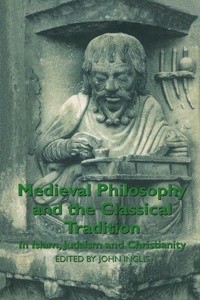
Medieval Philosophy and the Classical Tradition
In Islam, Judaism and Christianity
1st Edition
Published on 25. April 2013
Book
Paperback/Softback
328 pages
978-0-415-84950-0 (ISBN)
Description
An initial chapter on the history of Islamic philosophy sets the stage for sixteen articles on issues across the three traditions. The goal is to see the Islamic tradition in its own richness and complexity as the context of most Jewish intellectual work.
More details
Language
English
Place of publication
London
United Kingdom
Publishing group
Taylor & Francis Ltd
Target group
College/higher education
Dimensions
Height: 234 mm
Width: 156 mm
Thickness: 18 mm
Weight
500 gr
ISBN-13
978-0-415-84950-0 (9780415849500)
Copyright in bibliographic data and cover images is held by Nielsen Book Services Limited or by the publishers or by their respective licensors: all rights reserved.
Schweitzer Classification
Other editions
Additional editions
E-Book
10/2005
Routledge
€64.49
Available for download
E-Book
10/2005
Routledge
€64.49
Available for download
Book
02/2002
1st Edition
Routledge
€232.30
Shipment within 10-20 days
Person
John Inglis is Associate Professor of Philosophy at the University of Dayton.
Content
Notes on Contributors Acknowledgements Introduction: Towards a Balanced Historiography of Medieval Philosophy John Inglis Section One: Historical Context 1. Medieval Islamic Philosophy and the Classical Tradition Micheal E. Marmura Section Two: Philosophy 2. A Philosophical Odyssey: Ghazzali's Intentions of the Philosophers Gabriel Said Reynolds 3. The Relationship between Averroes and al-Ghazali: as it presents itself in Averroes' Early Writings, especially in his Commentary on al-Ghazali's al-Mustasfa Frank Griffel 4. Al-Ghazali and Halevi on Philosophy and the Philosophers Barry S. Kogan Section Three: Neoplatonism 5. Projection and Time in Proclus D. Gregory MacIsaac 6. Forms of Knowledge in the Arabic Plotinus Peter Adamson 7. Secundum rei vim vel secundum cognoscentium facultatem : Knower and Known in the Consolation of Philsosophy pf Boethius and the proslogion of Anselm Wayne J. Hankey 8. Proclean 'Remaining' and Avicenna on Existence as Accident: Neoplatonic Methodology and a Defense of 'Pre-Existing' Essences Sarah Pessin 9. Augustine vs Plotinus: The Uniqueness of the Vision at Ostia Thomas Williams Section Four: Creation 10. Infinite Power and Plenitude: Two Traditions on the Necessity of the Eternal Taneli Kukkonen 11. The Challenge to Medieval Christian Philosophy: Relating Creator to Creatures David B. Burrell, C.S.C. Section Five: Virtue 12. Three Kinds of Objectivity Jonathan Jacobs 13. On Defining Maimonides' Aristotelianism Daniel H. Frank 14. Porphyry, Bonaventure and Thomas Aquinas: A Neoplatonic Hierarchy of Virtues and Two Christian Appropriations Joshua P. Hochschild Section Six: The Latin Reception 15. William of Auvergne and the Aristotelians: The Nature of a Servant Michael Miller 16. Is God a 'What'? Avicenna, William of Auvergne, and Aquinas on the Divine Essence John P. Rosheger 17. Maimonides and Roger Bacon: Did Roger Bacon Read Maimonides? Jeremiah Hackett Index