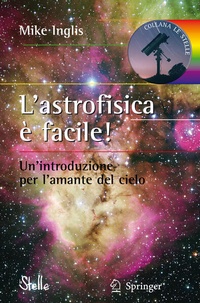
Molti astrofili ritengono che l'astrofisica sia un argomento difficile, che richiede conoscenze matematiche almeno a livello universitario.
Non è necessariamente così. L'approccio quantitativo adottato da Mike Inglis riesce a spiegare tutti gli aspetti dell'astrofisica in termini semplici, evitando i tecnicismi matematici con i quali questa disciplina viene spesso associata.
L'astrofisica è facile! inizia considerando il diagramma H-R e altri strumenti di base dell'astrofisico, poi spazia nell'Universo, trattando del mezzo interstellare, delle nebulose, della nascita, dell'evoluzione e della morte delle stelle, fino a considerare la fisica delle galassie e degli ammassi di galassie.
Per ogni argomento, l'autore elenca una lista di oggetti che si prestano ad essere osservati con strumenti amatoriali, di modo che l'astrofilo può uscire ad ammirare sulla volta celeste le stelle, le nebulose, le galassie di cui il libro sta trattando.
Series
Edition
Language
Place of publication
Target group
Edition type
Illustrations
Dimensions
Height: 235 mm
Width: 155 mm
Thickness: 12 mm
Weight
ISBN-13
978-88-470-1059-8 (9788847010598)
DOI
10.1007/978-88-470-1060-4
Schweitzer Classification
Mike Inglis was born in Wales in Great Britain, but now lives and works in the United States, wherehe is Professor of Astronomy and Astrophysics at the State University of New York. He is a Fellow ofthe Royal Astronomical Society, a NASA Solar System Ambassador, a Member of the RoyalInstitution, and a Member of the British Astronomical Association. He is the author of many booksand research papers including A Field Guide to Deep Sky Objects (Springer, 2012, 2nd edition), AnObserver's Guide to Stellar Evolution (Springer, 2003), Astronomy of the Milky Way, Vol. I - TheNorthern Sky (Springer, 2016), Astronomy of the Milky Way, Vol. II - The Southern Sky (Springer,2018), An Observer's Guide to Star Clusters (Springer 2013), and Astrophysics is Easy! (Springer, 2015,2nd edition). He is a series editor for several Springer book series for both amateur and professionalastronomers, as wellas a teacher of undergraduate and graduate students in astrophysics.Although a professional astronomer, he is also a lifelong amateur astronomer and observes thenight sky around the world, whenever time, and the sky, permit.
Gli strumentia del mestiere.- Il mezzo interstellare.- Le stelle.- Le galassie.