

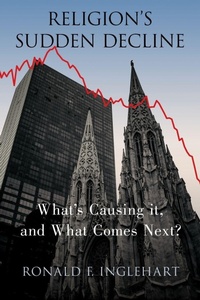
Religion's Sudden Decline
What's Causing it, and What Comes Next?
Published on 3. March 2021
Book
Paperback/Softback
208 pages
978-0-19-754705-2 (ISBN)
Description
Mass attachment to religion is rapidly declining in most of the world; Why, and What comes next?
The world is becoming less religious. Since 2007, there has been a pervasive decline in religious belief and most of the world's people now say that God is less important in their lives than they said He was in the quarter century before 2007. The American public showed the most dramatic shift of all. The United States, which for many years stood as a highly religious outlier among the world's high-income countries, now ranks as the 12th least religious country for which data are available. Many factors contributed to this dramatic worldwide shift, but as Inglehart shows, certain ones stand out. For centuries, virtually all major religions encouraged women to stay home and produce as many children as possible; and they sternly discouraged divorce, abortion, homosexuality, contraception, and any other form of sexual behavior not linked with reproduction. These norms were necessary for societies to survive when facing high infant mortality and low life expectancy: societies that didn't instill them tended to die out. Recent technological advances have greatly increased life expectancy and cut infant mortality to a tiny fraction of its historic levels, making these norms no longer necessary for societal survival. These norms require repressing strong natural urges, but, since they present traditional norms as absolute values, most religions strongly resist change. The resulting tension, together with the fact that rising existential security has made people less dependent on religion, opened the way for an exodus from religion. Utilizing a massive global data base, Inglehart analyzes the conditions under which religiosity collapses, and explores its implications for the future.
The world is becoming less religious. Since 2007, there has been a pervasive decline in religious belief and most of the world's people now say that God is less important in their lives than they said He was in the quarter century before 2007. The American public showed the most dramatic shift of all. The United States, which for many years stood as a highly religious outlier among the world's high-income countries, now ranks as the 12th least religious country for which data are available. Many factors contributed to this dramatic worldwide shift, but as Inglehart shows, certain ones stand out. For centuries, virtually all major religions encouraged women to stay home and produce as many children as possible; and they sternly discouraged divorce, abortion, homosexuality, contraception, and any other form of sexual behavior not linked with reproduction. These norms were necessary for societies to survive when facing high infant mortality and low life expectancy: societies that didn't instill them tended to die out. Recent technological advances have greatly increased life expectancy and cut infant mortality to a tiny fraction of its historic levels, making these norms no longer necessary for societal survival. These norms require repressing strong natural urges, but, since they present traditional norms as absolute values, most religions strongly resist change. The resulting tension, together with the fact that rising existential security has made people less dependent on religion, opened the way for an exodus from religion. Utilizing a massive global data base, Inglehart analyzes the conditions under which religiosity collapses, and explores its implications for the future.
Reviews / Votes
"Ingelhart's latest contribution establishes certain facts about religious decline and posits some logical sources for why many citizens in the post-industrial world are losing their religion." -- Paul Froese, Journal of Peace Research Overall, Inglehart's book is as thorough and detailed as it is accessible and engaging. * A. Remillard, CHOICE * Inglehart has rewritten the story of how modernization affects religion. You might not agree with his theory, but you need to read this book: it will be cited in debates over religious change for years to come. * David Voas, University College London * In Religion's Sudden Decline,... Ronald F. Inglehart points specifically to the rise of what he calls "existential security" as the key driver, presenting global survey data that show that countries with high political stability and low socioeconomic inequality are more secular than those with the opposite characteristics. * Nova Religio *More details
Language
English
Place of publication
New York
United States
Target group
Professional and scholarly
Dimensions
Height: 234 mm
Width: 156 mm
Thickness: 11 mm
Weight
319 gr
ISBN-13
978-0-19-754705-2 (9780197547052)
Copyright in bibliographic data and cover images is held by Nielsen Book Services Limited or by the publishers or by their respective licensors: all rights reserved.
Schweitzer Classification
Other editions
Additional editions
Book
03/2021
Oxford University Press Inc
€149.60
Shipment within 15-20 days
E-Book
08/2020
1st Edition
OUP eBook
€17.49
Available for download
E-Book
08/2020
1st Edition
OUP eBook
€17.49
Available for download
Person
Ronald F. Inglehart is the Lowenstein Professor of Political Science emeritus at the University of Michigan. He helped found the Euro-Barometer surveys and is Founding President of the World Values Survey Association, which since 1981 has repeatedly surveyed representative national samples of the publics of 108 countries containing over 90 percent of the world's population. He is a fellow of the American Academy of Arts and Sciences and of the American Academy of Political and Social Science and has three honorary doctorates.
Content
Chapter 1. The Shift from Pro-fertility norms to Individual-choice norms.
Chapter 2. Religion matters.
Chapter 3. The Secularization debate.
Chapter 4. Evolutionary Modernization theory and secularization.
Chapter 5. What's causing it? The rise of Individual-choice norms.
Chapter 6. What's causing it? Insecurity.
Chapter 7. Secularization accelerates in high-income countries.
Chapter 8. What comes next: People need a clear belief system-- What is replacing religion?
Chapter 9. What comes next: At what point does even Sweden get a xenophobic authoritarian party?
Chapter 10. What Comes Next?
Chapter 2. Religion matters.
Chapter 3. The Secularization debate.
Chapter 4. Evolutionary Modernization theory and secularization.
Chapter 5. What's causing it? The rise of Individual-choice norms.
Chapter 6. What's causing it? Insecurity.
Chapter 7. Secularization accelerates in high-income countries.
Chapter 8. What comes next: People need a clear belief system-- What is replacing religion?
Chapter 9. What comes next: At what point does even Sweden get a xenophobic authoritarian party?
Chapter 10. What Comes Next?