

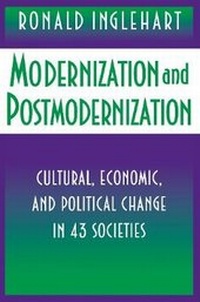
Modernization and Postmodernization
Cultural, Economic, and Political Change in 43 Societies
Published on 1. June 1997
Book
Hardback
440 pages
978-0-691-01181-3 (ISBN)
Description
This work argues that economic development, cultural change and political change go together in coherent and even, to some extent, predictable patterns. It implies that some trajectories of socioeconomic change are more likely than others, and consequently that certain changes are foreseeable. Once a society has embarked on industrialization, for example, a whole syndrome of related changes, from mass mobilization to diminishing differences in gender roles, is likely to appear. Advanced industrial society leads to a basic shift in values, de-emphasizing the instrumental rationality that characterized modern society. Postmodern values then bring new societal changes, including democratic political institutions and the decline of state socialist regimes. To demonstrate the links between belief systems and political and socioeconomic variables, this book draws on a database, the "World Values Surveys". It covers a broad range for looking at the impact of mass publics on political and social life.
It provides information from societies representing 70 per cent of the world's population from societies with per capita incomes as low as USD300 per year to those with per capita incomes 100 t
It provides information from societies representing 70 per cent of the world's population from societies with per capita incomes as low as USD300 per year to those with per capita incomes 100 t
Reviews / Votes
[This is] Inglehart's most convincing demonstration of the theory of intergenerational value change, the cornerstone of his scholarship... With data from 43 societies collected over nearly three decades, and representing 70 percent of the world's population ...the analysis of Inglehart's unprecedented comparative dataset is nuanced, sophisticated, and certain to stimulate the kind of criticism that will deepen our understanding of social change. The Review of Politics Ronald Inglehart is one of the very few scholars to have remained consistently engaged with both the study of political culture and the development of modernization theory over the past few decades. In Modernization and Postmodernization, he presents the cumulative results of decades of research on the interrelationships among cultural values, democracy, and capitalism. His findings are consistently thought-provoking and often surprising and should inspire prolonged and productive controversy... Overall, Inglehart's fascinating book raises tantalizing questions about the long-term trajectory of value change in modern society. -- Stephen E. Hanson Comparative PoliticsMore details
Language
English
Place of publication
New Jersey
United States
Target group
Professional and scholarly
College/higher education
Product notice
Trade binding
Illustrations
95 line illus. 30 tables
Dimensions
Height: 254 mm
Width: 197 mm
Weight
851 gr
ISBN-13
978-0-691-01181-3 (9780691011813)
Copyright in bibliographic data and cover images is held by Nielsen Book Services Limited or by the publishers or by their respective licensors: all rights reserved.
Schweitzer Classification
Other editions
Additional editions
Ronald Inglehart
Modernization and Postmodernization
Cultural, Economic, and Political Change in 43 Societies
E-Book
03/2021
1st Edition
Princeton University Press
€58.99
Available for download
Person
Ronald Inglehart is Professor of Political Science and Program Director at the Institute for Social Research at the University of Michigan. Among his books are The Silent Revolution: Changing Values and Political Styles among Western Publics and Culture Shift in Advanced Industrial Society, both published by Princeton University Press.
Content
Acknowledgments Ch. 1 Value Systems: The Subjective Aspect of Politics and Economics Ch. 2 Individual-Level Change and Societal-Level Change Ch. 3 Modernization and Postmodernization in 43 Societies Ch. 4 Measuring Materialist and Postmaterialist Values Ch. 5 The Shift toward Postmaterialist Values, 1970-1994 Ch. 6 Economic Development, Political Culture, and Democracy: Bringing the People Back In Ch. 7 The Impact of Culture on Economic Growth Ch. 8 The Rise of New Issues and New Parties Ch. 9 The Shift toward Postmodern Values: Predicted and Observed Changes, 1981-1990 Ch. 10 The Erosion of Institutional Authority and the Rise of Citizen Intervention in Politics Ch. 11 Trajectories of Social Change App. 1 A Note on Sampling: Figures A.1 and A.2 App. 2 Partial 1990 WVS Questionnaire, with Short Labels for Items Used in Figure 3.2 App. 3 Supplementary Figures for Chapters 3, 9, and 10; Figures A.3 (Chapter 6), A.4-A.21 (Chapter 9), A.22-A.26 (Chapter 10), and A.27 (Chapter 11) App. 4 Construction of Key Indices Used in This Book App. 5 Complete 1990 WVS Questionnaire, with Variable Numbers in ICPSR Dataset References Index