

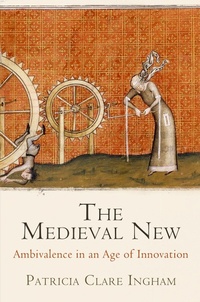
The Medieval New
Ambivalence in an Age of Innovation
Published on 30. April 2015
Book
Hardback
288 pages
978-0-8122-4706-0 (ISBN)
Description
Despite the prodigious inventiveness of the Middle Ages, the era is often characterized as deeply suspicious of novelty. But if poets and philosophers urged caution about the new, Patricia Clare Ingham contends, their apprehension was less the result of a blind devotion to tradition than a response to radical expansions of possibility in diverse realms of art and science. Discovery and invention provoked moral questions in the Middle Ages, serving as a means to adjudicate the ethics of invention and opening thorny questions of creativity and desire.
The Medieval New concentrates on the preoccupation with newness and novelty in literary, scientific, and religious discourses of the twelfth through sixteenth centuries. Examining a range of evidence, from the writings of Roger Bacon and Geoffrey Chaucer to the letters of Christopher Columbus, and attending to histories of children's toys, the man-made marvels of romance, the utopian aims of alchemists, and the definitional precision of the scholastics, Ingham analyzes the ethical ambivalence with which medieval thinkers approached the category of the new. With its broad reconsideration of what the "newfangled" meant in the Middle Ages, The Medieval New offers an alternative to histories that continue to associate the medieval era with conservation rather than with novelty, its benefits and liabilities. Calling into question present-day assumptions about newness, Ingham's study demonstrates the continued relevance of humanistic inquiry in the so-called traditional disciplines of contemporary scholarship.
The Medieval New concentrates on the preoccupation with newness and novelty in literary, scientific, and religious discourses of the twelfth through sixteenth centuries. Examining a range of evidence, from the writings of Roger Bacon and Geoffrey Chaucer to the letters of Christopher Columbus, and attending to histories of children's toys, the man-made marvels of romance, the utopian aims of alchemists, and the definitional precision of the scholastics, Ingham analyzes the ethical ambivalence with which medieval thinkers approached the category of the new. With its broad reconsideration of what the "newfangled" meant in the Middle Ages, The Medieval New offers an alternative to histories that continue to associate the medieval era with conservation rather than with novelty, its benefits and liabilities. Calling into question present-day assumptions about newness, Ingham's study demonstrates the continued relevance of humanistic inquiry in the so-called traditional disciplines of contemporary scholarship.
Reviews / Votes
"The Medieval New is precise in its methods, pioneering in its claims, and creative in bringing together ethical, literary, theological, and historical concerns. Patricia Clare Ingham presents a sensitive and nuanced view of the relationship between 'old' and 'new' that adds immeasurably to the conversation about innovation and its relation to tradition." (Richard Newhauser, Arizona State University)More details
Series
Language
English
Place of publication
Pennsylvania
United States
Target group
College/higher education
Product notice
Paper over boards
Illustrations
4 illus.
Dimensions
Height: 236 mm
Width: 156 mm
Thickness: 32 mm
Weight
595 gr
ISBN-13
978-0-8122-4706-0 (9780812247060)
Copyright in bibliographic data and cover images is held by Nielsen Book Services Limited or by the publishers or by their respective licensors: all rights reserved.
Schweitzer Classification
Other editions
Additional editions
E-Book
04/2015
1st Edition
University of Pennsylvania Press
€197.99
Available for download
Person
Patricia Clare Ingham is Professor of English at Indiana University. She is author of Sovereign Fantasies: Arthurian Romance and the Making of Britain, also available from the University of Pennsylvania Press, and coeditor of Postcolonial Moves: Medieval Through Modern.
Content
Introduction. Newfangled Values
PART I. EX NIHILO
Chapter 1. Scholastic Novelties
Chapter 2. Conjuring Roger Bacon
PART II. INGENIUM
Chapter 3. Ingenious Youth
Chapter 4. Little Nothings
PART III. CURIOSITAS
Chapter 5. Suspect Economies
Chapter 6. Old Worlds and New
Afterword. An Age of Innovation
Notes
Bibliography
Index
Acknowledgments
PART I. EX NIHILO
Chapter 1. Scholastic Novelties
Chapter 2. Conjuring Roger Bacon
PART II. INGENIUM
Chapter 3. Ingenious Youth
Chapter 4. Little Nothings
PART III. CURIOSITAS
Chapter 5. Suspect Economies
Chapter 6. Old Worlds and New
Afterword. An Age of Innovation
Notes
Bibliography
Index
Acknowledgments