

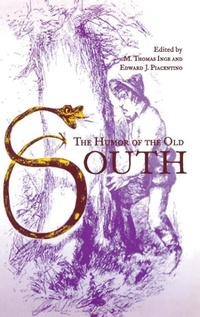
The Humor of the Old South
Published on 1. July 2001
Book
Hardback
336 pages
978-0-8131-2194-9 (ISBN)
Description
The humor of the Old South -- tales, almanac entries, turf reports, historical sketches, gentlemen's essays on outdoor sports, profiles of local characters -- flourished between 1830 and 1860. The genre's popularity and influence can be traced in the works of major southern writers such as William Faulkner, Erskine Caldwell, Eudora Welty, Flannery O'Connor, and Harry Crews, as well as in contemporary popular culture focusing on the rural South.
This collection of essays includes some of the past twenty five years' best writing on the subject, as well as ten new works bringing fresh insights and original approaches to the subject. A number of the essays focus on well known humorists such as Augustus Baldwin Longstreet, Johnson Jones Hooper, William Tappan Thompson, and George Washington Harris, all of whom have long been recognized as key figures in Southwestern humor.
Other chapters examine the origins of this early humor, in particular selected poems of William Henry Timrod and Washington Irving's "The Legend of Sleepy Hollow," which anticipate the subject matter, character types, structural elements, and motifs that would become part of the Southwestern tradition. Renditions of "Sleepy Hollow" were later echoed in sketches by William Tappan Thompson, Joseph Beckman Cobb, Orlando Benedict Mayer, Francis James Robinson, and William Gilmore Simms.
Several essays also explore antebellum southern humor in the context of race and gender. This literary legacy left an indelible mark on the works of later writers such as Mark Twain and William Faulkner, whose works in a comic vein reflect affinities and connections to the rich lode of materials initially popularized by the Southwestern humorists.
This collection of essays includes some of the past twenty five years' best writing on the subject, as well as ten new works bringing fresh insights and original approaches to the subject. A number of the essays focus on well known humorists such as Augustus Baldwin Longstreet, Johnson Jones Hooper, William Tappan Thompson, and George Washington Harris, all of whom have long been recognized as key figures in Southwestern humor.
Other chapters examine the origins of this early humor, in particular selected poems of William Henry Timrod and Washington Irving's "The Legend of Sleepy Hollow," which anticipate the subject matter, character types, structural elements, and motifs that would become part of the Southwestern tradition. Renditions of "Sleepy Hollow" were later echoed in sketches by William Tappan Thompson, Joseph Beckman Cobb, Orlando Benedict Mayer, Francis James Robinson, and William Gilmore Simms.
Several essays also explore antebellum southern humor in the context of race and gender. This literary legacy left an indelible mark on the works of later writers such as Mark Twain and William Faulkner, whose works in a comic vein reflect affinities and connections to the rich lode of materials initially popularized by the Southwestern humorists.
Reviews / Votes
Forward-looking and intelligent....The essays approach the materials as literary evocations of social and civil life. - David E. E. SloaneMore details
Language
English
Place of publication
Lexington
United States
Product notice
sewn/stitched
Cloth over boards
Dimensions
Height: 240 mm
Width: 161 mm
Thickness: 22 mm
Weight
665 gr
ISBN-13
978-0-8131-2194-9 (9780813121949)
Copyright in bibliographic data and cover images is held by Nielsen Book Services Limited or by the publishers or by their respective licensors: all rights reserved.
Schweitzer Classification
Persons
M. Thomas Inge, Robert Emory Blackwell Professor of English and Humanities at Randolph-Macon College, is the editor of William Faulkner: The Contemporary Reviews and Conversations with William Faulkner. Edward J. Piacentino, professor of English at High Point University, is the author of T.S. Stribling: Pioneer Realist in Modern Southern Literature.