

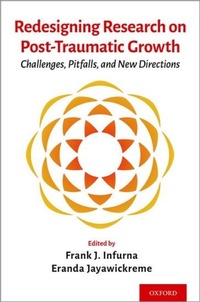
Redesigning Research on Post-Traumatic Growth
Challenges, Pitfalls, and New Directions
Published on 13. October 2021
Book
Hardback
312 pages
978-0-19-750740-7 (ISBN)
Description
The literature on post-traumatic growth (PTG) has been instrumental in highlighting the human capacity to overcome adversity, illuminating the different pathways people may follow when confronted with adversity. Although the theme of strength from adversity is central to many disciplines and certain cultural narratives, these claims lack robust empirical evidence. This literature gap can be traced to a reliance on retrospective assessments for methodology and difficulty in determining which outcomes are most appropriate for studying PTG.
Redesigning Research on Post-Traumatic Growth offers new directions for PTG research. The book illustrates the benefits of research designs that incorporate multiple methods of assessment and highlights the value of integrating various disciplines, such as philosophy and multiple areas of psychology (e.g., clinical, developmental, health, and personality) for more holistic understanding of the human capacity to overcome adversity. The book is divided into four sections: current challenges in examining PTG, methodological advancements, research in specific populations, and opportunities for further research. Introductory chapters identify the limits of traditional PTG assessments and find solutions in prospective longitudinal studies. From here, this methodology is put into practice with unique case examples from studies with Syrian refugees, older adults, and couples coping with a cancer diagnosis. The book concludes with calls for further research on event characteristics of adversity, as well as narrative identity, wisdom, and open-mindedness as key growth outcomes. Redesigning Research on Post-Traumatic Growth will serve as the starting point for the next generation of research on PTG
Redesigning Research on Post-Traumatic Growth offers new directions for PTG research. The book illustrates the benefits of research designs that incorporate multiple methods of assessment and highlights the value of integrating various disciplines, such as philosophy and multiple areas of psychology (e.g., clinical, developmental, health, and personality) for more holistic understanding of the human capacity to overcome adversity. The book is divided into four sections: current challenges in examining PTG, methodological advancements, research in specific populations, and opportunities for further research. Introductory chapters identify the limits of traditional PTG assessments and find solutions in prospective longitudinal studies. From here, this methodology is put into practice with unique case examples from studies with Syrian refugees, older adults, and couples coping with a cancer diagnosis. The book concludes with calls for further research on event characteristics of adversity, as well as narrative identity, wisdom, and open-mindedness as key growth outcomes. Redesigning Research on Post-Traumatic Growth will serve as the starting point for the next generation of research on PTG
Reviews / Votes
Much of the literature on post-traumatic growth has been immune to methodological critique. This volume does a fantastic job presenting new perspectives that provide a foundation for a robust science of whether and how people can grow and thrive following adversity." * Howard Tennen, PhD, Board of Trustees Distinguished Professor, University of Connecticut * This is a truly outstanding multidisciplinary volume, containing a wealth of research on the meaning and assessment of post-traumatic growth, and on post-traumatic growth in particular groups and populations. It admirably marries a healthy scepticism about previous findings, and a positive outlook on future approaches. It is essential reading for anyone interested in and working in this area." * Michael Brady, PhD, Professor of Philosophy and Head of Humanities, University of Glasgow * This edited volume should be required reading for anyone interested in truly understanding the phenomenon of post-traumatic growth. The research described herein uses cutting edge methods and diverse samples to seriously grapple with the conceptual and methodological issues that have hampered our understanding post-traumatic growth to date." * Patricia Frazier, PhD, Distinguished McKnight University Professor, University of Minnesota *More details
Language
English
Place of publication
New York
United States
Target group
Professional and scholarly
Product notice
sewn/stitched
Cloth over boards
Dimensions
Height: 239 mm
Width: 162 mm
Thickness: 25 mm
Weight
590 gr
ISBN-13
978-0-19-750740-7 (9780197507407)
Copyright in bibliographic data and cover images is held by Nielsen Book Services Limited or by the publishers or by their respective licensors: all rights reserved.
Schweitzer Classification
Other editions
Additional editions
Frank J. Infurna | Eranda Jayawickreme
Redesigning Research on Post-Traumatic Growth
Challenges, Pitfalls, and New Directions
E-Book
07/2021
OUP eBook
€34.99
Available for download
Frank J. Infurna | Eranda Jayawickreme
Redesigning Research on Post-Traumatic Growth
Challenges, Pitfalls, and New Directions
E-Book
07/2021
OUP eBook
€34.99
Available for download
Persons
Frank J. Infurna, PhD, is an Associate Professor in the Department of Psychology at Arizona State University. Dr. Infurna's professional work focuses on resilience to major life stressors and psychosocial factors that contribute to healthy aging outcomes across adulthood and old age. His research on major life stressors has shown that contrary to previous research, resilience is not the modal response to major life stressors, but in fact individuals typically show substantial declines in psychological functioning, followed by gradual improvements near-previous levels.
Eranda Jayawickreme, PhD is an Associate Professor in the Department of Psychology and Senior Research Fellow at the Program for Leadership and Character at Wake Forest University. Dr. Jayawickreme's research focuses on post-traumatic growth as positive personality change, moral personality, wisdom, well-being and integrative theories of personality. His work with populations in Rwanda, Sri Lanka, and the USA has made
substantial contributions to further understanding whether and how growth is possible following adversity.
Eranda Jayawickreme, PhD is an Associate Professor in the Department of Psychology and Senior Research Fellow at the Program for Leadership and Character at Wake Forest University. Dr. Jayawickreme's research focuses on post-traumatic growth as positive personality change, moral personality, wisdom, well-being and integrative theories of personality. His work with populations in Rwanda, Sri Lanka, and the USA has made
substantial contributions to further understanding whether and how growth is possible following adversity.
Content
1. Growth and the Multiple Dimensions of Well-Being: A Philosopher's Take on the Idea of Post-Traumatic Growth Valerie Tiberius 2. Current Assessment and Interpretation of Perceived Post-Traumatic Growth Crystal L. Park and Adriel Boals 3. Post-Traumatic Growth Interventions Ann Marie Roepke, Areti Zikopoulos, and Marie Forgeard 4. Using Dynamic Personality Theories, Cognitive Neuroscience, and mHealth to Uncover the Process of Post-Traumatic Personality Change in Women with Breast Cancer Lara M. Baez, Michael H. Antoni, and Aaron S. Heller 5. Using Methods from Personality Psychology to Study Post-Traumatic Growth Eranda Jayawickreme and Sara Etz Mendonca 6. Emotions and Positive Personality Change in Syrian Origin Young Adults Who Have Recently Resettled in the Netherlands Odilia M. Laceulle, Kinan Alajak, Eva Alisic, Zeina Al Sawaf, Haza F. Rahim, Renee Zonneveld, Joanne M. Chung 7. Post-Traumatic Growth in Later Adulthood: Disentangling Shorter-and Longer-Term Changes Following Transitions into Senior Housing Facilities Gloria Luong, J. Doug Coatsworth, and Sy-Miin Chow 8. Prospectively Examining the Effects of a Cancer Diagnosis on Patients, Spouses/Partners, and their Relationship Elaine O. Cheung, Frank J. Penedo, Judith T. Moskowitz, Betina Yanez, Sheetal M. Kircher, Shilajit D. Kundu, Sarah C. Flury, and Patricia I. Moreno 9. Using Culturally and Contextually Informed Theorizing in Research on Post-Traumatic Growth Rebecca M. B. White, Gustavo Carlo, George P. Knight, Jenn Yun-Tein, Nancy A. Gonzales, and Alexandria Curlee 10. Modeling Growth and Resilience among Military Personnel: How Using Different Models Yields Different Answers William J. Chopik 11. Studying Post-Traumatic Growth across the Adult Lifespan: Conceptual and Methodological Considerations Omar E. Staben, Molly J. Gardner, Frank J. Infurna, Suniya S. Luthar, and Kevin J. Grimm 12. Considering Characteristics of Events in Research on Post-Traumatic Growth Maike Luhmann and Ina Fassbender 13. Openness to Experience and Post-Traumatic Growth Marie Forgeard, Elana Bayer-Pacht, Paul J. Silvia, Ann Marie Roepke, and Throestur Bjoergvinsson 14. The Relationship between Narration and Character Growth after Interpersonal Failures and Transgressions Laura E. R. Blackie and Kate C. McLean 15. Pathways from Adversity to Wisdom Anna Dorfman, David A. Moscovitch, and Igor Grossmann 16. Redesigning Research on Post-Traumatic Growth: Current Knowledge and New Directions Frank J. Infurna and Eranda Jayawickreme