

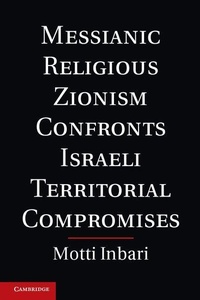
Messianic Religious Zionism Confronts Israeli Territorial Compromises
Published on 27. August 2012
Book
Hardback
211 pages
978-1-107-00912-7 (ISBN)
Description
The Six Day War in 1967 profoundly influenced how an increasing number of religious Zionists saw Israeli victory as the manifestation of God's desire to redeem God's people. Thousands of religious Israelis joined the Gush Emunim movement in 1974 to create settlements in territories occupied in the war. However, over time, the Israeli government decided to return territory to Palestinian or Arab control. This was perceived among religious Zionist circles as a violation of God's order. The peak of this process came with the Disengagement Plan in 2005, in which Israel demolished all the settlements in the Gaza Strip and four settlements in the West Bank. This process raised difficult theological questions among religious Zionists. This book explores the internal mechanism applied by a group of religious Zionist rabbis in response to their profound disillusionment with the state, reflected in an increase in religious radicalization due to the need to cope with the feelings of religious and messianic failure.
Reviews / Votes
'Motti Inbari's book is an insightful introduction into Messianic Religious Zionists' (MRZ) evolving worldviews as they relate to political negotiations over land compromises. Inbari is particularly insightful in his discussion of the changes in approach since the Oslo period in the 1990s ... [he] effectively synthesizes significant secondary sources with available primary sources to provide a stimulating and much-needed analysis of the changing attitudes of MRZ rabbis and followers toward violent responses to territorial compromises.' H-Judaic 'An extremely valuable book that should be read by anyone interested in the role of religious Zionism in Israel.' Politics, Religion and IdeologyMore details
Language
English
Place of publication
Cambridge
United Kingdom
Target group
Professional and scholarly
Dimensions
Height: 240 mm
Width: 161 mm
Thickness: 17 mm
Weight
533 gr
ISBN-13
978-1-107-00912-7 (9781107009127)
Copyright in bibliographic data and cover images is held by Nielsen Book Services Limited or by the publishers or by their respective licensors: all rights reserved.
Schweitzer Classification
Other editions
Additional editions
Book
07/2014
Cambridge University Press
€48.70
Shipment within 15-20 days
E-Book
08/2012
Cambridge University Press
€20.99
Available for download
E-Book
07/2012
1st Edition
Cambridge University Press
€23.49
Available for download
Person
Mordechai ('Motti') Inbari is the author of Jewish Fundamentalism and the Temple Mount: Who Will Build the Third Temple?, which won the American-Israeli Cooperative Enterprise Best Publication Award in Israel Studies (2008) and the Ben Shemesh Best Dissertation Award for the Study of Zionism and the State of Israel (2007). His work has appeared in Israel Studies, Hebrew Union College Annual, Nova Religio, Modern Judaism, Journal of Church and State and Studies in Contemporary Jewry. Prior to his appointment at the University of North Carolina, Pembroke, he served as a Post-Doctoral Associate at the Schusterman Center for Israel Studies at Brandeis University.
Content
1. Zionist perceptions in the thought of Rabbi Zvi Yehuda Kook and the roots of Gush Emunim; 2. Gush Emunim and the Israeli-Egyptian peace agreement; 3. The statist approach confronted with the Oslo Accords; 4. 'Hearing a baby's cry': political reality and messianic retreat in the thought of Rabbi Yehuda Amital; 5. Post-Zionism in the religious-Zionist camp: the 'Jewish leadership' movement; 6. Fundamentalism in crisis: the response of messianic religious Zionism to the theological dilemmas raised by Israel's disengagement plan; 7. The position of the messianic religious Zionist rabbis to political violence and incitement; 8. The American fundamentalist response to 'land for peace' solutions.