

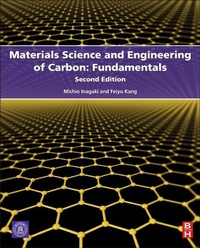
Materials Science and Engineering of Carbon: Fundamentals
2nd Edition
Published on 7. July 2014
Book
Hardback
542 pages
978-0-12-800858-4 (ISBN)
Description
Materials Science and Engineering of Carbon: Fundamentals provides a comprehensive introduction to carbon, the fourth most abundant element in the universe. The contents are organized into two main parts. Following a brief introduction on the history of carbon materials, Part 1 focuses on the fundamental science on the preparation and characterization of various carbon materials, and Part 2 concentrates on their engineering and applications, including hot areas like energy storage and environmental remediation. The book also includes up-to-date advanced information on such newer carbon-based materials as carbon nanotubes and nanofibers, fullerenes and graphenes.
More details
Edition
2nd edition
Language
English
Place of publication
Woburn
United States
Publishing group
Elsevier - Health Sciences Division
Target group
Professional and scholarly
For graduate students and young scientists in universities, research institutes and industrial companies, who are working on and/or interested in carbon materials. Also, for university students and people who are interested in high technology science and engineering
Product notice
sewn/stitched
Cloth over boards
Dimensions
Height: 236 mm
Width: 193 mm
Thickness: 30 mm
Weight
1438 gr
ISBN-13
978-0-12-800858-4 (9780128008584)
Copyright in bibliographic data and cover images is held by Nielsen Book Services Limited or by the publishers or by their respective licensors: all rights reserved.
Schweitzer Classification
Other editions
Additional editions

Michio Inagaki | Feiyu Kang
Materials Science and Engineering of Carbon: Fundamentals
Book
10/2018
2nd Edition
Butterworth-Heinemann
€117.80
The article will not be published
Michio Inagaki | Feiyu Kang
Materials Science and Engineering of Carbon: Fundamentals
E-Book
06/2014
2nd Edition
Butterworth-Heinemann
€116.00
Available for download
Persons
Michio Inagaki, Ph.D. is a famous carbon material scientist, who obtained his PhD degree from Nagoya University in 1963. He has worked on carbon materials for more than 50 years. In 2011, he won the Peter A. Thrower Award for Exceptional Contribution to the International Carbon Community. Feiyu Kang received his PhD from The Hong Kong University of Science and Technology in 1997. He is honorary editorial advisory board of international journal CARBON, Joint Chairmen of international symposiums: CARBON2002 (Beijing), Carbon2011 (Shanghai) and 15th International Symposium on Intercalation Compounds (ISIC15), Coordinators of international research projects: Professor M. Inagaki (NSFC-JSPS) and Professor I. Mochida (JST-MOST).Prof. Kang has investigated graphite and carbon materials since 1988. His research interest includes nano-carbon materials, graphite producing process, porous carbon and nuclear graphite. Prof. Kang had published more than 200 scientific papers and 3 books.
Content
Part 1. Introduction
Part 2. Fundamental Science of Carbon M
1. Carbon Families2. Structure and Texture of Carbon Materials3. Carbonization4. Novel Techniques for Carbonization5. Graphitization6. Acceleration of Graphitization7. Pore Development in Carbon Materials8. Introduction of Foreign Species
Part 3. Engineering and Applications of Carbon Materials9. Polycrystalline Graphite Blocks10. Highly-Oriented Graphite11. Non-graphitizing and Glass-like Carbons12. Nanocarbons13. Fibrous Carbons14. Porous Carbons15. Carbon-based Composites16. Intercalation Compounds17. Carbon Materials for Energy Storage18. Carbon Materials for Environment Remediation
Part 2. Fundamental Science of Carbon M
1. Carbon Families2. Structure and Texture of Carbon Materials3. Carbonization4. Novel Techniques for Carbonization5. Graphitization6. Acceleration of Graphitization7. Pore Development in Carbon Materials8. Introduction of Foreign Species
Part 3. Engineering and Applications of Carbon Materials9. Polycrystalline Graphite Blocks10. Highly-Oriented Graphite11. Non-graphitizing and Glass-like Carbons12. Nanocarbons13. Fibrous Carbons14. Porous Carbons15. Carbon-based Composites16. Intercalation Compounds17. Carbon Materials for Energy Storage18. Carbon Materials for Environment Remediation