

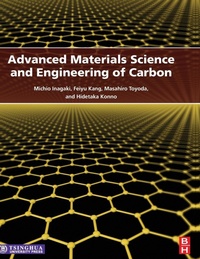
Advanced Materials Science and Engineering of Carbon
Published on 6. November 2013
Book
Hardback
440 pages
978-0-12-407789-8 (ISBN)
Description
Carbon materials are exceptionally diverse in their preparation, structure, texture, and applications. In Advanced Materials Science and Engineering of Carbon, noted carbon scientist Michio Inagaki and his coauthors cover the most recent advances in carbon materials, including new techniques and processes, carbon materials synthesis, and up-to-date descriptions of current carbon-based materials, trends and applications.
Beginning with the synthesis and preparation of nanocarbons, carbon nanotubes, and graphenes, the book then reviews recently developed carbonization techniques, such as templating, electrospinning, foaming, stress graphitization, and the formation of glass-like carbon. The last third of the book is devoted to applications, featuring coverage of carbon materials for energy storage, electrochemical capacitors, lithium-ion rechargeable batteries, and adsorptive storage of hydrogen and methane for environmental protection, photocatalysis, spilled oil recovery, and nuclear applications of isotropic high-density graphite.
Beginning with the synthesis and preparation of nanocarbons, carbon nanotubes, and graphenes, the book then reviews recently developed carbonization techniques, such as templating, electrospinning, foaming, stress graphitization, and the formation of glass-like carbon. The last third of the book is devoted to applications, featuring coverage of carbon materials for energy storage, electrochemical capacitors, lithium-ion rechargeable batteries, and adsorptive storage of hydrogen and methane for environmental protection, photocatalysis, spilled oil recovery, and nuclear applications of isotropic high-density graphite.
Reviews / Votes
"I recommend this book without hesitation to all interested in carbon materials, particularly to those entering the field. It is written at a level appropriate to researchers with a chemistry, physics, or materials background." --MRS Bulletin, November 2014More details
Language
English
Place of publication
Woburn
United States
Publishing group
Elsevier - Health Sciences Division
Target group
College/higher education
Professional and scholarly
Research scientists and graduate students in universities, institutes and industrial companies, who are working on and/or interested in carbon materials.
Product notice
Laminated cover
Illustrations
Approx. 240 illustrations
Dimensions
Height: 241 mm
Width: 195 mm
Thickness: 30 mm
Weight
1083 gr
ISBN-13
978-0-12-407789-8 (9780124077898)
Copyright in bibliographic data and cover images is held by Nielsen Book Services Limited or by the publishers or by their respective licensors: all rights reserved.
Schweitzer Classification
Persons
Michio Inagaki, Ph.D. is a famous carbon material scientist, who obtained his PhD degree from Nagoya University in 1963. He has worked on carbon materials for more than 50 years. In 2011, he won the Peter A. Thrower Award for Exceptional Contribution to the International Carbon Community. Feiyu Kang received his PhD from The Hong Kong University of Science and Technology in 1997. He is honorary editorial advisory board of international journal CARBON, Joint Chairmen of international symposiums: CARBON2002 (Beijing), Carbon2011 (Shanghai) and 15th International Symposium on Intercalation Compounds (ISIC15), Coordinators of international research projects: Professor M. Inagaki (NSFC-JSPS) and Professor I. Mochida (JST-MOST).Prof. Kang has investigated graphite and carbon materials since 1988. His research interest includes nano-carbon materials, graphite producing process, porous carbon and nuclear graphite. Prof. Kang had published more than 200 scientific papers and 3 books.
Content
Introduction
Carbon nanotubes: synthesis and formation
Graphene: synthesis and preparation
Carbonization under pressure
Stress graphitization
Glass-like carbon: its activation and graphitization
Template carbonization: morphology and pore control
Carbon nanofibers via electrospinning
Foaming of carbon (including exfoliation)
Nanoporous carbon membranes
Carbon materials for electrochemical capacitors
Carbon materials in lithium-ion rechargeable batteries
Carbon materials in photocatalysis
Carbon materials for spilled heavy oil recovery
Carbon materials for adsorption of molecules and ions
Highly-oriented graphite with high thermal conductivity
Isotropic high-density graphite for nuclear applications
Conclusions
Carbon nanotubes: synthesis and formation
Graphene: synthesis and preparation
Carbonization under pressure
Stress graphitization
Glass-like carbon: its activation and graphitization
Template carbonization: morphology and pore control
Carbon nanofibers via electrospinning
Foaming of carbon (including exfoliation)
Nanoporous carbon membranes
Carbon materials for electrochemical capacitors
Carbon materials in lithium-ion rechargeable batteries
Carbon materials in photocatalysis
Carbon materials for spilled heavy oil recovery
Carbon materials for adsorption of molecules and ions
Highly-oriented graphite with high thermal conductivity
Isotropic high-density graphite for nuclear applications
Conclusions