

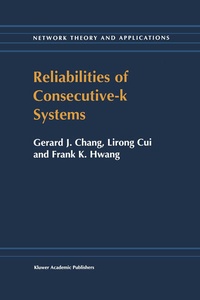
Reliabilities of Consecutive-k Systems
Published on 17. September 2011
Book
Paperback/Softback
X, 212 pages
978-1-4613-7972-0 (ISBN)
Description
The consecutive-k system was first studied around 1980, and it soon became a very popular subject. The reasons were many-folded, includ ing: 1. The system is simple and natural. So most people can understand it and many can do some analysis. Yet it can grow in many directions and there is no lack of new topics. 2. The system is simple enough to become a prototype for demonstrat ing various ideas related to reliability. For example, the interesting concept of component importance works best with the consecutive-k system. 3. The system is supported by many applications. Twenty years have gone and hundreds of papers have been published on the subject. This seems to be a good time for retrospect and to sort the scattered material into a book. Besides providing our own per spective, the book will also serve as an easy reference to the numerous ramifications of the subject. It is hoped that a summary of work in the current period will become the seed of future break-through.
More details
Series
Edition
Softcover reprint of the original 1st ed. 2000
Language
English
Place of publication
New York
United States
Target group
Professional and scholarly
Research
Illustrations
X, 212 p.
Dimensions
Height: 240 mm
Width: 160 mm
Thickness: 13 mm
Weight
366 gr
ISBN-13
978-1-4613-7972-0 (9781461379720)
DOI
10.1007/978-1-4613-0273-5
Schweitzer Classification
Other editions
Additional editions
Chung In-Hang | Lirong Cui | F.K. Hwang
Reliabilities of Consecutive-k Systems
E-Book
12/2013
Springer
€96.29
Available for download
Chung In-Hang | Lirong Cui | F.K. Hwang
Reliabilities of Consecutive-k Systems
Book
11/2000
Kluwer Academic Publishers
€106.99
Shipment within 15-20 days
Content
1. Introduction.- 1.1 The consecutive system and generalizations.- 1.2 The problems and the methodologies.- 1.3 Notation.- 2. Computation of Reliability.- 2.1 Recursive equations.- 2.2 The matrix approach.- 2.3 The combinatorial approach.- 2.4 Bounds and approximations.- 3. Design of Optimal Consecutive Systems.- 3.1 Optimal consecutive-2 systems.- 3.2 Invariant consecutive-k systems.- 3.3 The Birnbaum importance.- 3.4 Half-line importance.- 3.5 The combinatorial importance and the rare-event importance.- 3.6 Consecutive-k G system.- 4. The Lifetime Distribution.- 4.1 Mean time to failure.- 4.2 Estimation of Parameters.- 4.3 Increasing failure rate preservation.- 4.4 IFR property for k ? 4.- 5. Asymptotic Analysis.- 5.1 Elementary method.- 5.2 Generating function method.- 5.3 Poisson convergence method.- 5.4 The dependence models.- 5.5 Distribution for exchangeable lifetimes.- 6. Window Systems.- 6.1 The k-within-consecutive-m-out- of-n system.- 6.2 The (2, m, n) system.- 6.3 b-Fold-window systems.- 6.4 Asymptotic analysis.- 7. The Network Model.- 7.1 The linear consecutive-2 network system.- 7.2 Connectivity and hamiltonian reliability.- 7.3 The reversible model.- 7.4 The k ? 3 case.- 8. Consecutive-2 Graphs.- 8.1 Reliabilities of consecutive-2 graphs.- 8.2 Optimal consecutive-2 graphs: general theory.- 8.3 Invariant d-nary trees.- 8.4 Other consecutive-2 graphs.- 8.5 The 2-dimensional case.- 9. Some Related Systems.- 9.1 Consecutively connected systems.- 9.2 Multi-failure consecutive systems.- 9.3 Redundant consecutive-k systems.- 9.4 Weighted consecutive systems.- 10. Applications.- 10.1 Examples of modelings.- 10.2 Application examples with computations.- References.