

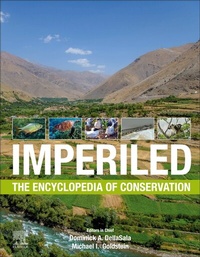
Imperiled: The Encyclopedia of Conservation
Elsevier (Publisher)
Published on 9. June 2022
Book
2608 pages
978-0-12-821139-7 (ISBN)
Description
Imperiled: The Encyclopedia of Conservation, part of a three-volume set, updates on humanity's expanding ecological footprint. With climate change, increases in human population, consumption levels, and other anthropogenic factors, nearly half the known species on Earth could soon be gone. This book provides a global synthesis of the world's imperiled species and ecosystems. It documents rarity and endangerment, the major drivers of loss, areas of conservation importance, and implementation strategies to save and restore imperiled species and ecosystems. This is first of its kind coverage of Earth's imperiled species and ecosystems in a comprehensive encyclopedia.
More details
Language
English
Place of publication
United States
Target group
Professional and scholarly
Students and researchers interested in conservation biology, sustainability, forestry, ecology, wildlife management, marine ecology, population biology, environmental ethics, natural resource policy and biogeography.
Concerned government and non-government organizations e.g. Convention on Biological Diversity, IUCN, Conservation International etc.
Illustrations
Approx. 1375 illustrations (1375 in full color); Illustrations
Dimensions
Height: 276 mm
Width: 216 mm
Weight
450 gr
ISBN-13
978-0-12-821139-7 (9780128211397)
Copyright in bibliographic data and cover images is held by Nielsen Book Services Limited or by the publishers or by their respective licensors: all rights reserved.
Schweitzer Classification
Persons
Dominick DellaSala, Ph. D, is Chief Scientist of Wild Heritage, a project of the Earth Island Institute, and former President of the Society for Conservation Biology, North America. He is an internationally renowned scholar of over 200 publications on forest ecology, endangered species, conservation biology, and climate change. Dominick has given keynote talks ranging from academic conferences to the United Nations Earth Summit. He has been featured in hundreds of news stories and documentaries, testified in the US congress numerous times, and received conservation leadership and book writing awards. He is on the editorial board of Elsevier's Earth Systems and Environmental Sciences, co-chief editor of Elsevier's Encyclopedia of the Anthropocene, The World's Biomes, and Encyclopedia of Conservation; Co-editor the Ecological Importance of Mixed Severity Fires: Nature's Phoenix (Elsevier), editor and author of the award winning Temperate and Boreal Rainforests of the World: Ecology and Conservation; and subject editor of several scientific journals. He is driven by a passion to save life on Earth for his daughters, grandkids, and future generations. Dr. Michael I. Goldstein is a planner and biologist for the US Forest Service in Juneau, Alaska. Mike has worked on many applied management issues across terrestrial and aquatic systems, addressing pesticides, dispersed recreation, development, timber harvest, and other forms of resource extraction. Mike was a principal architect and editor of Elsevier's major reference work "Earth Systems and Environmental Sciences," served as Co-Editor-in-Chief of the Encyclopedia of the Anthropocene and Co-Editor of the Anthropocene's Climate Change volume, served as Co-Editor-in-Chief of the Encyclopedia of the World's Biomes and Editor of the Biomes section on Islands and Atolls. In his spare time, Mike coaches skiing, enjoys fishing, camping in remote places, and teaching his three children the joys of life.
Content
1. Rarity and Imperilment
2. Species at Risk: Imperiled Plants
3. Species at Risk: Imperiled Vertebrates
4. Species at Risk: Imperiled Invertebrates
5. Imperiled Terrestrial Ecosystems
6. Imperiled Freshwater Ecosystems
7. Imperiled Marine Ecosystems
8. Imperiled Ecosystem Services
9. Conservation Case Studies
2. Species at Risk: Imperiled Plants
3. Species at Risk: Imperiled Vertebrates
4. Species at Risk: Imperiled Invertebrates
5. Imperiled Terrestrial Ecosystems
6. Imperiled Freshwater Ecosystems
7. Imperiled Marine Ecosystems
8. Imperiled Ecosystem Services
9. Conservation Case Studies