

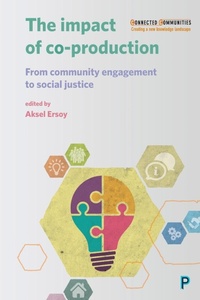
The Impact of Co-production
From Community Engagement to Social Justice
Policy Press
1st Edition
Published on 1. November 2017
Book
Paperback/Softback
248 pages
978-1-4473-3029-5 (ISBN)
Description
Bringing together academics, artists, practitioners and 'community activists', this book explores the possibilities for, and tensions of, social justice work under the contemporary drive for community-orientated 'impact' in the academy.
Threading a line between celebratory accounts of institutionalised community engagement, self-professed 'radical' scholarship for social change and critical accounts of the governmentalisation of community, the book makes an original contribution to all three fields of scholarship.
Showcasing experimental research and co-production practices taking place in the UK, Australia, Sweden and Canada and within universities, independent research organisations and internationally prestigious museums and galleries, the book considers what research impact could look like for a wide range of audiences and how universities could engage with different publics in ways that would be relevant and useful, but may not necessarily be easily measurable.
Asking hard questions of the current impact agenda, the book offers an insight into emerging routes towards co-production for social justice.
Threading a line between celebratory accounts of institutionalised community engagement, self-professed 'radical' scholarship for social change and critical accounts of the governmentalisation of community, the book makes an original contribution to all three fields of scholarship.
Showcasing experimental research and co-production practices taking place in the UK, Australia, Sweden and Canada and within universities, independent research organisations and internationally prestigious museums and galleries, the book considers what research impact could look like for a wide range of audiences and how universities could engage with different publics in ways that would be relevant and useful, but may not necessarily be easily measurable.
Asking hard questions of the current impact agenda, the book offers an insight into emerging routes towards co-production for social justice.
Reviews / Votes
"This book provides a unique and provocative examination of community engagement practice through the lens of distributive and social justice." Ted Alter, Professor of Agricultural, Environmental and Regional Economics, Pennsylvania State University, USMore details
Series
Edition
First Edition
Language
English
Place of publication
Bristol
United Kingdom
Publishing group
Bristol University Press
Target group
Professional and scholarly
Illustrations
13 s/w Abbildungen
13 Illustrations, black and white
Dimensions
Height: 234 mm
Width: 156 mm
Thickness: 14 mm
Weight
386 gr
ISBN-13
978-1-4473-3029-5 (9781447330295)
Copyright in bibliographic data and cover images is held by Nielsen Book Services Limited or by the publishers or by their respective licensors: all rights reserved.
Schweitzer Classification
Other editions
Additional editions
The Impact of Co-production
From Community Engagement to Social Justice
Book
11/2017
1st Edition
Policy Press
€107.80
Shipment within 15-20 days
E-Book
11/2017
1st Edition
Policy Press
€248.99
Available for download
E-Book
11/2017
1st Edition
Policy Press
€51.99
Available for download
Persons
Dr Aksel Ersoy is a social scientist based at Delft University of Technology, the Netherlands, where he is Assistant Professor of Urban Development Management. His research interests include smart cities, economic development, urban planning and policy.
Content
Introduction, Aksel Ersoy
Chapter 1. Enabling Conditions for Communities and Universities to Work Together: a Journey of University Public Engagement, Marina Chang and Gemma Moore
Chapter 2. Understanding Impact and Its Enabling Conditions: Learning From People Engaged in Collaborative Research, Alex Haynes
Chapter 3. Emphasising Mutual Benefit: Rethinking the Impact Agenda through the Lens of Share Academy, Judy Willcocks
Chapter 4. From Poverty to Life Chances: Framing Co-produced Research in the Productive Margins Programme, Sue Cohen, Allan Herbert, Nathan Evans and Tove Samzelius
Chapter 5. Methodologically Sound? Participatory Research at a Community Radio Station, Catherine Wilkinson
Chapter 6. The Regulatory Aesthetics of Co-production, Penny Evans and Angela Piccini
Chapter 7. Participatory Mapping and Engagement with Urban Water Communities, OEzlem Edizel and Graeme Evans
Chapter 8. Hacking into the Science Museum: Young Trans People Disrupt the Power Balance of Gender 'Norms' in the Museums 'Who Am I?' Gallery, Kayte McSweeney and Jay Stewart
Chapter 9. Mapping In, On, Towards Aboriginal Space: Trading Routes and an Ethics of Artistic Inquiry, Glen Lowry and Mimi Gellman
Chapter 10. Adapting to the Future: Vulnerable Bodies, Resilient Practices, Deirdre Heddon and Sue Porter
Conclusion: Reflections on Contemporary Debates in Coproduction Studies, Aksel Ersoy
Chapter 1. Enabling Conditions for Communities and Universities to Work Together: a Journey of University Public Engagement, Marina Chang and Gemma Moore
Chapter 2. Understanding Impact and Its Enabling Conditions: Learning From People Engaged in Collaborative Research, Alex Haynes
Chapter 3. Emphasising Mutual Benefit: Rethinking the Impact Agenda through the Lens of Share Academy, Judy Willcocks
Chapter 4. From Poverty to Life Chances: Framing Co-produced Research in the Productive Margins Programme, Sue Cohen, Allan Herbert, Nathan Evans and Tove Samzelius
Chapter 5. Methodologically Sound? Participatory Research at a Community Radio Station, Catherine Wilkinson
Chapter 6. The Regulatory Aesthetics of Co-production, Penny Evans and Angela Piccini
Chapter 7. Participatory Mapping and Engagement with Urban Water Communities, OEzlem Edizel and Graeme Evans
Chapter 8. Hacking into the Science Museum: Young Trans People Disrupt the Power Balance of Gender 'Norms' in the Museums 'Who Am I?' Gallery, Kayte McSweeney and Jay Stewart
Chapter 9. Mapping In, On, Towards Aboriginal Space: Trading Routes and an Ethics of Artistic Inquiry, Glen Lowry and Mimi Gellman
Chapter 10. Adapting to the Future: Vulnerable Bodies, Resilient Practices, Deirdre Heddon and Sue Porter
Conclusion: Reflections on Contemporary Debates in Coproduction Studies, Aksel Ersoy