

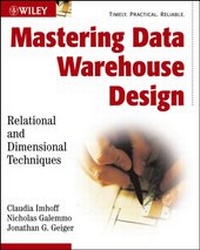
Mastering Data Warehouse Design
Relational and Dimensional Techniques
Published on 22. August 2003
Book
Paperback/Softback
456 pages
978-0-471-32421-8 (ISBN)
Description
* A cutting-edge response to Ralph Kimball's challenge to the data warehouse community that answers some tough questions about the effectiveness of the relational approach to data warehousing
* Written by one of the best-known exponents of the Bill Inmon approach to data warehousing
* Addresses head-on the tough issues raised by Kimball and explains how to choose the best modeling technique for solving common data warehouse design problems
* Weighs the pros and cons of relational vs. dimensional modeling techniques
* Focuses on tough modeling problems, including creating and maintaining keys and modeling calendars, hierarchies, transactions, and data quality
More details
Edition
1. Auflage
Language
English
Place of publication
New York
United States
Target group
Professional and scholarly
Product notice
Paperback (trade)
Unsewn / adhesive bound
Illustrations
Drawings: 136 B&W, 0 Color
Dimensions
Height: 238 mm
Width: 188 mm
Thickness: 25 mm
Weight
685 gr
ISBN-13
978-0-471-32421-8 (9780471324218)
Schweitzer Classification
Other editions
Additional editions
Claudia Imhoff | Nicholas Galemmo | Jonathan G. Geiger
Mastering Data Warehouse Design
Relational and Dimensional Techniques
E-Book
08/2003
Wiley
€30.99
Available for download
Persons
CLAUDIA IMHOFF (CImhoff@Intelsols.com) is President and Founder of Intelligent Solutions, a leading consultancy on analytic CRM and BI technologies and strategies. She is a popular speaker, an internationally recognized expert, and coauthor of five books.
NICHOLAS GALEMMO (ngalemmo@yahoo.com) was Information Architect at Nestlé USA. He has twenty-seven years' experience as a practitioner and consultant involved in all aspects of application systems design and development. He is currently an independent consultant.
JONATHAN G. GEIGER (JGeiger@IntelSols.com) is Executive Vice President at Intelligent Solutions, Inc. In his thirty years as a practitioner and consultant, he has managed or performed work in virtually every aspect of information management.
Content
Acknowledgments.
About the Authors.
PART ONE: CONCEPTS.
Chapter 1. Introduction.
Chapter 2. Fundamental Relational Concepts.
PART TWO: MODEL DEVELOPMENT.
Chapter 3. Understanding the Business Model.
Chapter 4. Developing the Model.
Chapter 5. Creating and Maintaining Keys.
Chapter 6. Modeling the Calendar.
Chapter 7. Modeling Hierarchies.
Chapter 8. Modeling Transactions.
Chapter 9. Data Warehouse Optimization.
PART THREE: OPERATION AND MANAGEMENT.
Chapter 10. Accommodating Business Change.
Chapter 11. Maintaining the Models.
Chapter 12. Deploying the Relational Solution.
Chapter 13. Comparison of Data Warehouse Methodologies.
Glossary.
Recommended Reading.
Index.