

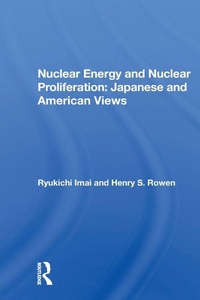
Nuclear Energy And Nuclear Proliferation
Japanese And American Views
1st Edition
Published on 2. November 2020
Book
Paperback/Softback
214 pages
978-0-367-17165-0 (ISBN)
Description
This book brings to light the major differences in the way Japanese and Americans perceive nuclear energy and nuclear proliferation. It makes an important contribution to the process of building a foundation for better understanding between the two countries.
More details
Language
English
Place of publication
London
United Kingdom
Publishing group
Taylor & Francis Ltd
Target group
College/higher education
Dimensions
Height: 229 mm
Width: 152 mm
Thickness: 12 mm
Weight
321 gr
ISBN-13
978-0-367-17165-0 (9780367171650)
Copyright in bibliographic data and cover images is held by Nielsen Book Services Limited or by the publishers or by their respective licensors: all rights reserved.
Schweitzer Classification
Other editions
Additional editions
Book
05/2019
1st Edition
Routledge
€206.20
Shipment within 15-20 days
E-Book
04/2019
1st Edition
Routledge
€59.49
Available for download
E-Book
04/2019
1st Edition
Routledge
€59.49
Available for download
Person
Ryukichi Imai is general manager, engineering, of the Japan Atomic Power Company and is also special assistant to Japan's minister of foreign affairs, dealing mainly with nuclear and arms control matters.
Henry S. Rowen is professor of public management in the Graduate School of Business at Stanford University. He has served previously as president of the Rand Corporation, assistant director of the U.S. Bureau of the Budget, and deputy assistant secretary of defense for International Security Affairs.
Henry S. Rowen is professor of public management in the Graduate School of Business at Stanford University. He has served previously as president of the Rand Corporation, assistant director of the U.S. Bureau of the Budget, and deputy assistant secretary of defense for International Security Affairs.
Content
Part 1: A Japanese View 1. The Confused History of Nuclear Nonproliferation 2. Areas of Conflict 3. What Kinds of Proliferation Should Be Prevented? 4. In Search of Workable Solutions 5. Systems Analysis of Nonproliferation Logic 6. Specific Nonproliferation Proposals 7. The Basic Structure of Nonproliferation 8. Comments on Mr. Imai's Position Part 2: An American View 9. The Present International System and Its Inadequacies 10. Four Principles for a Safer International System 11. The Benchmark Case 12. Economic Analysis of the Benchmark System 13. Measures to Enhance Security of Supply 14. The Importance of Dealing with the "Back End" 15. Alternative Paths Examined 16. Creating and Strengthening Institutions Institutional Initiatives 17. In Conclusion 18. Comments on Mr. Rowen's Position