

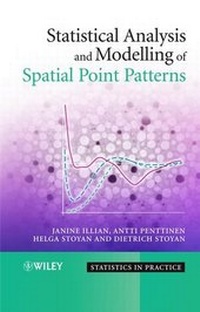
Statistical Analysis and Modelling of Spatial Point Patterns
Published on 18. January 2008
Book
Hardback
560 pages
978-0-470-01491-2 (ISBN)
Description
Spatial point processes are mathematical models used to describe and analyse the geometrical structure of patterns formed by objects that are irregularly or randomly distributed in one-, two- or three-dimensional space. Examples include locations of trees in a forest, blood particles on a glass plate, galaxies in the universe, and particle centres in samples of material.
Numerous aspects of the nature of a specific spatial point pattern may be described using the appropriate statistical methods. Statistical Analysis and Modelling of Spatial Point Patterns provides a practical guide to the use of these specialised methods. The application-oriented approach helps demonstrate the benefits of this increasingly popular branch of statistics to a broad audience.
The book:
* Provides an introduction to spatial point patterns for researchers across numerous areas of application.
* Adopts an extremely accessible style, allowing the non-statistician complete understanding.
* Describes the process of extracting knowledge from the data, emphasising the marked point process.
* Demonstrates the analysis of complex datasets, using applied examples from areas including biology, forestry, and materials science.
* Features a supplementary website containing example datasets.
Statistical Analysis and Modelling of Spatial Point Patterns is ideally suited for researchers in the many areas of application, including environmental statistics, ecology, physics, materials science, geostatistics, and biology. It is also suitable for students of statistics, mathematics, computer science, biology and geoinformatics.
Companion website:
www.wiley.com/go/penttinen
Reviews / Votes
"It adopts an extremely accessible style, allowing the non-statistician complete understanding, describes the process of extracting knowledge from the data, emphasizing marked point processes, demonstrates the analysis of complex data sets, using applied examples from areas including biology, forestry, and materials science, and features a supplementary website containing example datasets. This text is ideally suited for researchers in many areas of applications, including environmental statistics, ecology, physics, material science, geostatistics, and biology. It is also suitable for students of statistics, mathematics, computer science, biology and geoinformatics." (Zentralblatt Math, 2010)"Statistical Analysis and Modelling of Spatial Point Patterns is an extremely well-written book and is accessible to a wide audience, including both applied statisticians and researchers from other fields with a reasonably sophisticated background in statics." (Journal of the American Statistical Association, September 2010)"The book presents statistical methods that are relevant in practice, focusing on traditional methods, in particular those based on summary statistics, but also more recent models and methods are briefly discussed. "(Biometrics , September 2009)
"The book is a useful addition to Wiley's series Statistics in Practice." (Journal of Tropical Pediatrics, February 2009)
"The abstract flavor this brings to the subject means that methods may have very wide applicability over different application domains. This applicability, in turn, is reflected by the large number of interesting examples described in the book. The book provides a comprehensive overview of the area." (International Statistical Review, December 2008)
More details
Series
Edition
1. Auflage
Language
English
Place of publication
United States
Publishing group
John Wiley & Sons Inc
Target group
Professional and scholarly
Product notice
sewn/stitched
Paper over boards
Dimensions
Height: 235 mm
Width: 157 mm
Thickness: 34 mm
Weight
954 gr
ISBN-13
978-0-470-01491-2 (9780470014912)
Schweitzer Classification
Other editions
Additional editions
Janine Illian | Antti Penttinen | Helga Stoyan
Statistical Analysis and Modelling of Spatial Point Patterns
E-Book
08/2008
Wiley
€116.99
Available for download
Persons
Janine Illian, SIMBIOS, University of Abertay, Dundee, Scotland.
Antti Pentinen, Professor in the Department of Mathematics and Statistics, University of Jyvaskyla, Finland.
Dietrich Stoyan, Professor a the Insitut fuer Stochastik, University of Freiberg, Germany.
Antti Pentinen, Professor in the Department of Mathematics and Statistics, University of Jyvaskyla, Finland.
Dietrich Stoyan, Professor a the Insitut fuer Stochastik, University of Freiberg, Germany.
Content
Preface.
List of Examples.
1. Introduction.
1.1 Point process statistics.
1.2 Examples of point process data.
1.3 Historical notes.
1.4 Sampling and data collection.
1.5 Fundamentals of the theory of point processes.
1.6 Stationarity and isotropy.
1.7 Summary characteristics for point processes.
1.8 Secondary structures of point processes.
1.9 Simulation of point processes.
2. The Homogeneous Poisson point process.
2.1 Introduction.
2.2 The binomial point process.
2.3 The homogeneous Poisson point process.
2.4 Simulation of a homogeneous Poisson process.
2.5 Model characteristics.
2.6 Estimating the intensity.
2.7 Testing complete spatial randomness.
3. Finite point processes.
3.1 Introduction.
3.2 Distributions of numbers of points.
3.3 Intensity functions and their estimation.
3.4 Inhomogeneous Poisson process and finite Cox process.
3.5 Summary characteristics for finite point processes.
3.6 Finite Gibbs processes.
4. Stationary point processes.
4.1 Basic definitions and notation.
4.2 Summary characteristics for stationary point processes.
4.3 Second-order characteristics.
4.4 Higher-order and topological characteristics.
4.5 Orientation analysis for stationary point processes.
4.6 Outliers, gaps and residuals.
4.7 Replicated patterns.
4.8 Choosing appropriate observation windows.
4.9 Multivariate analysis of series of point patterns.
4.10 Summary characteristics for the non-stationary case.
5. Stationary marked point processes.
5.1 Basic definitions and notation.
5.2 Summary characteristics.
5.3 Second-order characteristics for marked point processes.
5.4 Orientation analysis for marked point processes.
6. Modelling and simulation of stationary point processes.
6.1 Introduction.
6.2 Operations with point processes.
6.3 Cluster processes.
6.4 Stationary Cox processes.
6.5 Hard-core point processes.
6.6 Stationary Gibbs processes.
6.7 Reconstruction of point patterns.
6.8 Formulas for marked point process models.
6.9 Moment formulas for stationary shot-noise fields.
6.10 Space-time point processes.
6.11 Correlations between point processes and other random structures.
7. Fitting and testing point process models.
7.1 Choice of model.
7.2 Parameter estimation.
7.3 Variance estimation by bootstrap.
7.4 Goodness-of-fit tests.
7.5 Testing mark hypotheses.
7.6 Bayesian methods for point pattern analysis.
Appendix A Fundamentals of statistics.
Appendix B Geometrical characteristics of sets.
Appendix C Fundamentals of geostatistics.
References.
Notation index.
Author index.
Subject index.